
Lucid Diagnostics' Breakthrough Test Sets a New Course in Esophageal Cancer Detection
Lucid leverages patented non-invasive technology to address early esophageal cancer detection within a large at-risk GERD population, balancing clinical progress and commercial challenges.
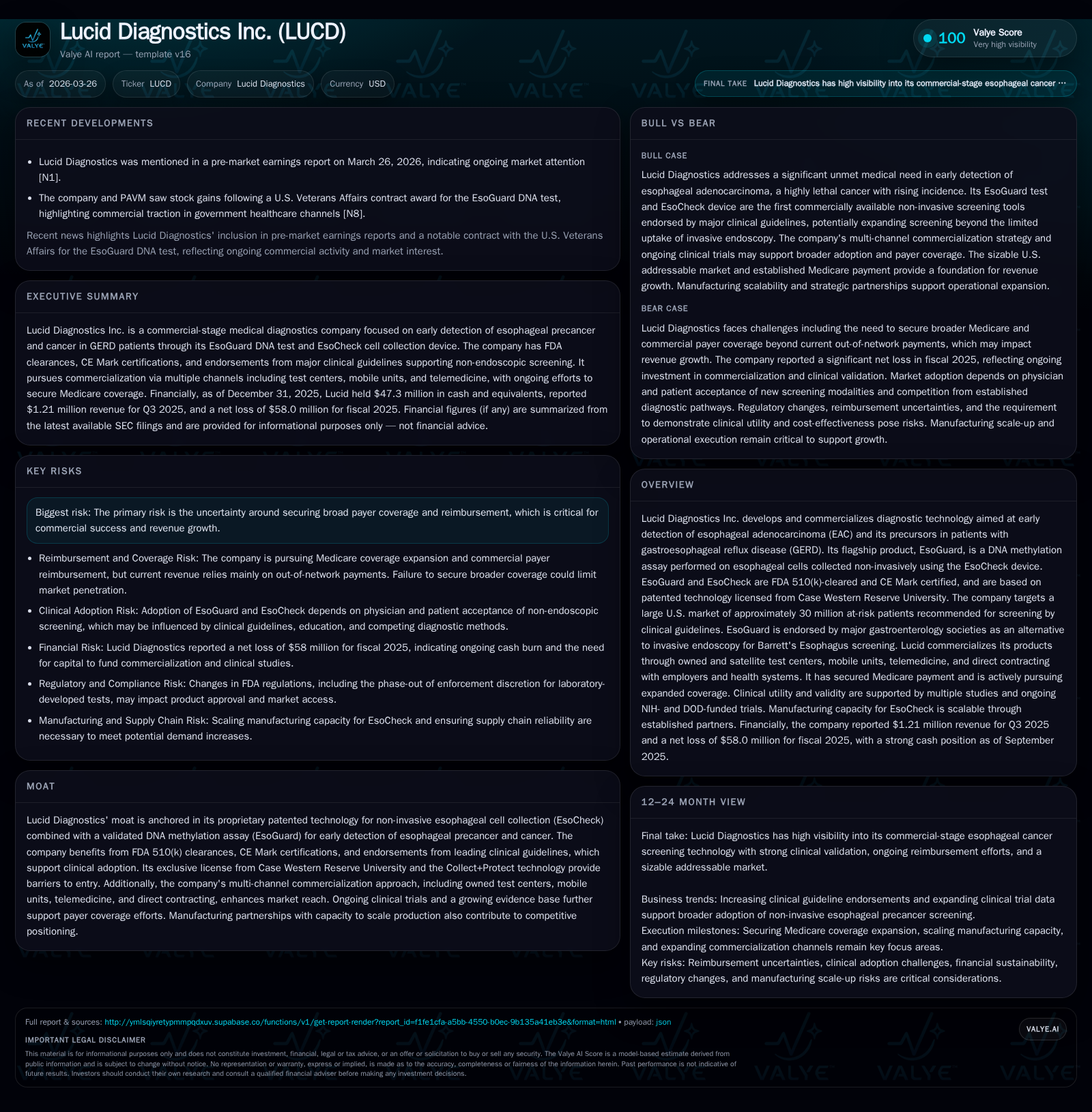
Lucid Diagnostics Inc. has developed EsoGuard, a DNA methylation assay performed on esophageal cells collected non-invasively via the EsoCheck device, targeting early detection of esophageal adenocarcinoma in patients with GERD. The company has demonstrated strong top-line growth from $0.5M in 2021 to $4.35M in 2024 but continues to operate at deep losses with net income down to -$58M in 2025 and negative free cash flow reflective of its scale-up stage. Lucid's multi-channel commercialization and FDA clearance position it well for future uptake, though securing broad payer reimbursement remains a critical hurdle. Capital structure constraints, including convertible securities dilution, underscore the importance of upcoming regulatory and coverage milestones.
Technology Innovation Anchoring Lucid Diagnostics' Market Entry
Lucid Diagnostics commercializes EsoGuard, the first commercially available DNA methylation assay specifically targeting early esophageal adenocarcinoma (EAC) and Barrett's Esophagus (BE) precursors in patients at risk due to gastroesophageal reflux disease (GERD). The assay analyzes methylation at 31 CpG sites across two genes—Vimentin (VIM) and Cyclin A1 (CCNA1)—using bisulfite-converted next-generation sequencing (NGS). Analytical validation studies report approximately 97% sensitivity, 95% specificity, and 98% accuracy for detecting BE and EAC lesions from surface esophageal cells.
Crucial to sample procurement is Lucid’s EsoCheck device, an FDA 510(k)-cleared, CE Mark certified swallowable balloon catheter that collects cells non-invasively within a two-minute office procedure. The device's patented Collect+Protect™ technology allows targeted collection from the distal esophagus while shielding samples from contamination during withdrawal. This precise sampling anchors EsoGuard’s diagnostic performance. Clinical validation employed two prospective screening cohort studies demonstrating positive predictive value (PPV) between 30–33% and negative predictive value (NPV) near 99% for BE/EAC detection—metrics suitable for clinical adoption given the invasiveness of current standard endoscopy screenings.
Both products arise from an exclusive license agreement with Case Western Reserve University, granting Lucid ownership over technology differentiating them from competitors pursuing less-targeted cellular or biomarker approaches. This innovative blend of sampling hardware and molecular assay establishes the technical foundation needed to capture the sizable at-risk U.S. population effectively.
Historical Performance: Revenue Growth Versus Persistent Losses
Lucid's historically limited revenues have ramped significantly as commercialization efforts intensified. Annual revenues climbed from $0.5M in FY2021 to $2.43M in FY2023 before accelerating to $4.35M by FY2024—a rapid 79% year-over-year increase evidencing growing clinical adoption [F1]. Despite improving topline scale, profitability remains elusive; operating losses remain wide reaching -$48.48M in FY2023 and further expanding to nearly -$49.64M projected by end-FY2025 [F1]. Net losses mirror this trajectory, deepening to -$58.01M most recently.
Operating cash flow also paints a picture of ongoing burn during expansion phases: from -$29.68M in FY2022 worsening through -$44.14M in FY2024 and near -$46.49M by FY2025 [F1]. Capital expenditures peaked previously around $3.2M but contracted sharply to $0.20M recently as infrastructure investments tapered [F1]. Equity fluctuated, reverting to positive $10.94M by FY2025 after prior negative equity states implied balance sheet pressure [F1].
These figures illustrate typical diagnostics commercialization dynamics where upfront R&D, clinical validation, marketing pushes, and sales channel buildout prolong unprofitability well past initial revenue inflection points. Return on equity is deeply negative (~-530% based on last reported net income vs equity), highlighting intense capital absorption amid scaling [F1].
Historical performance (annual)
| FY | Rev ($mm) | Net ($mm) | CFO ($mm) | OpInc ($mm) | Rev YoY | Net YoY |
|---|---|---|---|---|---|---|
| 2025 | -58 | -46 | -50 | -27.4% | ||
| 2024 | 4 | -46 | -44 | -46 | +79.0% | +13.6% |
| 2023 | 2 | -53 | -33 | -48 | +6.2% | |
| 2022 | -56 | -30 | -56 |
Source: SEC companyfacts cache [F1].
Capital returns and efficiency (annual)
| FY | FCF ($mm) | ROE% |
|---|---|---|
| 2025 | -47 | -530.4 |
| 2024 | -844.5 | |
| 2023 | -36 | 2278.9 |
| 2022 | -33 | -243.7 |
Source: SEC companyfacts cache [F1].
Note: Data sourced exclusively from Lucid Diagnostics SEC filings and company financial disclosures [F1].
Evolving Commercial Strategy and Market Penetration Tactics
Acknowledging that traditional endoscopic screening for Barrett's Esophagus involves invasive procedures with cost/access limitations constraining reach among GERD sufferers (~30 million Americans per guidelines), Lucid adopts a multifaceted commercialization approach [N1][F1]. Their channels include fully owned Lucid Test Centers where licensed healthcare professionals perform specimen collection using EsoCheck; satellite centers expanding geographic access; employed mobile units facilitating onsite sampling; telemedicine platforms enabling remote consultations coupled with local specimen shipments; plus direct contractual agreements with payors and employers aiming to streamline access for covered populations.
This multi-channel approach allows bypassing some barriers intrinsic to conventional specialist referrals while scaling test volumes progressively—a necessary evolution given manufacturing capacity constraints described by management [N1][S1]. However, scaling complexities extend into provider education on payer coverage prerequisites along with multidisciplinary coordination among gastroenterologists who integrate these tests into diagnostic workflows.
Payment contracting remains fragmented across private insurers and governmental programs; selective coverage decisions restrict widescale reimbursement uptake currently [S9][N1]. Thus procurement costs remain partially out-of-pocket under cash-pay models while coverage negotiations continue.
Pipeline Expansion and Regulatory Milestones Underpinning Future Growth
EsoGuard benefits from its FDA 510(k) clearance for both test and collection device plus CE Mark certification enabling international market access [F1][S1]. Breakthrough Device designation awarded by FDA accelerates engagement paths for potential indication expansions or label enhancements [S14]. Multiple ongoing clinical studies seek to confirm utility beyond initial BE/EAC indications including refining predictive accuracy relevant for collateral patient groups [N1][S1].
Key future milestones will hinge on trial data releases potentially catalyzing payer coverage expansions—a critical gating factor not yet concretely realized [N1][S19]. Failure or delay could constrain near-term revenue scale-up although successful demonstration of cost-effectiveness may motivate adoption amid shifting value-based care imperatives.
Regulatory vigilance persists around compliance maintenance per FDA post-market surveillance along with risk management aligning with state laboratory licensure requirements especially where Lucid owns or operates collection sites [S12][S16].
Chief Challenges: Reimbursement and Market Acceptance
The single largest commercial risk remains uncertain and potentially protracted third-party payer reimbursement decisions [S9][S21]. Diagnostic tests face stringent evidentiary thresholds before routine coverage including demonstration not only of analytical validity but also clinical utility that translates into improved patient outcomes or healthcare savings.
Despite endorsement by major gastroenterology societies offering alternatives to invasive endoscopy screening protocols for BE/AEC detection using EsoGuard/EsoCheck combination [N1], reimbursement fragmentation persists at the insurance level limiting broader uptake.
Additional regulatory compliance risks stem from overlapping healthcare laws: HIPAA mandates protecting patient data privacy during specimen collection/processing demanding robust IT security controls; federal Anti-Kickback Statute limitations impose restrictions around promotional activities requiring dedicated compliance frameworks; product liability exposure exists inherent in medical devices diagnostic context potentially incurring monetary damages or reputational harm should adverse events occur [S3][S4][S11].
These layers reinforce operational complexity modulating market acceptance curves beyond pure scientific merit alone.
Capital Structure, Cash Flow Dynamics, and Shareholder Returns
As of September 30th 2025 Lucid held approximately $47 million cash/equivalents which must fund ongoing operating deficits exceeding tens of millions annually while managing modest capital expenditures ($0.2 million latest period) [F1][S17]. The company’s balance sheet reflects modest equity ($10.94 million), recuperated somewhat after prior losses but still comparatively thin given burn levels [F1].
Funding derives substantially from convertible debt instruments issued during recent capital raises carrying dilution risks upon conversion impacting existing stockholders’ ownership stakes—an important consideration amidst capital needs exacerbated by PAVmed parent company funding dependencies noted in disclosures [S17][S18][S23].
Lucid neither pays dividends nor pursues share buybacks consistent with its growth stage strategy focused on reinvestment for commercial expansion rather than returns distribution [F1]. Transitioning toward positive cash flow will require sustaining revenue momentum combined with successful cost management initiatives plus likely additional financing rounds.
Competitive Positioning within the Diagnostics Industry
Lucid’s defensible competitive advantages are grounded chiefly in exclusive licensing of patented technologies from Case Western Reserve University encompassing both Collect+Protect™ cell collection via EsoCheck plus targeted methylation analysis via EsoGuard—patents creating substantial barriers against direct replication by new entrants [F1][N1][S24].
Supply chain robustness derives partially from established manufacturing partnerships with scalable capacity potential vital for meeting anticipated demand spikes following reimbursement breakthroughs.
Their comprehensive go-to-market model blending owned clinical sites alongside mobile sampling units plus telemedicine integration enables broader outreach compared with traditional gastroenterology referral pathways reliant solely on invasive endoscopy appointment bottlenecks.
Continued investment in clinical evidence generation coupled with payer engagement strategies remains paramount as the marketplace matures against incumbent invasive diagnostic modalities competing largely on entrenched physician preference patterns despite higher procedural burdens.
This analysis aims exclusively to provide detailed insights into Lucid Diagnostics’ strategic positioning and financial dynamics based on currently available data without offering any investment recommendations or forecasts beyond stated facts.
Disclaimer: This is research-only, informational analysis and not investment advice. It may include AI-generated interpretation and general industry context. Always verify important details using primary sources.

Comments