
Freightos Ltd Confronts Volatile Trade Winds with Tech-Driven Cost Control
Freightos leverages its digital freight platform to navigate trade volatility, focusing on leadership shifts and cost efficiency for profitability.
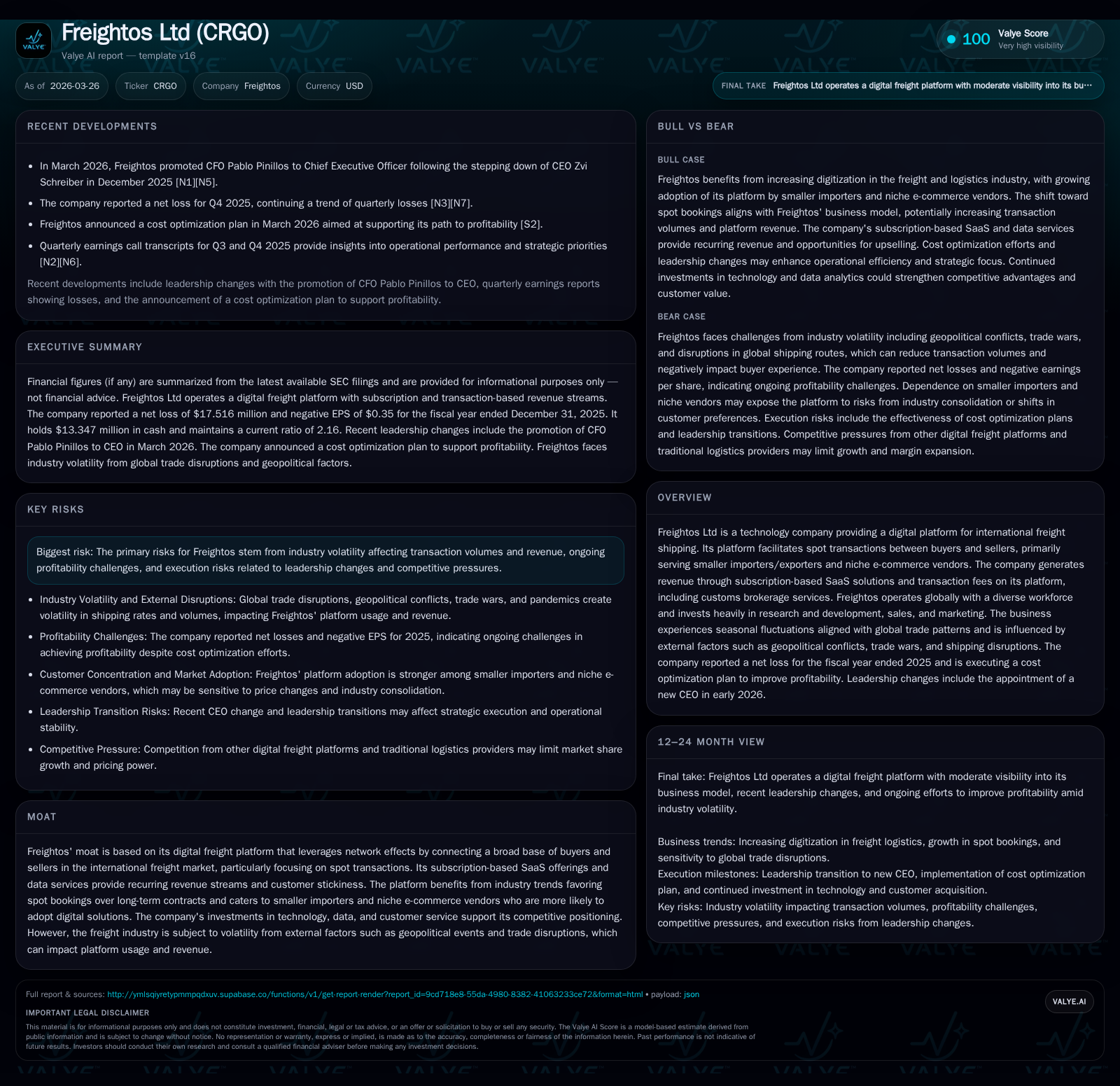
Freightos Ltd operates a unique digital platform that facilitates spot freight transactions, primarily serving SMBs and niche e-commerce vendors globally. Despite persistent net losses through 2025, the company has shown consistent improvement in reducing its losses while facing significant headwinds from global trade disruptions and tariff impacts. Leadership changes culminating in the appointment of CFO Pablo Pinillos as CEO signal a strategic pivot emphasizing operational efficiency and cost optimization amid volatile market conditions. Freightos’ subscription-based SaaS and transaction fee revenue streams demonstrate resilience but remain vulnerable to geopolitical shocks and shipping disruptions.
Historical Financial Performance and Growth Drivers
Freightos has steadily navigated the volatile freight industry landscape with technology-enabled solutions focused on facilitating spot transactions between buyers and sellers worldwide. The company’s financials reflect this trajectory through narrowing net losses over recent years: from a substantial -$65.5 million loss in FY2023 down to -$17.5 million in FY2025 [F1]. Despite still operating at a net loss, this represents an approximate 22% year-over-year improvement from FY2024’s -$22.5 million.
This improved trend underscores incremental progress driven by expanded platform adoption even as global trade experienced uneven patterns due to external shocks. Revenue growth is influenced by both volume fluctuations—transaction counts governed by economic cycles—and pricing metrics impacted by spot freight rate volatility. The company’s focus on SMB importers/exporters and niche e-commerce vendors, segments more quick to embrace digital booking platforms, continues to underpin steady platform engagement despite macroeconomic pressures [S1].
Historical performance (annual)
| FY | Net ($mm) | Net YoY |
|---|---|---|
| 2025 | -18 | +22.1% |
| 2024 | -22 | +65.6% |
| 2023 | -65 | -165.1% |
| 2022 | -25 |
Source: SEC companyfacts cache [F1].
Capital returns and efficiency (annual)
| FY | ROE% |
|---|---|
| 2025 | -40.8 |
| 2024 | -41.0 |
| 2023 | -90.9 |
| 2022 | -114.0 |
Source: SEC companyfacts cache [F1].
*Revenue data not explicitly provided in filings; analysis based on net income trends.
Platform Dynamics Against a Backdrop of Global Freight Volatility
The international freight market remains highly susceptible to geopolitical tensions, tariff amendments, and infrastructural constraints that create supply-demand imbalances with pronounced effects on pricing elasticity. In 2025, Freightos faced disruptions including tariff-driven frontloading that inflated early-year shipments before sharply declining port volumes—US ocean imports decreased about 0.5%, while air imports contracted roughly 1% following removal of the $800 de minimis exemption for B2C air cargo imports [S1].
Conversely, other trade lanes saw resilience: Asia-Europe air cargo volumes grew approximately 10%, contributing to a modest global volume rise of around 3% for air freight and about 4.5% for ocean freight worldwide [S1]. However, protective measures underway in Europe targeting de minimis exemptions by mid-2026 threaten to dampen e-commerce parcel growth similarly.
Freightos’ platform benefits from the rising preference for spot bookings over fixed long-term contracts—a trend that aligns well with its digital marketplace business model focused on agile SMB customers who are price-sensitive yet increasingly reliant on real-time booking transparency [S1][N2]. The Red Sea maritime route disruption initially caused shipping rate spikes but has settled into a new equilibrium with higher rates sustained alongside route shifts—illustrating how operational upheavals affect both gross booking values (GBV) per transaction and total transaction counts on Freightos’ platform.
Shifts in Leadership Steering Toward Profitability
March 2026 marked a pivotal leadership transition as Freightos appointed Pablo Pinillos — previously CFO — as Chief Executive Officer while maintaining his CFO responsibilities [N4][S3]. Mr. Pinillos brings extensive experience scaling tech companies through strategic financial operations and growth transformation roles at blockchain-security firm Coincover and mobile application automation leader Bitrise.
This leadership reshuffle signals an intensified focus on achieving sustainable profitability through rigorous cost management paired with continued investment in technology capabilities. Mr. Pinillos’ dual role enables synergistic oversight of capital allocation during an ongoing cost optimization initiative announced concurrently with his appointment aimed at streamlining sales, marketing, administrative functions while preserving core R&D investments vital for innovation-led growth [N2][S2].
User Segments, Pricing Models, and Revenue Composition
Freightos generates revenue primarily through two streams: subscription-based Software-as-a-Service (SaaS) solutions catering typically to larger multinational freight forwarders with flat or user/site-based pricing models; and platform transaction fees charged as percentages of gross booking values or flat fees depending on buyer/seller status and mode of transport [S4][S5].
The Platform segment includes fees from customs brokerage services via its Clearit offering—charged flat fees tailored by shipment complexity—and ancillary service fees adding incremental revenue diversity [S4]. Smaller importers/exporters gravitate toward Freightos’ digital platform for its flexibility managing spot freight transactions, offering them agility lacking in traditional contract-heavy logistics relationships.
This customer profile yields relatively sticky demand supported by the company’s growing suite of data subscription services such as FBX and FAX freight indices which increase platform value through actionable market intelligence [S4][S5]. However, price sensitivity prevailing among SMBs means transaction count elasticity can be material when shipping rates surge due to external shocks.
Strategic Cost Optimization Efforts and Profitability Outlook
In March 2026, Freightos launched an explicit cost optimization plan intended to accelerate its path toward consistent profitability by balancing expense reductions against necessary reinvestment in product development and sales capacity [N2][S2].
The initiative targets rationalizing selling & marketing spend—historically elevated given Freightos' competitive customer acquisition environment—as well as trimming general administrative overhead while cautiously maintaining or growing R&D budgets that fuel product innovation critical for long-term scaling advantages [S8].
Management recognizes the challenge posed by volatile freight volumes that impact unit economics unpredictably; thus leveraging operating leverage is critical to tightening losses amid demand uncertainty. This heightened focus on disciplined expense control coupled with scalable SaaS subscription growth underpins a cautiously optimistic outlook contingent on macro stability [N2][S8].
Capital Allocation: Balancing Growth Investments and Fiscal Discipline
Freightos maintains a solid liquidity buffer entering 2026 with approximately $13.3 million in cash and equivalents against $16.7 million current liabilities yielding a current ratio near 2.16 — highlighting prudent working capital management despite ongoing losses [F1][S20].
No dividends or share repurchases have been declared or pursued given the company's reinvestment priorities focused on expanding technology infrastructure and scaling sales efforts amid industry cyclicality [F1][S6]. Equity base showed contraction reflecting accumulated losses but sufficient capital structure resilience remains bolstered by management vigilance over fiscal discipline.
Recent disclosures confirm continuation of equity incentive programs aligned with retention strategies rather than shareholder payouts at this stage, emphasizing reinvestment imperatives over capital returns [S9][S15].
Risks From Geopolitical Disruption and Market Sensitivity
Persistent risks stem from inherent mismatches between logistics infrastructure capacity planning — spanning vessel availability, port throughput limits, trucking labor constraints — that often lag rapid demand shifts creating amplified supply-demand imbalances [S1]. Such mismatches intensify price volatility given price-inelastic demand phenomenon common across freight markets.
Furthermore, escalating geopolitical conflicts like the Red Sea crisis cause unpredictable route realignments that alter costs unevenly across lanes impacting platform transaction volumes variably.
Trade policy turbulence including tariffs and protective regulations erode global trade growth fundamentals affecting Freightos’ addressable market size particularly via reduced demand in U.S. ocean import segments and prospective EU de minimis restrictions effective July 2026 [S1]. Cybersecurity exposure remains material given Freightos operates a digital trading platform reliant on robust IT security frameworks overseen by specialized executive teams integrated into board governance structures encompassing risk committees versed in emerging cyber threats [S16][S21].
Key Milestones to Monitor Amid Industry Uncertainty
Looking ahead through 2026, observers should track several pivotal developments influencing Freightos’ trajectory:
- The lasting impact of Middle East regional conflicts on shipping lane accessibility and resultant rate structures remains uncertain though likely substantial given initial elevated pricing periods observed post-crisis onset [N1][S12];
- EU proposals aiming to suspend de minimis thresholds mid-year portend diminished growth prospects for cross-border B2C air imports affecting key lane dynamics Freightos serves;
- User adoption trends under new CEO Pablo Pinillos will be key barometers signaling whether cost rationalization efforts accompany stable or expanding gross booking value mix;
- Broader macroeconomic impacts arising from oil price trends influencing bunker fuel costs may modulate container vessel deployment affecting ocean freight rates crucial for pricing power on platform transactions.
In absence of explicit forward guidance beyond these factors disclosed publicly, stakeholders must rely on monitoring dynamic external variables layered atop Freightos’ strategic operational adjustments for cues regarding pacing toward breakeven profitability.
This analysis synthesizes publicly available SEC filings and news sources as of March 26, 2026. It aims solely to describe Freightos Ltd’s financial condition, strategic initiatives, industry context, risks, and evolving leadership framework without any investment recommendation or forecast speculation.
Disclaimer: This is research-only, informational analysis and not investment advice. It may include AI-generated interpretation and general industry context. Always verify important details using primary sources.

Comments