
Can-Fite BioPharma's Clinical Progress and Patent Expansion Contrast with Persistent Operating Losses
The clinical-stage biopharma firm advances A3 adenosine receptor drugs amid steep revenue decline and increased R&D spending.
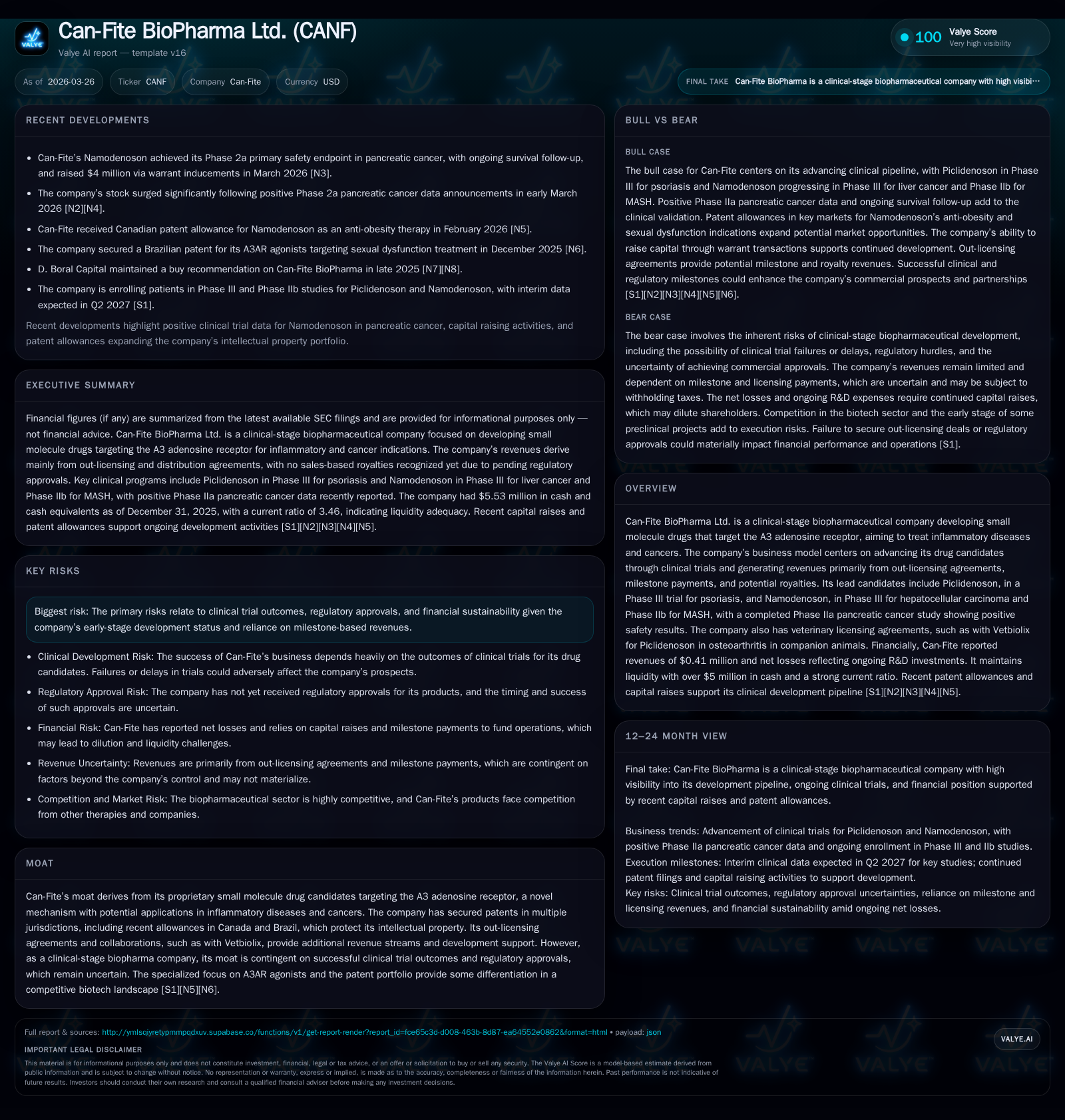
Can-Fite BioPharma Ltd. focuses on small molecule therapies targeting the A3 adenosine receptor, with lead programs in Phase III trials for inflammatory and cancer indications. Despite clinical milestones such as positive pancreatic cancer Phase IIa data and expanded patent allowances for Namodenoson, the company’s revenues fell nearly 40% in 2025 due to milestone timing and distribution patterns. Operating losses widened 22%, driven by higher research expenses supporting late-stage trials, while liquidity remains constrained but sufficient for twelve months backed by recent financing. The business model relies heavily on out-licensing deals, royalties, and capital raises, leaving upside tied closely to clinical trial outcomes and regulatory approvals.
Company Overview
Can-Fite BioPharma Ltd. operates as a clinical-stage biopharmaceutical company targeting the A3 adenosine receptor (A3AR) pathway with small molecule drug candidates aimed at treating inflammatory diseases and various cancers [S1][S12]. The company primarily derives its revenue from milestone payments, royalties, and out-licensing agreements rather than commercial drug sales given its early-stage development status.
Its lead clinical programs include:
- Piclidenoson, a late-stage candidate in a Phase III trial for psoriasis,
- Namodenoson, which is concurrently progressing through a Phase III trial for hepatocellular carcinoma (HCC), a Phase IIb study for metabolic dysfunction-associated steatohepatitis (MASH), and recently completed a Phase IIa pancreatic cancer study demonstrating favorable safety outcomes [N2][N4][S8].
Additionally, Can-Fite maintains an active veterinary market presence through its licensing agreement with Vetbiolix for Piclidenoson focused on osteoarthritis treatment in companion animals [S12].
Historical Financial Performance
The company’s financials illustrate typical challenges of a clinical-stage biotech: very low revenue streams coupled with significant investment-led operating losses as it advances multiple experimental therapies.
Historical performance (annual)
| FY | Rev ($) | Net ($mm) | CFO ($mm) | OpInc ($mm) | Rev YoY | Net YoY |
|---|---|---|---|---|---|---|
| 2025 | 405000 | -10 | -9 | -10 | -39.9% | -24.7% |
| 2024 | 674000 | -8 | -8 | -8 | -3.2% | |
| 2023 | -8 | -8 | -8 | +25.0% | ||
| 2022 | 810000 | -10 | -11 | -10 | -5.0% |
Source: SEC companyfacts cache [F1].
Capital returns and efficiency (annual)
| FY | Div ($mm) | FCF ($mm) | ROE% |
|---|---|---|---|
| 2025 | -9 | -175.8 | |
| 2024 | -8 | -145.0 | |
| 2023 | 3 | -8 | -122.3 |
| 2022 | 3 | -11 | -227.5 |
Source: SEC companyfacts cache [F1].
Revenue declined sharply (-39.9%) from $0.67 million in 2024 to $0.41 million in 2025 despite ongoing global licensing activities [F1][S18]. This decline primarily reflects the recognition pattern of milestone payments under distribution agreements rather than a fundamental drop in commercial interest or licensing deals [S12].
Operating income deteriorated further to nearly $10 million negative largely driven by higher research costs associated with advancing late-stage clinical trials, particularly for Namodenoson and Piclidenoson [S18]. Net losses closely track operating losses given minimal other income sources.
Operating cash flow remains negative at approximately $8.95 million outflow in the latest year evidencing costly clinical advancement efforts funded primarily through equity capital raises [F1][S18]. Notably, capital expenditure levels are low (<$5k per annum), consistent with virtual biopharma operations relying mostly on outsourced clinical trial services.
Business Model and Intellectual Property
Can-Fite leverages a focused drug discovery platform centered on A3 adenosine receptor agonists which modulate inflammation and tumor growth pathways uniquely compared to existing therapeutics [S1]. Its moat lies in proprietary chemistry protected by patents granted across major markets including recent approvals expanding technical claims around Namodenoson's indications such as obesity management [N3][S1].
The company monetizes these assets via strategic out-licensing deals: notable partners include SKK in Japan, Kwang Dong in Korea, Cipher Pharmaceuticals, Gebro Pharma, Chong Kun Dang Pharmaceuticals—each paying upfront fees plus milestones and royalties contingent on future development success [S12]. Another revenue source is its veterinary licensee Vetbiolix that exercised its exclusive option after promising proof-of-concept osteoarthritis data; upfront payment (~$271k) was received alongside agreed tiered royalties based on sublicensing revenues and eventual net sales upon approval [S12][N1].
Forward Outlook and Clinical Milestones
Clinical programs form the core pipeline catalysts:
Piclidenoson: The COMFORT Phase III psoriasis trial is currently enrolling patients with an interim analysis anticipated by Q2 2027 [S8].
Namodenoson: Continues patient enrollment in the LIVERATION Phase III study for HCC with an interim readout also expected mid-2027; simultaneously advancing Phase IIb MASH trial enrollment while following positive pancreatic cancer Phase IIa safety outcomes post enrollment completion [N2][N4][S8].
Additionally, Can-Fite aims to finalize regulatory submissions for Lowe Syndrome protocol formulation by Q2 of this year—a potential new indication leveraging A3AR targeting [S8].
These milestones underpin near-term valuation inflection points though delays or failed endpoints could extend timelines or increase funding needs given limited internal commercialization capabilities.
Capital Strategy and Liquidity Position
As of December 31, 2025, Can-Fite reported cash and equivalents of approximately $5.53 million against current liabilities of around $2.73 million producing a current ratio of about 3.46—indicative of reasonable short-term liquidity despite ongoing net cash burn [F1][S14].
The company has supplemented working capital through equity financings highlighted by a registered direct offering raising about $3 million in April 2025 plus an At-The-Market (ATM) program that yielded ~$5.7 million gross proceeds during FY25 [S14]. Additionally, warrant inducement transactions conducted early March 2026 brought in gross proceeds north of $4 million providing incremental financial cushioning [N3][S26][S27].
Despite these injections, persistent operating cash flow deficits (~$9 million annually) underscore continued dependency on capital markets or lucrative partnering deals for sustained operation beyond mid-2027 absent product revenues [F1][S6]. Management has instituted contingency plans prioritizing R&D program flexibility including potential delays or discontinuations should financing conditions deteriorate [S4].
Returns and Capital Allocation Considerations
No dividends were paid through the most recent fiscal years consistent with industry norms for pre-commercial biotech companies [F1]. Share-based compensation forms part of operating expenses managed via binomial option-pricing models under ASC718 guidelines balancing personnel incentives versus shareholder dilution risk [S16].
With negative net incomes relative to modest equity bases at roughly $5.59 million by FY25-end yields an approximate return on equity (ROE) near negative 176%, reflecting the developmental nature without realized product cash flows so far [F1]. Free cash flow remains deeply negative illustrating high fixed costs related primarily to clinical advancement efforts rather than CAPEX-intensive infrastructure spending typical of manufacturing companies.
Risks Snapshot
Principal risks inherent include:
- Failure or delay in pivotal clinical trials potentially stalling product registration,
- Regulatory hurdles complicating approval timelines,
- Revenue volatility due to milestone payment timing under out-license agreements,
- Capital constraints that could force reprioritization or downsizing research projects,
- Competition within crowded oncology/inflammation therapy spaces competing on novel mechanisms or more advanced candidates,
- Potential withholding taxes impacting international payments reducing net income inflows,
- Cybersecurity threats although currently assessed as non-material by management oversight bodies [S11][S15][S20][S23].
Conclusion
Can-Fite BioPharma presents a case study of a biotech harnessing proprietary A3AR agonist technology across oncology, autoimmune, and veterinary indications progressing into late-stage clinical development despite persistently challenging financial results marked by declining revenues driven by milestone accounting rather than fundamental loss of partner confidence.
Upcoming key milestone readouts scheduled Q2-Q3 2027 will be critical inflection points determining whether the company can transition from R&D spend toward potential royalty-bearing commercial success supported by an expanding patent estate licensable globally. Operations throughout this period depend heavily on capital market access given ongoing cash burn well exceeding current liquid resources. Prospective observers must weigh scientific promise against financial endurance risks common among small-cap clinical biotechs.
This analysis is based solely on publicly available information as of March 26, 2026.
Disclaimer: This is research-only, informational analysis and not investment advice. It may include AI-generated interpretation and general industry context. Always verify important details using primary sources.

Comments