
FVCBankcorp Expands Regional Franchise with Focused Loan Growth and Sustained Capital Returns
FVCBankcorp continues growing through organic lending and strategic acquisitions, targeting high-quality commercial real estate and government contractor financing in the Washington metropolitan area.
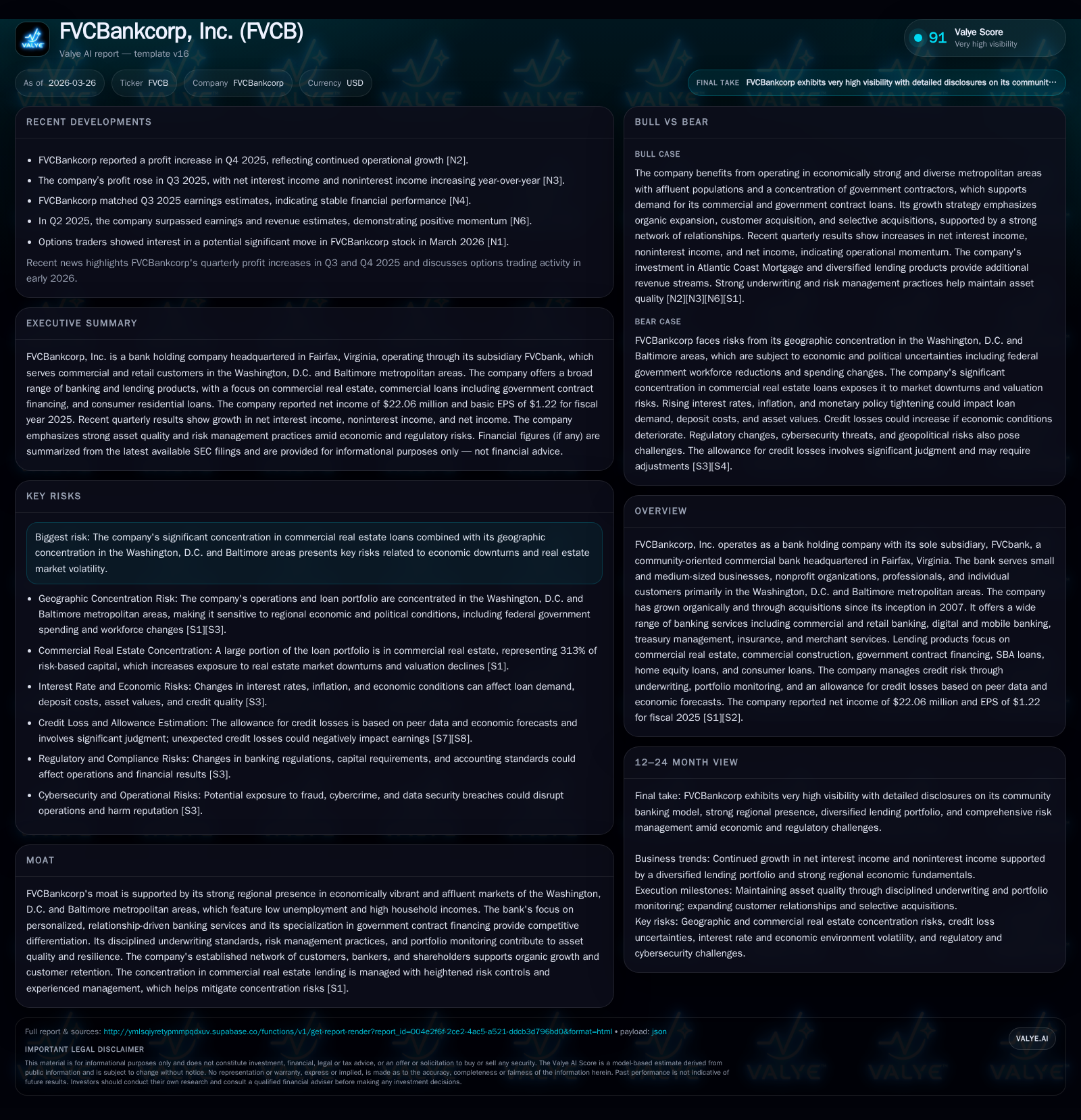
Since inception in 2007, FVCBankcorp has built a regional niche servicing small and medium businesses, professionals, and nonprofits around Washington, D.C. and Baltimore. The company’s disciplined underwriting and relationship-driven approach underpin steady growth in loans and deposits, alongside risk management focused on commercial real estate concentration. With net income rising over 46% year-over-year to $22 million in 2025, the firm balances expansion with expanding capital base and renewed buyback activity while cautiously monitoring economic sensitivities in its concentrated markets.
Company Overview and Historical Performance
Founded in 2007 and headquartered in Fairfax County, Virginia, FVCBankcorp operates through its sole subsidiary FVCbank, a community-oriented commercial bank serving the Washington, D.C., and Baltimore metropolitan statistical areas [S1]. The Company has expanded its presence primarily organically, complemented by two bank acquisitions—in Arlington, Virginia (1st Commonwealth Bank of Virginia in 2012) and Rockville, Maryland (Colombo Bank in 2018)—which broadened access to affluent suburban markets [S1].
The bank focuses on commercial clients including small-to-medium businesses, nonprofit organizations, professionals, and government contractors. It offers a mix of traditional deposit-taking coupled with loan products such as commercial real estate (CRE), commercial construction, SBA loans, government contract financing (a key sector differentiator), home equity loans, and consumer lending [S1]. Complementary services include treasury management, merchant services, insurance brokerage commissions via minority ownership interest in Atlantic Coast Mortgage LLC (ACM), digital banking platforms, and bank-owned life insurance income [S1].
From a financial standpoint, net interest income (NII)—the difference between interest earned on assets like loans/securities and interest paid on liabilities—dominates revenues but is supplemented by noninterest income sources [S1]. Over the last three years through FY2025, net income has demonstrated significant improvement as seen below:
Historical performance (annual)
| FY | Net ($mm) | CFO ($mm) | Capex ($) | Net YoY |
|---|---|---|---|---|
| 2025 | 22 | 24 | 47000 | +46.4% |
| 2024 | 15 | 18 | 141000 | +294.1% |
| 2023 | 4 | 16 | 212000 | -84.7% |
| 2022 | 25 | 22 | 166000 |
Source: SEC companyfacts cache [F1].
Capital returns and efficiency (annual)
| FY | Buybacks ($mm) | FCF ($mm) | ROE% |
|---|---|---|---|
| 2025 | 7 | 24 | 8.7 |
| 2024 | 0 | 18 | 6.4 |
| 2023 | 1 | 16 | 1.8 |
| 2022 | 1 | 22 | 12.3 |
Source: SEC companyfacts cache [F1].
The YOY jump from FY2024 to FY2025 signals operational leverage combined with sustained asset growth [F1]. Operating cash flow similarly rose by about 31% from $18.2 million to $23.9 million while capital expenditures have remained minimal (<$50k annually), indicative of prudent infrastructure spending focused on branch-light expansion [F1]. The equity base has grown steadily to $253.6 million at end-2025 from $217.1 million three years ago—an important capital buffer against credit and interest rate risks [F1].
A notable point is the reactivation of share repurchases with approximately $6.7 million spent in FY2025 after no buys in FY2024; this is part of a Board-authorized buyback program that was recently extended to March 31, 2027 covering up to roughly 8% of outstanding shares [S3]. In addition to buybacks, the Company declared its first regular quarterly dividend ($0.06 per share) in mid-2025 supporting enhanced shareholder returns [S16][N2].
Portfolio Composition and Risk Management
FVCBankcorp’s loan portfolio stood at approximately $1.86 billion as of September 30, 2025 with minor fluctuations compared to December 31 prior year figures [S17]. Commercial real estate loans continue to comprise over half of total loans (54%), split between owner-occupied ($213 million) and non-owner occupied (~$781 million). Commercial construction loans account for an additional ~9%, collectively representing about two-thirds of the total loan portfolio—highlighting CRE concentration risk [S22]. Government contract financing is a specialized lending segment aligning well with the region’s contractor-heavy economy.
Credit quality metrics remain favorable: nonperforming loans totaled $10.5 million or about 0.47% of total assets at mid-2025—a decline from previous periods—and reserves specifically allocated against problem loans are commensurately conservative ($365k specific reserves) [S20]. This solid position is underpinned by rigorous underwriting standards involving extensive loan-level evaluations using peer performance data combined with a regression-informed expected credit loss model mandated under ASC 326 accounting standards [S1]. Due to limited loss history since inception (a typical challenge for community banks), FVCBankcorp predominantly leverages external peer data for probability of default assumptions while supplementing with qualitative overlays aligned to forward-looking economic scenarios [S1].
Other credit risk mitigants include collateral diversity—favorable market demographics featuring highly educated workforces and strong household incomes support collateral valuations—and active portfolio monitoring designed to preempt deterioration before escalations occur [S22][S20]. However, management acknowledges that concentrated exposure to CRE coupled with geographic dependency on Washington/Baltimore metro economies tied closely to federal government spending represent key downside risks should regional economic conditions weaken materially [S1].
Capital Adequacy and Liquidity Measures
Maintaining robust capital buffers is central for FVCBankcorp’s risk framework given its loan concentration profile. As of June 30, 2025—which reflects recent regulatory reporting—the Bank held common equity tier 1 (CET1) capital ratio at roughly 14%, well above required minima including conservation buffers set forth by regulators (currently around 7% CET1 minimum plus buffers) [S21][S6]. Total risk-based capital was approximately at a comfortable cushion of just over 15%. Tangible book value per share rose modestly from ~$12.52 at end-2024 to ~$13.08 mid-year reflecting capital accretion net of buybacks [S6][F1].
Liquidity is similarly well managed: liquid assets comprising cash equivalents and available-for-sale investments accounted for about 17% of total assets at September-end versus around 11% at prior year-end—a prudent build-up considering recent macroeconomic volatility affecting many regional banks’ funding profiles [S5][S7][S18]. The Company maintains access to multiple wholesale liquidity sources including Federal Home Loan Bank borrowings ($130 million advanced collateral-backed lines currently drawn) plus sizeable unused lines at both FHLB and Federal Reserve discount windows totaling over $900 million collectively available should extraordinary funding needs arise [S4][S7]. Deposit inflows remain steady; however estimated uninsured deposits represent approximately one-third to nearly half of total deposits depending on collateralization exclusions—typical for banks serving business clients with larger account balances seeking enhanced FDIC coverage via networks such as IntraFi [S16][S19]. Commitment facilities also include standby letters of credit that carry customary risk mitigants including collateral requirements based on client evaluation practices [S11][S10].
Growth Prospects & Outlook Considerations
Future growth will likely hinge on continued penetration within affluent suburban markets leveraging personalized relationship management—an advantage maintained by long-tenured bankers—and loan origination momentum particularly within commercial real estate segments exhibiting moderate owner occupancy gains balanced against strategic construction lending increases [S22][N2]. The investment in ACM mortgage-related services further supports diversification beyond core balance sheet lending into fee-generating segments complementary to regional housing demand dynamics [S1].
Risks that could constrain this growth include: local economic slowdowns tied directly or indirectly to shifts in federal government spending priorities or workforce contractions; shifts in real estate market valuations impacting collateral quality; unpredictable interest rate trajectories where rapid cost-of-funds increases could compress net interest margins; or increased credit losses beyond current peer-modeled allowances should macroeconomic conditions deteriorate severely or abruptly [S1][N2]. The management team’s stated approach emphasizes close portfolio stewardship including stress testing under multiple adverse scenarios alongside maintaining sufficient capital flexibility via dividends plus share repurchases as tactical levers [S3][N2].
Absent explicit numerical guidance disclosed recently or updates beyond established programs noted here, investors should monitor upcoming earnings releases for trends in loan growth rates by segment along with asset quality indicators including any shifts in allowance levels which could presage broader credit environment changes.
Capital Allocation & Returns Summary
The Company has demonstrated disciplined capital return policies more recently: initiation of a quarterly dividend program commencing August 2025 distributing roughly $1.1 million annually underscores confidence in cash flow stability while maintaining flexibility given low absolute capital expenditure needs [S16][N2][F1]. Concurrently renewed share repurchase authorizations enable opportunistic buybacks which complement dividends enhancing shareholder returns while managing equity dilution effects amidst organic growth phases [F1][S3].
Operating cash flows have consistently exceeded minimal capex outlays resulting in substantial free cash flow generation approaching $23.8 million most recently—enabling robust internal funding coverage for growth initiatives without excessive reliance on external equity issuance or debt layering beyond manageable levels such as FHLB advances ($130 million) plus subordinated debt ($18.7 million) carrying fixed but moderate coupon costs around mid-single digit percentages factoring hedges [F1][S9][S16][S17].
Return on equity approximates near mid-single digits (about 8.7%) reflecting both conservative risk posture and ongoing reinvestment into expanding customer relationships alongside tangible book value accretion fostering long-term franchise value enhancement [F1]. The interplay between sustaining adequate capital ratios above thresholds while remunerating shareholders selectively yet consistently defines current allocation priorities.
Conclusion
Since its founding over nearly two decades ago as a locally focused bank holding company anchored in Fairfax County Virginia, FVCBankcorp has cultivated a differentiated franchise serving government contractors alongside diversified commercial real estate borrowers within economically resilient Washington/Baltimore metro regions characterized by demographic affluence and skilled labor supply dynamics.
Its financial results reflect steady progress: consistent net income improvement powered by focused lending expansion balanced against prudent credit risk controls utilizing peer data-driven allowances; robust liquidity complemented by healthy deposit inflows; strong regulatory capital positioning enabling controlled shareholder distributions via dividends and resumed buybacks.
Nevertheless caution remains warranted given its CRE-heavy portfolio concentration augmented by economic exposure tied closely to federal budget fluctuations—a known vulnerability common across regional banks operating within concentrated metropolitan hubs.
Future developments worth monitoring include portfolio composition shifts especially CRE sub-segments vs government contract loan balances; allowance adequacy adjustments under evolving macroeconomic scenarios; margin impacts from changing interest rate environments; plus any incremental acquisition opportunities or strategic partnerships designed to deepen market penetration or diversify revenue streams sustainably.
This report synthesizes publicly available information as of March 26, 2026 without offering investment advice.
Disclaimer: This is research-only, informational analysis and not investment advice. It may include AI-generated interpretation and general industry context. Always verify important details using primary sources.

Comments