
Fidelity Solana Fund’s Launch Phase: Tracking SOL with Regulatory Precision
Assessing FSOL's initial operations, passive staking strategy, custody safeguards, and capital framework in its first fiscal year.
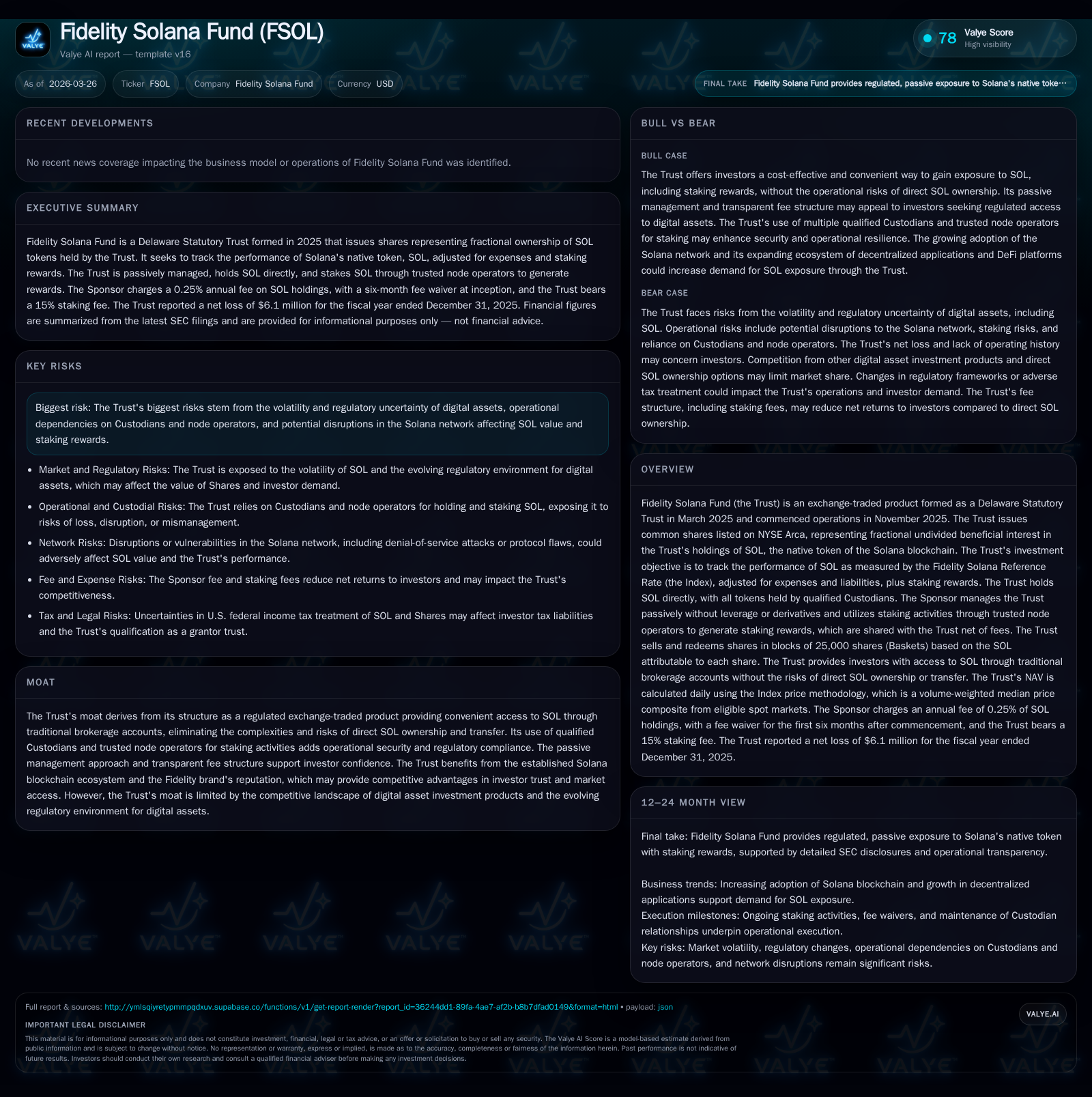
Fidelity Solana Fund began operations late 2025 as a regulated ETP offering direct exposure to the Solana blockchain's native token SOL through traditional brokerage channels. Its investment approach is anchored by direct SOL holdings combined with staking rewards distributed quarterly, structured to outperform the underlying SOL index net of expenses. The fund recorded a net loss of $6.1 million and an ROE of -5.3% in its inaugural fiscal year reflecting startup costs and scale-up phase. Operational security relies on multiple qualified custodians and trusted node operators ensuring compliance and asset safety. Going forward, FSOL's growth depends on market adoption of staking-based products and regulatory clarity amid digital asset volatility.
Origins and Initial Performance: Foundation in the First Operating Year
Fidelity Solana Fund (FSOL) is structured as a Delaware Statutory Trust established on March 20, 2025. The Trust officially launched trading on November 17, 2025, marking the commencement of its operations within that fiscal year [S1]. Prior to November 2025, FSOL engaged only in organizational activities such as registration under the Securities Act of 1933.
In its first financial reporting period ending December 31, 2025, the Trust reported a net loss of approximately $6.1 million resulting in a negative return on equity (ROE) of -5.3% [F1]. This loss primarily reflects initial startup costs associated with the fund’s launch phase, including operational setup and regulatory compliance expenditures. Given the short operating timeframe—about one and a half months post-launch within FY2025—these figures are consistent with an early-stage product scaling its infrastructure and market presence.
Historical performance (annual)
| FY |
|---|
| 2025 |
Source: SEC companyfacts cache [F1].
This table captures FSOL’s limited but foundational financial snapshot at launch.
Tracking SOL and Staking Rewards: FSOL’s Investment Objective Explained
FSOL aims to replicate the performance of SOL—the native token of the Solana blockchain—as measured by the Fidelity Solana Reference Rate (an index tracking SOL spot prices), adjusted for fund expenses plus accrued staking rewards [S1],[S16].
Unlike many digital asset funds that either hold tokens passively or engage in derivatives trading or leverage, FSOL maintains a strictly passive management style without leverage or derivatives. It holds actual SOL tokens through qualified custodians.
A key differentiator is the integration of staking rewards into returns. The Trust stakes most or all of its SOL holdings through trusted node operators—entities responsible for validating transactions on the Solana network—in order to earn protocol-native rewards for supporting network security. These rewards are collected by the fund and distributed quarterly to shareholders net of fees [S18].
Staking provides an incremental yield component beyond price appreciation, enhancing total return potential while maintaining exposure to native network economics.
Operational Structure Ensuring Custody and Compliance Security
Safekeeping of FSOL’s underlying SOL tokens is entrusted to multiple regulated qualified custodians: Anchorage Digital Bank N.A., BitGo Bank & Trust N.A., and Coinbase Custody Trust Company LLC [S1]. These custodians employ multi-signature wallets, cold storage components, insurance coverage options, and compliance with anti-money laundering standards.
Shares representing fractional undivided beneficial ownership interests in these SOL holdings trade publicly on NYSE Arca. They are created or redeemed exclusively in large blocks called "Baskets," each consisting of 25,000 shares corresponding proportionally to defined amounts of SOL held by the trust net of liabilities [S5].
Authorized Participants—typically registered broker-dealers or institutional financial entities—interact directly with FSOL for Basket creation/redemption processes. They must also be Depository Trust Company (DTC) participants enabling seamless settlement via DTC’s book-entry system which preserves liquidity.
Residual operational risks persist such as delays during creation/redemption cycles amid high market volatility or disruptions affecting node operator performance or custodial functions [S11],[S17].
Regulatory and Market Risks Highlighted in Latest Filings
FSOL operates within an evolving regulatory environment for digital assets marked by some uncertainty despite recent clarifications classifying SOL as a "digital commodity" not treated as a security by the SEC [S27]. Enforcement actions addressing fraud or manipulation remain active topics across U.S. agencies including CFTC oversight over derivatives markets.
Risks stem from inherent digital asset price volatility impacting token value and staking reward yields as well as reliance on third-party service providers such as custodians and node operators whose failures could disrupt fund performance or liquidity [S4],[S13],[S29]. Blockchain network risks such as protocol upgrades or forks introduce tax complexities for shareholders alongside potential asset abandonment policies governing forks not recognized as native SOL [S24].
These factors place FSOL among early entrants balancing consumer protection frameworks against novel crypto-asset market dynamics.
Capital Allocation Approach: NAV Integrity and Stakeholder Returns
FSOL employs standard ETP capital allocation practices centering around creation/redemption activity conducted exclusively in Baskets of 25,000 shares which correspond pro rata to underlying SOL held accounting for accrued expenses or liabilities [S9].
Authorized Participants bear all transaction-associated fees—including brokerage commissions, transfer taxes, blockchain network fees (“gas”), and other processing costs—through Transaction Fees payable upon creation or redemption orders [S5]. This fee arrangement enables cost transparency while supporting arbitrage mechanisms maintaining secondary market share prices close to NAV per share.
The Trust does not pay dividends nor engage in share buybacks; instead it distributes quarterly net staking rewards which accrue from validating transactions through staked SOL across appointed trusted nodes [S15],[S21]. These distributions reflect actual income generated less applicable expenses.
Tax treatment follows convention for grantor trusts holding digital assets where shareholders recognize capital gains/losses upon sale or redemption events; specialized guidance also addresses tax implications arising from receipt of staking rewards classified as ordinary income distributable directly by the trust to investors [S14],[S16].
Future Outlook: Growth Catalysts and Market Constraints to Monitor
Although FSOL has provided no explicit forward guidance beyond risk disclosures at inception several potential growth drivers warrant monitoring:
- Expanded institutional adoption fueled by regulatory clarity distinguishing digital commodities from securities may increase demand for custodied token exposure combined with yield via staking rewards.
- Growth within the Solana network—including dApp expansion driving transactional volume—could enhance staking reward generation opportunities augmenting total returns distributed.
- Enhanced liquidity provision via Authorized Participants along with secondary market dynamics may support tighter tracking spreads between share prices and NAV.
Constraints include ongoing systemic volatility inherent in crypto markets causing fluctuating token valuations impacting fund NAV stability plus regulatory interventions potentially affecting permissible activities surrounding staking or custody practices [S4],[S6].
What Investor Milestones to Watch in This Emerging Product
Over the next 12–18 months investors should track:
- Premium/discount patterns exhibited by FSOL shares relative to net asset value indicating arbitrage mechanism efficacy or market demand imbalances.
- Timing regularity and sufficiency of quarterly staking reward distributions signifying operational success integrating node operator performance.
- Volume activity among Authorized Participants affecting secondary market depth facilitating smooth creations/redemptions mitigating liquidity shocks.
- Further SEC or CFTC rule developments specifically targeting crypto ETPs managing native tokens via custody plus yield-generating strategies impacting compliance costs or permissible fund structures.
Overall FSOL stands as a pioneering crypto exchange-traded product blending traditional market infrastructure with nascent proof-of-stake economics. While early results reveal inherent startup challenges reflected in preliminary losses relative to potential scalability benefits, the fund offers tangible regulatory-compliant access paths for investors targeting Solana exposure including incremental yield capture absent direct wallet ownership complexities.
This report presents factual analysis based upon data current through March 26, 2026. It does not constitute investment advice nor express any opinion regarding suitability of any investment product described herein.
Disclaimer: This is research-only, informational analysis and not investment advice. It may include AI-generated interpretation and general industry context. Always verify important details using primary sources.

Comments