
Dakota Gold Expands Exploration Footprint with Strategic Capital Raises Yet Faces Progress Uncertainty
Dakota Gold Corp. maintains a dominant land position in a historic gold district while navigating the challenges inherent to exploration-stage mining ventures.
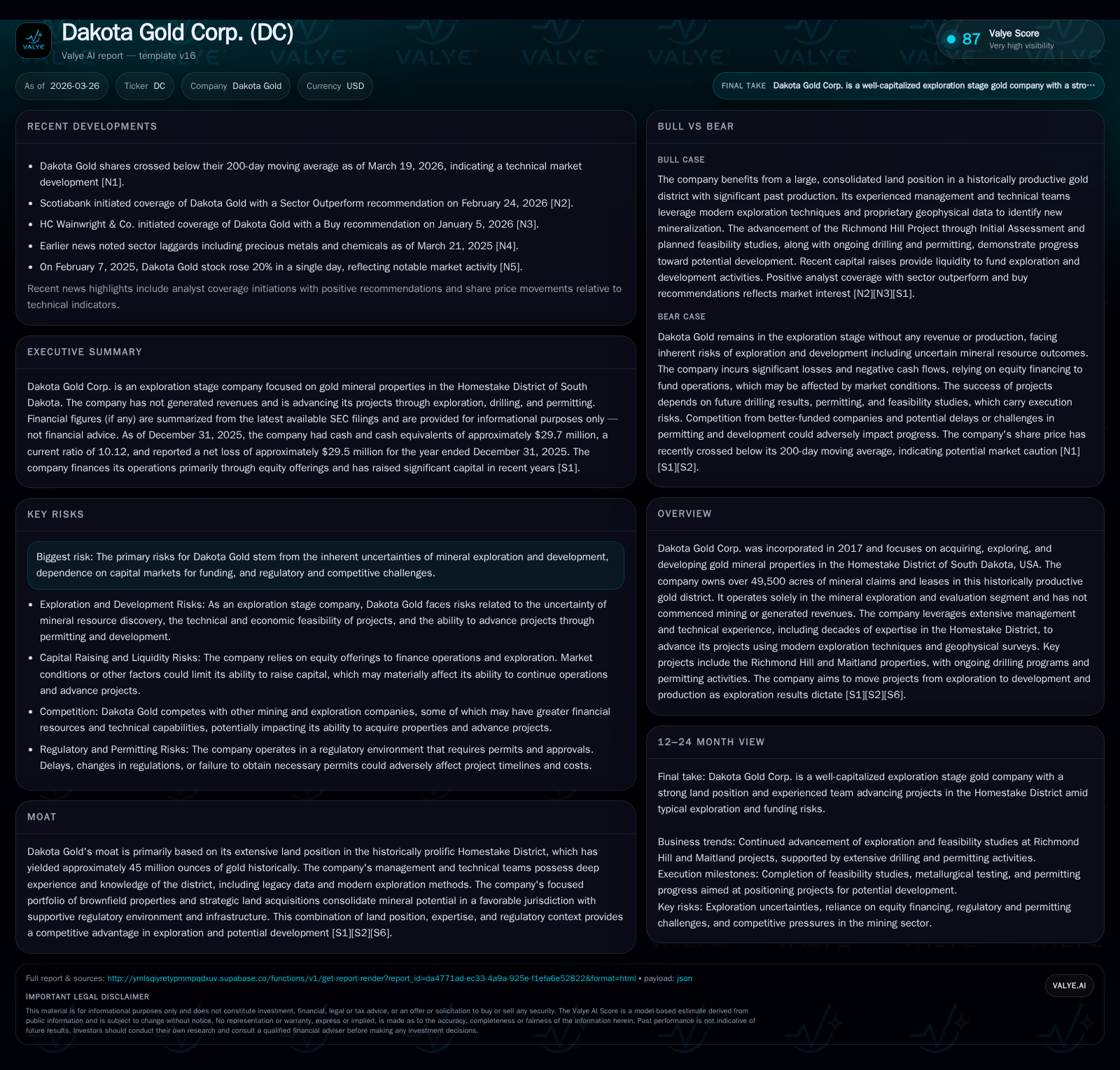
Dakota Gold Corp., focused exclusively on gold exploration in South Dakota's prolific Homestake District, has amassed key mineral claims covering over 49,500 acres with significant drilling programs underway. Despite no current revenue or production, management leverages deep institutional knowledge and modern techniques to advance flagship projects such as Richmond Hill and Maitland. The company has sustained consistent operating losses driven by exploration costs but fortified its liquidity through multiple equity offerings totaling over $100 million since 2024. While the company's technical progress and regulatory permitting remain critical milestones to watch, its large landholdings and experienced team provide a valuable foundation amid the sector's capital-intensive and uncertain exploration landscape.
Company Overview and Historical Performance
Dakota Gold Corp., incorporated in 2017 and now domiciled in Delaware, is an exploration-stage company focused solely on the acquisition and evaluation of gold mineral properties within the Homestake District of South Dakota. This district is historically significant for producing approximately 45 million ounces of gold over more than a century, largely concentrated within a geographic area less than three square miles in size around the historic Homestake Mine [S1].
Historical performance (annual)
| FY | Net ($mm) | CFO ($mm) | OpInc ($mm) | Capex ($) |
|---|---|---|---|---|
| 2025 | -30 | -25 | -31 | 196445 |
| 2024 | -31 | -34 | 143387 | |
| 2023 | -31 | -38 | 1054320 | |
| 2022 | -19 | -18 | -22 | 197199 |
Source: SEC companyfacts cache [F1].
Capital returns and efficiency (annual)
| FY | FCF ($mm) | ROE% |
|---|---|---|
| 2025 | -26 | -26.3 |
| 2024 | -32 | |
| 2023 | -32 | |
| 2022 | -19 | -16.9 |
Source: SEC companyfacts cache [F1].
Dakota Gold holds a commanding land position exceeding 49,500 acres through 2,147 unpatented claims coupled with surface leases across the district. Key assets include the Richmond Hill and Maitland properties along with others consolidated through strategic acquisitions [S1][S9]. The company operates only in one segment—mineral exploration and evaluation—which emphasizes early-stage project advancement rather than mining operations or revenue generation. To date, Dakota Gold has yet to commence production or generate revenues [S1][S9].
Management’s approach leverages the deep experience of leadership with combined decades spent working in the district during its historical operational phase primarily under the Homestake Mining Company banner. This continuity of knowledge matters significantly given that much of the district outside the traditional underground mines remains underexplored using modern geophysical methods [S1].
Since initiating drilling activities in 2022, Dakota Gold has completed a cumulative total of 473 drill holes spanning approximately 493,472 feet (150,493 meters), distributed mainly between its Maitland and Richmond Hill projects. Drilling intensity expanded yearly with notable activity: 25 holes (70k feet) in 2022; 89 holes (181k feet) in 2023; 117 holes (147k feet) in 2024; and by end-2025 an additional 211 core holes plus rotary holes completed at Richmond Hill alone [S1]. The maiden S-K 1300 Initial Assessment for Richmond Hill was released April 2024—a foundational step signaling progression from early exploration towards resource delineation [S1].
Financial Performance Summary
Given its developmental status, Dakota Gold’s financials reflect substantial investment without accompanying revenues or profitability yet realized:
| FY | OpInc (USD) | Net Income (USD) | CFO (USD) | Capex (USD) | Equity (USD) |
|---|---|---|---|---|---|
| 2025 | -30,754,742 | -29,538,699 | -25,445,427 | 196,445 | 112,520,539 |
| 2024 | -34,332,242 | -33,884,536 | -31,478,407 | 143,387 | -- |
| 2023 | -38,036,392 | -- | -31,197,716 | 1,054,320 | -- |
| 2022 | -21,679,178 | -19,281,477 | -18,415,624 | 197,199 | 113,834,405 |
The operating loss expanded significantly between FY2022 and FY2023 as drilling accelerated but showed some improvement by FY2025 with approximately 10% reduction year-over-year [F1]. Net losses mirror this pattern.
Cash flow used in operations remains closely aligned with net loss trends but shows some moderation as exploration efficiency improves: cash used decreased from $31.5 million in FY2024 to $25.4 million in FY2025 despite increased drilling scale at Richmond Hill [F1]. Capital expenditures are relatively modest compared to operational outlays reflecting limited fixed asset additions to date [F1].
Equity levels grew modestly amidst continued share issuances to fund exploration but exact annual comparators are limited [F1]. Return on equity is currently negative at approximately -26% based on losses relative to equity base [F1].
Future Growth Prospects
Growth potential hinges critically on advancing current projects through successive exploration phases toward defined mineral resources under S-K 1300 standards—beyond the maiden Initial Assessment milestone achieved at Richmond Hill issuance April 30th, 2024 [S1]. Success here would ideally unlock development studies leading ultimately to permitting for production.
Ongoing programmatic activities include:
- Expanding drill campaigns at Richmond Hill with up to four rigs active simultaneously.
- Preparing permit applications; as of late-2025 fourteen active permits were held with several more pending approval [S1].
- Metallurgical testing programs underway aiming to provide data integral for future feasibility analyses [S20].
- Opportunistic acquisition of adjacent lands bolstering claim consolidation within this highly prospective district [S21].
Operationally supportive infrastructure exists given South Dakota’s mining history and regulatory framework noted by management as favorable relative to other jurisdictions [S1][S22]. All projects reside within a consistent geology that favors continuity of technical interpretation leveraging historic data sets integrated with new geophysical mapping [S21].
Risks constraining growth remain typical for exploration entities: uncertain discovery outcomes given lack of proven reserves outside initial assessment area; competition for capital funding especially if metals prices sour; challenges obtaining necessary environmental permits; possible delays due to technical or community factors; plus exposure to commodity price volatility impacting project economics [S7][S22].
Forecasts / Milestones / Expectations
No explicit quantified guidance is disclosed beyond expenditure projections capped at approximately $32 million planned through March 25th, 2027 [S6]. Given previous pacing trends this approximates continued intensive drilling and exploratory analytics.
Critical inflection points investors should monitor include:
- Release dates of updated Initial Assessments or Preliminary Economic Assessments conforming to S-K Subpart 1300 requirements that detail inferred or indicated resource estimates.
- Progression of permitting timelines especially for Richmond Hill given its flagship status.
- Discovery drill results that materially enhance resource potential.
- Capital raising success facilitating sustained operations amid a non-revenue business model.
- Any signs of moving from exploration towards development indicators such as feasibility studies initiation.
These milestones form essential groundwork prior to revenue generation on which valuation can be anchored.
Returns / Capital Allocation
Dividend payments are nonexistent as expected for an exploration-stage company without cash flow from operations nor income generation [S4][F1]. Similarly no share repurchase programs have been initiated; rather new shares continue issuance primarily via public offerings and ATM sales plans as principal capital sources.
Significant equity capital raises include:
- An Offering completed March 25th, 2025 raised gross proceeds of ~$35 million ($32.8 million net after issuance costs) via issuing approximately 12.4 million shares priced $2.83 apiece [S4].
- Post-December fundraising activities include over $71 million gross from early-2026 public offering plus exercised overallotment placing shares totaling close to $72.4 million gross proceeds [S6].
- ATM Programs initiated starting October 2022 have contributed roughly $20 million net incremental funding over recent years [S11][S16][S18].
These equity inflows underpin strong liquidity evidenced by ending cash balances close to $29.7 million at December ’25 plus net working capital above $27 million yielding a high current ratio around ten times coverage of short-term liabilities—comforting for near-term funding needs though without recurring operational cash inflows [F1][S6][S8].
Negative free cash flow persists calculated roughly at $(25.6) million annually given operating outflows minus capex indicating continued capital dependence that manageable only via periodic share issuances until commercial production emerges [F1].
Industry Context — Analysis Notes
Exploration companies like Dakota Gold operate within highly capital-intensive frameworks where discovery risk can lead years without positive cash flow or profitability. Strategic control over core land positions in historic but underexplored districts provides valuable optionality not easily replicable due to legacy claim structures and regulatory complexities.
Dakota Gold’s advantage rests heavily on leadership continuity tied directly back to legacy operators who extracted tens of millions of ounces historically — this expertise aids effective targeting reducing blind spending typical elsewhere.
Modern geophysical approaches combined with extensive historic datasets redefine these old districts' economic potential by revealing deposits obscured beneath younger cover rocks—a nuance critical for unlocking new gold resources worldwide today.
Capital markets remain cautious yet supportive when drill results confirm zones of economic mineralization allowing forward visibility towards resource declaration milestones required before project finance decisions can follow.
Consequently one important sector takeaway is effective capital stewardship — balancing sufficiently ambitious drill programs versus dilutionary financing cycles remains essential yet challenging for entities like Dakota Gold focused currently solely on value creation via resource definition.
Conclusion
Dakota Gold occupies a rare nexus combining unparalleled land tenure within arguably one of America’s richest gold districts alongside technical stewardship rooted deeply in local mining heritage. The company’s growth trajectory depends vitally on translating extensive drilling into compliant resource estimates that justify further development steps supported by permitting advances.
While recurring losses reflect ongoing early-stage risk characteristic broadly across mineral explorers emphasizing discovery uncertainty paired with significant funding reliance appear indelible features until commercial pathways emerge definitively. For now Dakota Gold’s solid balance sheet suffices to support planned multi-year campaigns intent on delivering these critical inflection points pivotal for value recognition.
Stakeholders should therefore focus keenly on upcoming technical disclosures emanating from Richmond Hill alongside evolving market conditions governing capital availability and commodity pricing sensitivity shaping longer-term prospects.
This analysis is based solely on publicly available information as of March-April 2026 including SEC filings and industry reports; it does not constitute investment advice or recommendation and should be interpreted accordingly.
Disclaimer: This is research-only, informational analysis and not investment advice. It may include AI-generated interpretation and general industry context. Always verify important details using primary sources.

Comments