
SeaStar Medical Advances Selective Cytopheretic Device Amid Operational Challenges
SeaStar Medical’s innovative immunomodulatory therapy progresses clinically while confronting severe financial constraints and commercial hurdles.
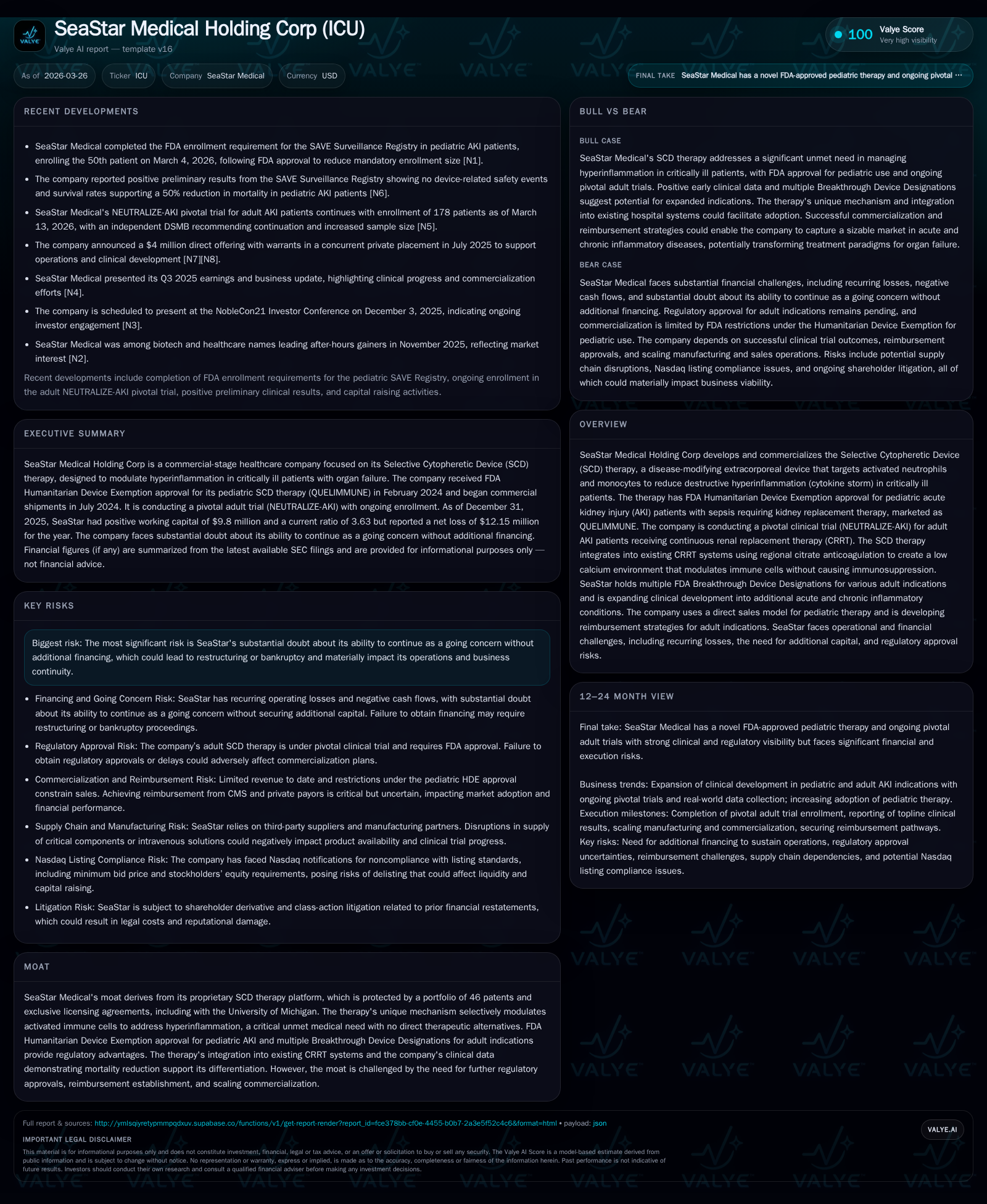
SeaStar Medical Holding Corp has pioneered a distinctive extracorporeal immunomodulation device, the Selective Cytopheretic Device (SCD), with FDA approval for pediatric acute kidney injury patients. The company is advancing adult clinical trials amid multiple FDA Breakthrough Device Designations aimed at broader indications. However, SeaStar faces persistent operating losses, cash flow deficits, and looming doubts about its financial viability without new funding. Its commercialization efforts are constrained by reimbursement challenges and patient registry requirements, underscoring a critical tension between clinical promise and operational sustainability.
Innovating in Immunomodulation: The Story Behind the Selective Cytopheretic Device
SeaStar Medical Holding Corp centers its business around the Selective Cytopheretic Device (SCD), a pioneering extracorporeal therapy designed to mitigate the harmful hyperinflammatory response often referred to as cytokine storm. This pathway involves an overactivation of neutrophils and monocytes—key white blood cells implicated in immune system escalation that can lead to multiorgan failure in critically ill patients. SeaStar’s SCD differentiates by selectively modulating these activated immune cells without inducing broad immunosuppression. The device integrates with existing continuous renal replacement therapy (CRRT) systems through regional citrate anticoagulation that creates a low calcium environment key to its mechanism.
The therapeutic importance of quelling hyperinflammation spans acute kidney injury (AKI), cardiac surgery-associated inflammatory states, cardiorenal syndrome (CRS), hepatorenal syndrome, and potentially chronic kidney disease contexts. SeaStar earned its first major regulatory milestone when the U.S. Food and Drug Administration (FDA) granted Humanitarian Device Exemption (HDE) approval for pediatric AKI patients requiring kidney replacement therapy—a population estimated at under 8,000 annually in the U.S. This approval led to the commercial launch of QUELIMMUNE in mid-2024.
Augmenting its intellectual property moat, SeaStar maintains an extensive patent portfolio comprising 46 patents plus exclusive licenses from the University of Michigan. The platform’s clinical novelty is further endorsed by six Breakthrough Device Designations from the FDA across diverse adult indications. These designations potentially afford expedited pathways toward approval and facilitate more frequent regulatory engagements.
The underlying science leverages nuanced immunomodulation distinct from anti-inflammatory drugs or broad immune suppressants—a critical consideration given that absolute immunosuppression can exacerbate susceptibility to infection in already vulnerable ICU populations.
Historical Financial Performance: Trends in Losses and Operating Cash Flows
Despite its technological promise and initial regulatory foothold in pediatrics, SeaStar’s financial performance over the four fiscal years ending 2025 reflects deep operational challenges. The company has incurred consistent operating losses since at least FY2022 without achieving profitability. Recent annual figures show some improvement yet substantial deficits remain:
Historical performance (annual)
| FY | Net ($mm) | CFO ($mm) | OpInc ($mm) | Net YoY |
|---|---|---|---|---|
| 2025 | -12 | -14 | -12 | +51.1% |
| 2024 | -25 | -16 | -18 | +5.3% |
| 2023 | -26 | -10 | -14 | -14.0% |
| 2022 | -23 | -8 | -12 |
Source: SEC companyfacts cache [F1].
Capital returns and efficiency (annual)
| FY | ROE% |
|---|---|
| 2025 | -116.6 |
| 2024 | 1137.4 |
| 2023 | 189.1 |
| 2022 | 279.5 |
Source: SEC companyfacts cache [F1].
Source: Company filings [F1]
Operating income improved approximately 32% year-over-year in FY2025 compared to FY2024 but remained negative at $12.2 million. Net loss narrowed by over half yet remained sizable at about $12.1 million with operating cash flows sustaining their negative trend alongside modest improvement (+15%). Equity transitioned back into positive territory by end-2025 after years of deficits likely reflecting recent recapitalization efforts.
This financial profile highlights continued heavy investment in research & development and commercialization without sufficient revenue scale—anchored on a limited product portfolio focused on QUELIMMUNE sales within a small pediatric market.
Regulatory Progress and Pipeline Development: Pediatric Launch to Adult Trials
Clinically focused progress marks a critical axis for SeaStar’s outlook. The FDA HDE approval obtained February 21, 2024 authorized commercial introduction of QUELIMMUNE for pediatric AKI patients reliant on CRRT due to sepsis-related conditions [S1]. Post-market obligations under HDE include the SAVE Surveillance Registry collecting safety and effectiveness data during routine use—a process that can slow broader adoption due to required Institutional Review Board approvals across hospitals.
Concurrently pivotal progress is underway for expanding SCD application into adult AKI populations with a multi-center pivotal study named NEUTRALIZE-AKI actively enrolling critically ill adults undergoing CRRT treatment [N1]. Success here is essential for progressing toward conventional FDA Premarket Approval outside rare disease HDE constraints.
Additional exploratory feasibility studies target cardiorenal syndrome patients awaiting left ventricular assist device implantation—an area with significant unmet medical need where inflammation correlates strongly with outcomes.
The six FDA Breakthrough Device Designations spanning these adult indications signal regulatory favor enabling accelerated review phases and more frequent dialogue with regulators; however final approvals depend on robust efficacy data from ongoing trials [S1].
The SCD's design advantage lies in seamless integration into existing CRRT circuits using regional citrate anticoagulation—a factor easing hospital adoption compared with novel extracorporeal devices requiring new infrastructure.
Market Potential and Commercialization Barriers for SCD Therapy
SeaStar faces substantial market opportunities tempered by commercialization challenges typical of innovative critical care devices.
While the total addressable patient population across acute hyperinflammatory states exceeds one million annually in the U.S., target subpopulations like pediatric AKI requiring CRRT remain small (~8k patients/year). Adult indications are larger but require full regulatory clearance beyond HDE status before reimbursement eligibility scales meaningfully.
Hospital uptake encounters inertia driven by procedural complexity; each institution must secure Institutional Review Board approval post-FDA clearance before adopting therapy broadly [S18]. Third-party payor coverage remains uncertain—CMS coding and payment alignment are pending but crucial since reimbursement levels directly influence hospital adoption economics.
Health economic outcome research indicates potential cost savings near $40k per pediatric hospitalization due to shortened length of stay with QUELIMMUNE use—supportive evidence for favorable reimbursement positioning despite current uncertainty [S16], [S15].
Manufacturing scale-up poses another challenge given precision requirements for medical-grade devices integrated into extracorporeal circuits; supply chain disruptions or quality control issues could adversely affect production schedules impacting sales growth and margins.[S20]
Liquidity Challenges and Capital Allocation Priorities
SeaStar reports positive working capital ($13.58 million current assets vs $3.74 million current liabilities as of end-2025) yet minimal cash reserves historically ($51 thousand reported end-2021), reflecting reliance on external financing cycles rather than organic cash generation.[F1],[S2],[S27]
Operating cash flow was deeply negative at nearly $13.6 million for FY2025 despite slight year-over-year improvement indicating sustained heavy outflows linked mainly to R&D investments and commercial build-out amid nascent revenue base.
No dividends or share repurchases have been recorded or indicated; capital allocation prioritizes advancing clinical programs including pediatric commercialization plus adult pivotal trials alongside building internal sales teams following termination of prior distributor agreements.[S13]
Equity returning positive after years of deficit suggests recent recapitalization or restructuring activity but overall financial sustainability remains contingent on securing further funding given ongoing cash burn.[F1]
Risk Profile: Regulatory, Litigation, and Operational Threats
Key risk factors identified throughout recent SEC Annual Reports emphasize substantial doubt about SeaStar’s ability to continue as a going concern absent additional funding—a persistent theme underscoring liquidity fragility amid steep operating losses.[S1],[S2]
Regulatory risks span delays or failures obtaining FDA approvals beyond pediatrics; potential trial enrollment challenges; stringent post-market surveillance demands; evolving healthcare laws restricting marketing activities; and product recall possibilities stemming from manufacturing or design issues.[S4],[S5],[S6],[S7]
Legal exposure includes active stockholder class action alleging securities fraud tied to prior disclosure misstatements culminating in restated financials announced March 2024; companion derivative lawsuit naming officers/directors remains pending resolution with magistrate report recommending dismissal with leave to amend filed early 2026.[S11]
Product liability risks are material given device use in critically ill populations; insurance coverage may be insufficient against such exposures.[S4]
Operational dependence on third-party contractors for manufacturing components introduces supply chain risks affecting production continuity; intellectual property litigation risks also remain inherent given licensed patents central to technology protection.[S24],[S25]
Investor Expectations: What to Watch Next for SeaStar Medical
Looking ahead requires monitoring several key milestones:
- Pivotal NEUTRALIZE-AKI trial readouts remain forthcoming; data supporting safety/efficacy will be pivotal for traditional PMA approval enabling market expansion beyond pediatric HDE use.[N1]
- Progression through CMS coding/payment discussions will critically shape reimbursement landscape impacting commercial adoption rates.[S13],[S18]
- Data accrual within SAVE Surveillance Registry will inform real-world safety/effectiveness insights influencing label extensions or broader acceptance.[N1]
- Financing events remain essential given ongoing cash deficits; potential equity raises or convertible instruments could alter capital structure with dilution implications absent explicit management guidance.[F1],[S2]
- Legal proceeding developments including class action motions may affect near-term shareholder sentiment due to potential indemnity costs or reputational impact.[S11]
- Manufacturing capacity enhancements or supply chain stabilization are crucial for scalable commercial rollout.[S20]
Given SeaStar’s early developmental stage coupled with tight liquidity juxtaposed against promising but unproven adult pipeline expansion prospects investors should weigh operational milestones closely without explicit forward-looking projections provided by management.
Disclaimer: This analysis is based solely on information contained in publicly available regulatory filings and news sources as cited herein dated through March 26, 2026. It does not constitute investment advice or recommendations but aims solely to provide an informed overview of SeaStar Medical Holding Corp's technology platform progress alongside financial and operational context.
Disclaimer: This is research-only, informational analysis and not investment advice. It may include AI-generated interpretation and general industry context. Always verify important details using primary sources.

Comments