
EWSB Bancorp Confronts Profitability Challenges While Fortifying Its Local Banking Niche
An analysis of EWSB Bancorp’s financial setbacks juxtaposed with its strategic reinforcement of community banking roots in Wisconsin.
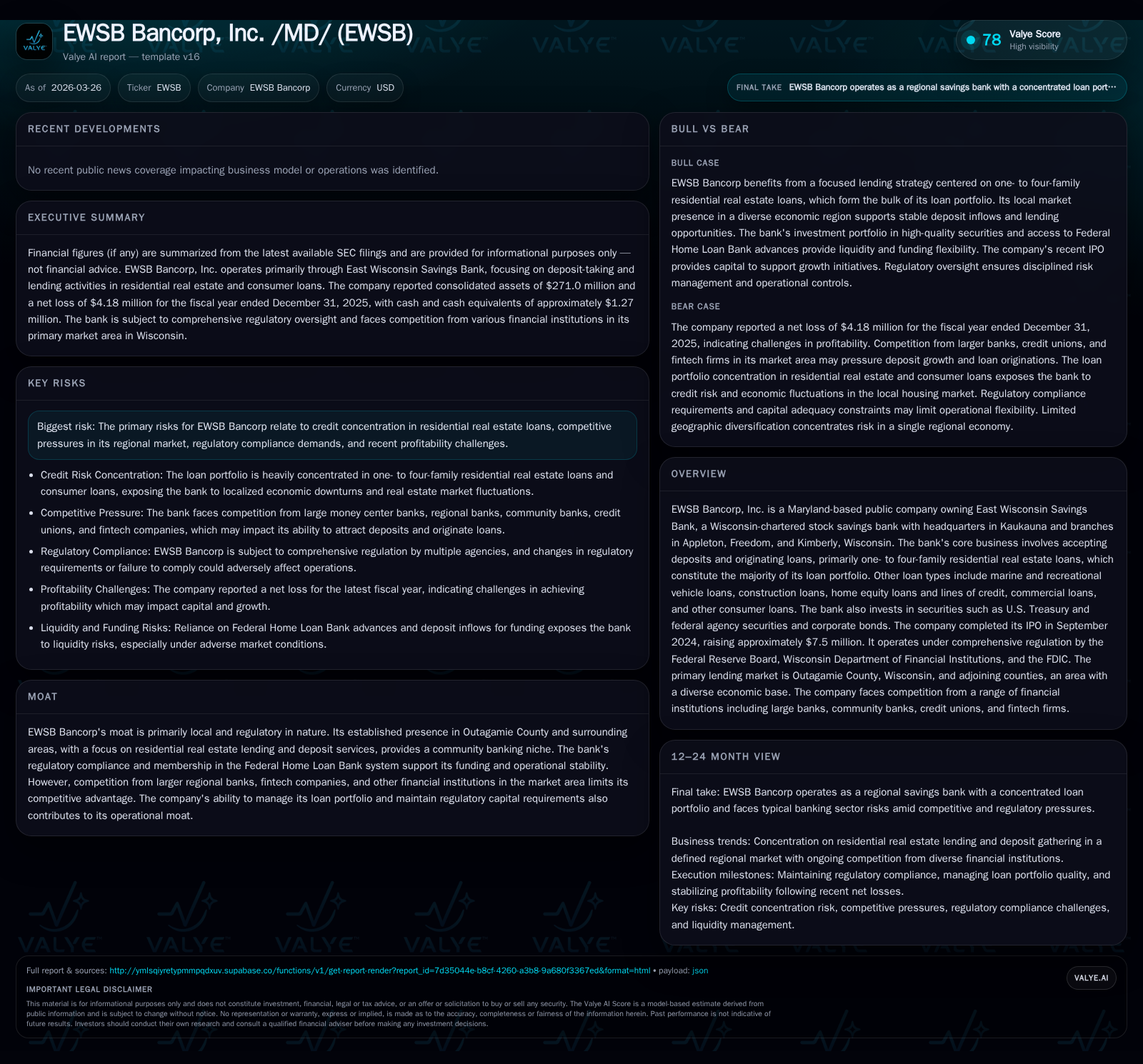
EWSB Bancorp, a Maryland-based holding company for East Wisconsin Savings Bank, has experienced growing net losses since its September 2024 IPO, reflecting operational and competitive pressures. The bank maintains a concentrated loan portfolio dominated by one- to four-family residential real estate loans, exposing it to sector-specific credit risks. Despite these challenges, EWSB upholds conservative capital management and regulatory compliance, underpinning its local market presence with a 5.2% deposit share in Outagamie County. Investors should closely monitor evolving loan quality, deposit dynamics, and capitalization as EWSB balances growth constraints amid intensifying fintech and regional bank competition.
Historic Financial Trajectory: From IPO to Consecutive Losses
Founded as the holding company of East Wisconsin Savings Bank with a Maryland domicile, EWSB Bancorp launched its IPO on September 20, 2024, attracting gross proceeds near $7.5 million through its common stock issuance [S8]. Transitioning from mutual holding status to a fully public stock ownership structure introduced fresh regulatory and shareholder expectations.
Since this pivotal event, the company has struggled to achieve profitability. Fiscal year 2024 closed with a net loss of roughly $1.7 million, which widened substantially to approximately $4.2 million in fiscal year 2025 [F1]. This deterioration reflects intensified operating challenges coupled with competitive pressures within its niche market.
Operating cash flow has shown some relative improvement — shrinking losses from around -$2.22 million in FY2024 to nearly -$1.67 million in FY2025 — yet remains insufficient for self-sustaining operations absent external capital support [F1]. Capital expenditures held steady near $105 thousand per annum over the two years [F1], consistent with typical community bank maintenance levels.
These results yield an estimated return on equity near negative 31.6% for FY2025, underscoring the scale of profitability headwinds given an equity base that contracted from approximately $15.6 million in FY2024 to $13.2 million by end-2025 [F1]. The equity shrinkage partly reflects accumulated losses offsetting initial IPO proceeds.
Residential Real Estate Lending: Core Driver and Risk Concentration
At the heart of EWSB's business is residential real estate lending focused primarily on one- to four-family properties within its regional footprint covering Outagamie County and adjacent areas [S1; S6; S18]. This segment constitutes the largest portion of its loan portfolio and drives net interest income.
The bank also extends credit into related sectors including home equity loans and lines of credit, construction loans, commercial loans, marine and recreational vehicle loans, as well as other consumer financing [S11; S18]. However, commercial exposures remain marginal relative to real estate loans.
Such concentrated credit exposure creates intrinsic risk tied directly to local housing market cycles and property valuation trends, which can swiftly affect collateral adequacy under default scenarios [S18]. The allowance for credit losses stabilized at roughly $1.1 million across 2024–2025 representing about 0.60% of total loans [S17]. This provision is maintained cautiously given observed delinquency rates remain low but sensitive to economic shifts.
Risk disclosures highlight vulnerabilities including potential defaults compounded by declines in residential real estate prices, stressing the importance of active portfolio monitoring and prudent underwriting policy adherence [S1; S4; S18].
Competitive Local Market: Navigating Fintech and Larger Bank Pressures
While EWSB maintains entrenched community ties—operating headquarters plus three branches within Outagamie County—it competes within a fragmented regional landscape featuring national money centers, sizeable regional banks, multiple community banks, credit unions as well as emerging fintech platforms targeting deposit and loan customers [S6].
Based on FDIC data through mid-2025, EWSB held about 5.2% deposit market share in the county ranking eighth out of nineteen banking competitors there [S6]. This modest footprint restricts scalability despite local loyalty advantages.
Competition extends beyond traditional institutions: fintech infiltration lowers barriers via digital onboarding innovations challenging smaller banks' technological agility while large retail banks leverage broader product suites and pricing advantages. Deposit gathering now must contend with money market funds and brokerage-managed cash products siphoning client liquidity away from core banking relationships [S6].
The ability—or inability—to innovate digitally alongside preserving personalized community banking experiences poses a key strategic tension influencing future growth trajectories.
Capital Structure and Allocation: Managing Liquidity, Dividends, and Regulatory Buffers
EWSB sources funding predominantly through deposits totaling approximately $231.5 million at end-2025—a rise from prior years—with certificates of deposit comprising nearly half this total [S23]. Deposits consist mainly of interest-bearing demand accounts supplemented by savings and noninterest-bearing components.
The bank supplements liquidity using borrowings chiefly via Federal Home Loan Bank advances amounting to roughly $38.4 million at year-end 2025 along with unused lines of credit at both the Federal Reserve Discount Window ($25 million) and correspondent federal funds facilities ($6 million), none drawn as of report date [S10; S23].
Capital adequacy is regulated via comprehensive tier 1 capital requirements adjusted by EWSB's election to exclude Accumulated Other Comprehensive Income from CET1 calculations (AOCI opt-out), impacting buffer metrics [S7]. While exact ratios were not furnished explicitly, regulatory compliance remains an ongoing focus supported by moderate equity levels around $13.2 million as noted earlier [F1].
No dividends or share repurchases have been undertaken since the IPO due primarily to continued operating losses consistent with Federal Reserve dividend payout policies restricting payouts absent sustainable earnings streams [S13; S16]. This conservative stance preserves capital amidst uncertain profitability outlooks.
Recent amendment to corporate bylaws removed director residency restrictions previously mandating principal residence within select Wisconsin counties—potentially broadening governance talent pools without diluting local market focus [S3].
Operational Cash Flows and Capital Expenditures: Analyzing Resource Utilization
Operational cash flow dynamics illustrate ongoing challenges converting accounting losses into cash-positive operations. Despite some narrowing YoY CFO deficits—from approximately -$2.22 million in FY2024 down to -$1.67 million in FY2025—negative operating cash flows persist undermining free cash flow generation when coupled with fixed capital spending near $105 thousand annually for branch upkeep and systems infrastructure maintenance [F1; S8; S2].
This free cash flow gap—approximated at -$1.77 million in FY2025—signals reliance on financing activities including capital raises or borrowing accruing regulatory scrutiny concerning liquidity management [F1]. The controlled level of capex is typical for a community bank prioritizing stability over rapid expansion.
Forward Outlook: Regulatory Compliance, Market Risks, and Growth Constraints
Looking forward, management underscores prevailing risks tightly linked to volatile interest rate environments affecting net interest margins and prepayment behavior on mortgage assets which could compress yields [S1]. Closely related are escalating concerns regarding rising loan delinquency rates fueled by inflationary pressures dampening borrower repayment capacity especially on residential mortgage segments.
EWSB remains under regulatory oversight including adherence to a confidential memorandum of understanding jointly overseen by state agencies and FDIC aiming to remediate identified weaknesses prior operational lapses or capital deficiencies [S4]. Failure to meet stipulated corrective actions could invite supervisory sanctions restricting operational leeway.
Competitive pressures exacerbate growth constraints as expanding fintech alternatives erode traditional deposit bases while larger affiliates leverage scale economies inaccessible to smaller players like EWSB fostering margin compression risk [S6]. The localized geographic focus simultaneously offers niche moats but inherently limits expansion scope absent acquisitions or product diversification which currently appear muted ambitions.
Key Metrics Table: Financial Performance Snapshot FY2024–FY2025
Historical performance (annual)
| FY | Net ($mm) | CFO ($mm) | Capex ($) | Net YoY |
|---|---|---|---|---|
| 2025 | -4 | -2 | 104878 | -145.7% |
| 2024 | -2 | -2 | 105913 |
Source: SEC companyfacts cache [F1].
Capital returns and efficiency (annual)
| FY | FCF ($mm) | ROE% |
|---|---|---|
| 2025 | -2 | -31.6 |
| 2024 | -2 | -10.9 |
Source: SEC companyfacts cache [F1].
Note: ROE calculated as annual net income divided by end-of-year equity base according to available data [F1]
What Investors Should Monitor Next: Loan Portfolio Quality, Deposit Trends, and Capital Adequacy
Several critical indicators warrant attention going forward:
- Loan Portfolio Quality: Changes in delinquency rates particularly within residential mortgage segments will signal evolving credit risk profiles amid localized economic shifts.
- Deposit Behavior: Monitoring deposit inflows versus outflows under fluctuating interest rate regimes will gauge core funding stability imperative for liquidity resilience [S14; S15; S19].
- Capital Adequacy: Regulatory capital buffers especially tier 1 ratios influenced by allowance estimates against potential future stresses remain pivotal.
- Regulatory Developments: Any material updates or additional stipulations arising from ongoing memoranda or supervisory findings could impact strategic flexibility.
- Governance Changes: Effects of broader director eligibility post-bylaws amendment on oversight effectiveness may subtly influence operational decisions at board level [S3].
Maintaining careful observation on these metrics will clarify whether EWSB can arrest its profit erosion trend while leveraging its community banking niche amid increasingly complex industry dynamics.
This analysis is based solely on publicly available SEC filings and Valye News research as of March 26th, 2026. It does not constitute investment advice or recommendations.
Disclaimer: This is research-only, informational analysis and not investment advice. It may include AI-generated interpretation and general industry context. Always verify important details using primary sources.

Comments