
Precigen’s Synthetic Biology Platform and Its Revenue Contraction: What Investors Should Know
Precigen’s pioneering gene therapy platform drives innovation amid steep revenue declines and mounting financial pressures.
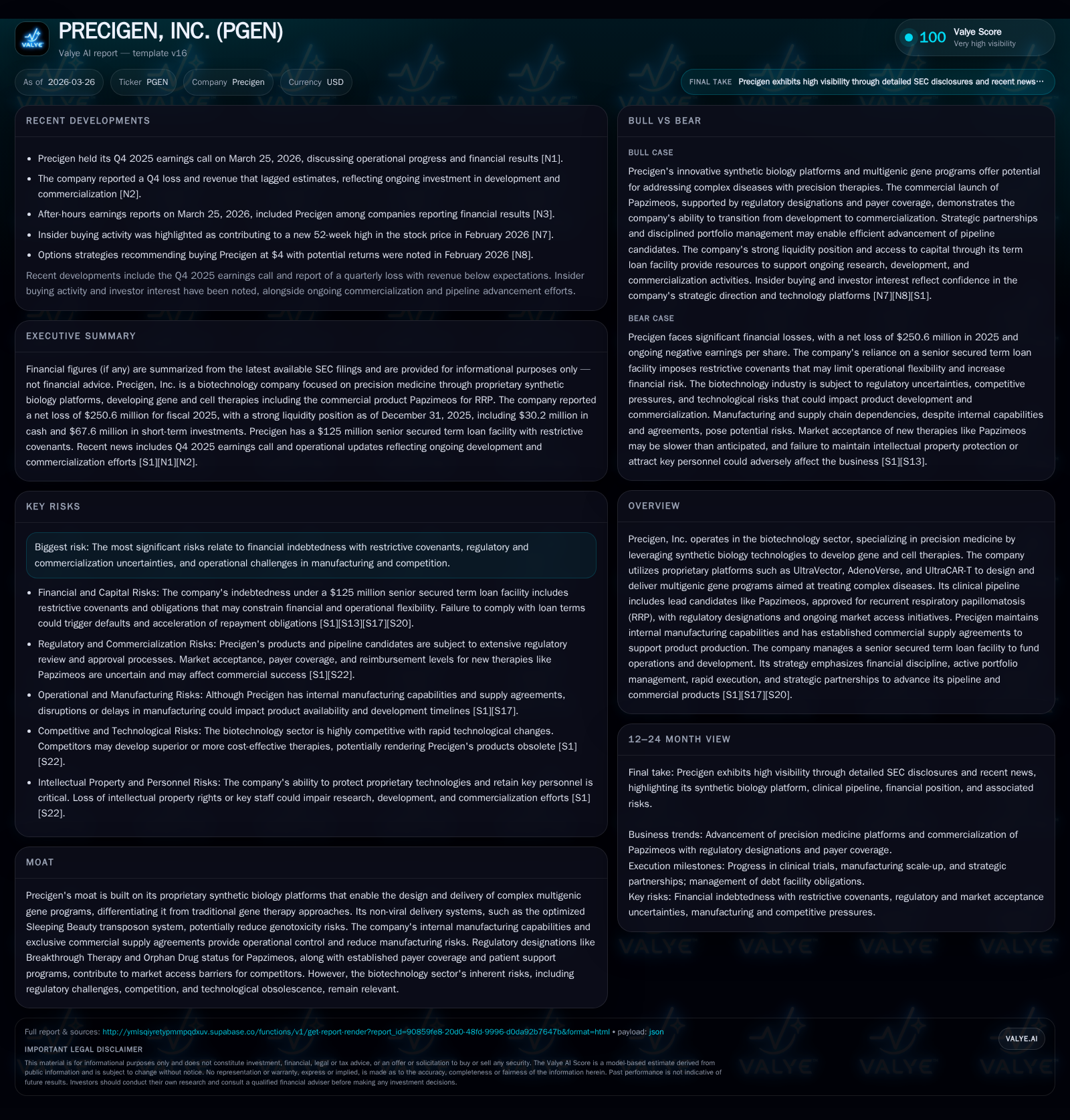
Precigen, Inc. represents a compelling biotech story marked by the FDA approval of Papzimeos for recurrent respiratory papillomatosis, harnessing proprietary synthetic biology platforms. Despite this regulatory milestone, the company faces significant financial headwinds highlighted by a sharp 60.6% revenue drop in recent years and widening operating losses totaling over $110 million in 2025 [F1]. Its capital structure includes a $125 million senior secured term loan with restrictive covenants limiting flexibility [S2,S4,S5]. Future growth hinges on successful commercialization of Papzimeos, advancing clinical candidates leveraging UltraVector and AdenoVerse technologies, and navigating operational challenges inherent in complex gene therapy manufacturing [valye_report_excerpt][N1]. Careful monitoring of emerging milestone achievements and cash flow trends will be pivotal for assessing progress toward sustainable profitability.
Historical Financial Trends Highlighting Growth Drivers and Setbacks
Precigen’s financial trajectory over the past several years paints a picture of sharp revenue contraction paired with intensifying losses. Revenue peaked at $77 million in FY2017 before plummeting to $17 million by FY2019—a 60.6% YoY decline persisting through recent periods (latest reported fiscal year end) [F1]. This precipitous decline reflects a combination of transitioning product and service compositions alongside heavy investments funnelled into clinical development and commercial infrastructure buildout.
Operating income has deteriorated dramatically alongside revenue shrinkage: escalating from negative $33.7 million in FY2018 to a staggering negative $110.5 million by FY2025, marking a -214.2% YoY change [F1]. The widening loss zone compounds the net income starkly, which recorded a $250.6 million deficit as of FY2025—nearly doubling its previous annual loss mark [-98.6% YoY] amidst ongoing R&D expenditures and pre-commercial launches [F1].
Cash flow dynamics underscore continued cash burn stress, with operating cash flow at -$87.8 million in FY2025, slightly outpacing previous year outflows but reflective of strategic capex reduction down to $2 million from near $8.6 million prior year as Precigen tightens its spend profile [F1]. This liquidity squeeze hints at intensifying capital discipline amid costly pipeline advancements.
Historical performance (annual)
| FY | Net ($mm) | CFO ($mm) | Capex ($mm) | Net YoY |
|---|---|---|---|---|
| 2025 | -251 | -88 | 2 | -98.6% |
| 2024 | -126 | -68 | 9 | -31.6% |
| 2023 | -96 | -67 | 2 | -438.7% |
| 2022 | 28 | -65 | 5 |
Source: SEC companyfacts cache [F1].
Capital returns and efficiency (annual)
| FY | FCF ($mm) | ROE% |
|---|---|---|
| 2025 | -90 | -1198.6 |
| 2024 | -77 | -327.8 |
| 2023 | -68 | -80.9 |
| 2022 | -70 | 22.4 |
Source: SEC companyfacts cache [F1].
Revenue contraction parallels amplified operating deficits; capex cuts accompany attempts to conserve liquidity.
Synthetic Biology Platforms Powering the Clinical Pipeline
Central to Precigen’s differentiation is a robust suite of proprietary synthetic biology platforms designed to enable delivery of complex multigenic gene programs unattainable via conventional technologies . The UltraVector platform employs a non-viral Sleeping Beauty transposon system optimized for stable genomic integration while minimizing genotoxicity risks intrinsic to viral vectors—a critical advantage for safety and durability.
Complementing this is the AdenoVerse platform specializing in adenoviral vector engineering optimized for antigen presentation efficacy exemplified by PRGN-2009 targeting HPV16/18 driven malignancies through multi-epitope encoded immunotherapies using proprietary gorilla adenovectors with large payload capacity enabling repeat dosing without neutralization issues [S19].
UltraCAR-T represents their modular chimeric antigen receptor T-cell technology that leverages multigene program design principles allowing combinatorial targeting mechanisms enhancing therapeutic breadth. Collectively these platforms underpin Precigen’s capability to rapidly engineer novel constructs tailored for complex disease targets while maintaining scalability.
This IP portfolio creates moat characteristics reinforced by granted patents on delivery methodologies alongside internal manufacturing ensuring control over quality-critical biologics supply chains—factors that mitigate outsourcing risks commonly faced in cell/gene therapy realms.
Papzimeos Launch and Market Access Initiatives
The approval and launch of Papzimeos stands as a watershed event—being the first FDA-approved treatment for recurrent respiratory papillomatosis (RRP), a rare disease with estimated US adult patient prevalence around 27,000 individuals [S19]. Papzimeos carries regulatory tailwinds including Breakthrough Therapy Designation and Orphan Drug status both in the US and Europe establishing meaningful entry barriers.
Commercialization efforts have been thorough: partnerships with Eversana for U.S. launch support; deployment of targeted field sales teams engaging Integrated Delivery Networks and community physicians; extensive market outreach via Pre-Approval Information Exchanges with payers covering approximately 215 million lives including Medicare/Medicaid participation; plus implementation of Papzimeos Support Programs addressing access hurdles through insurance navigation and financial aid components [S19][N1].
Despite these initiatives generating early demand consistent with expectations nationwide within multi-channel healthcare settings [N1], overall revenue impact remains nascent relative to substantial corporate cost base reflected in continuing losses [F1]. Manufacturing logistics benefit from internal production capabilities coupled with exclusive commercial supply agreements ensuring robustness ahead of scaling challenges.
Financial Position: Debt Structure and Capital Constraints
In September 2025 Precigen entered into a pivotal five-year senior secured term loan agreement totaling up to $125 million structured into an initial $100 million tranche funded immediately plus a delayed draw tranche up to $25 million available through mid-2027 subject to conditions [S2,S4,S5,S6,S7]. The loans bear interest comprising Term SOFR floored at 3.75% plus an added spread of 6.50%, payable quarterly.
Scheduled amortization spans eight equal quarterly installments commencing late 2028 until maturity September 2030 with make-whole provisions guarding lender interests upon prepayment or Change in Control events—underscoring stringent creditor protections typical for high-risk biopharma financing arrangements [S4,S5,S6].
Crucially all U.S.-based assets including intellectual property are pledged as collateral alongside subsidiaries providing guarantees securing obligations effectively restricting corporate operational flexibility significantly through affirmative covenants requiring maintenance of insurance; preservation of critical approvals; compliance statutes; alongside restrictive covenants curtailing new indebtedness incurrence; liens; dividend payments; asset transfers; investment activities; mergers or structural reorganizations without prior consent [S4,S5,S6,S7].
Such covenants create notable execution risk when combined with ongoing cash burn dynamics necessitating scrupulous liquidity management especially given upcoming amortization onset dates concurrent with developmental funding needs.
Future Growth Catalysts and Operational Challenges
Looking forward Precigen’s growth potential hinges primarily on scaling commercial traction of Papzimeos domestically while pressing towards European regulatory approval—the Marketing Authorization Application submitted in late 2025 currently under review marks a key upcoming milestone potentially unlocking broader market penetration there [S19,N1].
Simultaneously advancement of investigational candidates like PRGN-2009 leveraging AdenoVerse technology targeting HPV-related solid tumors represent medium-term value drivers contingent upon positive clinical trial data readouts anticipated per company disclosures [N1]. Operational execution risks persist notably across cell and gene therapy manufacturing scale-up complexities as well as competition from established viral vector developers innovating alternate platform constructs potentially diluting market exclusivity over time.[S25]
Financial constraints stemming from debt servicing obligations restrict additional capital raising options thereby placing premium on disciplined portfolio prioritization aligned with rapid "go/no-go" decision frameworks embodied within Precigen’s active portfolio management tenet described internally to maximize returns on limited R&D budgets [S26].
Capital Allocation Strategy and Shareholder Returns Outlook
Given current operating losses netting over $250 million annually coupled with restrictive debt covenants forbidding dividend issuance or share repurchase initiatives Precigen presently exhibits no direct mechanisms for shareholder returns distribution while focusing capital internally on pipeline maturation efforts [F1][S21]. Reported equity base contraction reflecting cumulative deficit absorption stands at roughly $20.9 million at FY2025 end resulting in an approximate return on equity calculation near -1198.6%, highlighting severe value erosion concerns absent near-term profitability inflection points [F1].
The company opts instead for reinvestment into its platforms prioritizing sustaining operational runway fortified by loan proceeds supplemented potentially by future financing rounds conditioned on pipeline progress yet underscored by tight liquidity covenant ratios necessitating vigilant capital stewardship going forward.
Key Metrics to Monitor in Upcoming Quarters
Market participants should closely track incremental quarterly revenue developments driven by Papzimeos patient uptake velocity alongside expanding payer coverage footprints which critically influence top-line momentum.
Equally important will be analysis of operating cash flow trends serving as bellwethers for near-term liquidity adequacy amid scheduled debt servicing requirements starting in late 2028 horizon.
Clinical milestone achievements particularly interim or final data releases for PRGN-2009 or other UltraVector/UltraCAR-T derivatives will act as valuation catalysts shaping investor sentiment around pipeline viability.
Lastly covenant compliance signals embedded within periodic financial disclosures offer pivotal insight into leverage risk modulation shaping overall credit profile sustainability within current loan facility architecture.
Disclaimer: This report synthesizes publicly available regulatory filings and earnings call transcripts without expressing investment advice or recommendations.
Disclaimer: This is research-only, informational analysis and not investment advice. It may include AI-generated interpretation and general industry context. Always verify important details using primary sources.

Comments