
GENESCO INC's Turnaround: Traction in Retail Amid Tariff Headwinds
GENESCO leverages a diverse brand portfolio and capital discipline to restore earnings while mitigating tariff pressures.
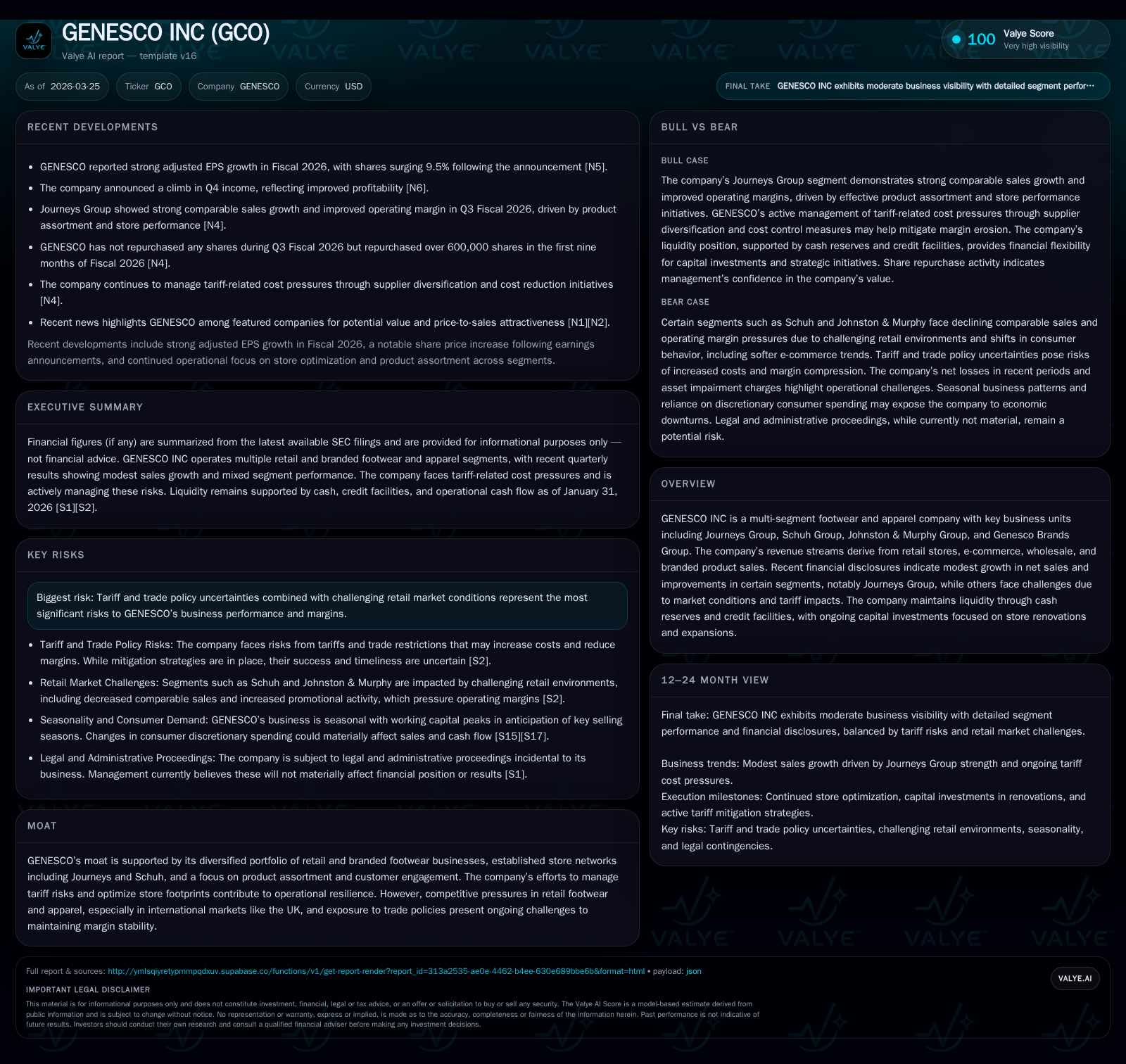
In fiscal year 2026, GENESCO INC demonstrated a modest earnings turnaround driven primarily by its Journeys Group, which posted healthy comparable sales gains. However, tariff-related cost pressures notably affected margins in the Genesco Brands Group. Management pursued active mitigation strategies including supplier diversification and pricing adjustments. Capital allocation prioritized store renovations and measured share repurchases amid cautious liquidity management. Going forward, stability hinges on continued retail execution amidst uncertain trade policy risks.
Revenue Evolution and Segment Performance Highlights FY25–FY26
GENESCO’s fiscal year 2026 revenue remained flat relative to fiscal 2025 at approximately $2.6 billion [F1]. This stability masks divergent segment trajectories underscored by a 6% increase in comparable sales at the Journeys Group—a key growth driver benefiting from strategic emphasis on product assortment and store experience enhancements [S2][N1]. In contrast, Schuh Group contended with a challenging UK retail environment evidenced by a 2% decline in comparable sales compounded by increased promotional activity diluting margins [S2][S29]. Johnston & Murphy Group experienced a 2% comparable sales decline fueled partly by softer e-commerce trends attributed to marketing spend realignments [S2]. Genesco Brands Group posted modest net sales growth of roughly 3% but suffered margin headwinds from tariffs [S2][S13]. Store optimization efforts resulted in net closings that partially offset gains from channel diversification, particularly the strengthening e-commerce performance for Journeys [N1][S28]. This allocation of performance across segments reflects GENESCO’s portfolio effect cushioning overall top-line volatility.
Tariff Impact and Management's Mitigation Initiatives
GENESCO’s cost structure faced substantive pressure due to tariffs enacted by the U.S. government targeting imports from China, Vietnam, Brazil, and India among others—a key input source for its direct sourcing brands constituting roughly 20% of sales [S1][S12]. These tariffs translated into gross margin compression primarily within the Genesco Brands Group as elevated landed costs coincided with ongoing exit costs from certain licenses [S13][S15][S26]. Management responded with multi-pronged mitigations including accelerating or canceling inventory orders, broadening supplier base toward countries subject to lower tariffs, renegotiating factory terms to reduce costs, and contemplating strategic price increases calibrated to market elasticity [S12][S19][S22]. Although these measures helped moderate margin degradation, risks remain pronounced given unpredictability surrounding trade policies and potential reciprocal actions from foreign governments.
Retail Transformation: Store Optimization and E-commerce Growth
GENESCO implemented deliberate store footprint rationalization comprising closures offset partially by new openings—nine closed against four new Journeys stores added during Q2 FY26—with ongoing capital investments channeled mostly into renovations upgrading retail ambience and enhancing consumer engagement metrics such as foot traffic conversion [N1][S28]. The Journeys Group showed significant traction through notably improved comparable sales (+9% in Q2 FY26), underpinned by diversified brand offerings responding well to evolving customer preferences embracing both athletic and casual styles [S28]. Schuh’s e-commerce channel was vital representing over 40% of segment sales but could not fully compensate for declining local currency store sales amid UK market softness [S29]. Johnston & Murphy’s digital channel weakened as marketing resource shifts impacted online engagement adversely [N1][S2]. Overall channel mix evolution highlights the retailer’s transition balancing physical retail renewal alongside digital penetration.
Profitability Trends and Margin Dynamics by Business Unit
Gross margin declined marginally as a percentage of net sales (from approximately 47.8% to 46.8%) due largely to tariff-driven cost escalations within Genesco Brands Group and increased promotional cadence at Schuh designed to maintain consumer relevance amid competitive pressures [S2][N8]. Journeys bucked this trend with lower shipping/warehouse expenses enhancing cost efficiency and enabling better margin stability [S2]. Selling and administrative expenses grew slightly but fell as a percentage of revenue (from roughly 46.1% down to approximately 44.7%), demonstrating expense leverage through occupancy savings and performance-based compensation moderation [S2][S13][F1]. Operating income surged about 24% year-over-year reaching $17.3 million in FY26 while operating margin held just above break-even at approximately 0.7%, reflecting a fragile but recovering earnings profile supported mainly by Journeys operational efficiencies balanced against tariff pain points elsewhere [F1][N8].
Liquidity, Capital Structure, and Balance Sheet Strength
As of January 31, 2026, GENESCO maintained robust liquidity with cash and equivalents at $105 million juxtaposed against current assets of $618.5 million vs current liabilities of $376.3 million yielding a solid current ratio near 1.64 [F1]. Net borrowings under its revolving credit facilities increased moderately especially reflecting US ($65 million) and UK revolver draws ($19.7 million), yet compliance with covenants remained intact under agreements recently extended through January 2031 [S4][S5][S7][S16]. A critical liquidity milestone was realized via receipt of a substantial $58.3 million IRS tax refund related to federal claims dating back several years which notably improved working capital dynamics during FY26 second quarter [S4][S5][S7][N1]. The company expects full collection of remaining accrued interest shortly bolstering short-term asset quality further [S7]. Seasonality influences cash flow timing markedly with operational cash generation concentrated in Q4 fiscal periods.
Capital Allocation: Capex Surge, Buybacks, and Return on Equity
Capital expenditures accelerated significantly (+51%) rising to approximately $62 million in FY26 dominated (~80%) by new store developments and refurbishments aligned with retail transformation goals [F1][S8][S25]. This outlay underscores management’s prioritization on reinvesting in physical assets to enhance consumer experience amid competitive dynamics sharpening post-pandemic retail challenges. Share repurchase activity moderated with $12.6 million spent in FY26 including about 604k shares repurchased at an average price near $20.79/share contrasting prior years’ higher volumes reflective of a more cautious posture preserving liquidity amid external uncertainties [F1][S8][S10]. Return on equity remained low though positive at roughly 2.3%, consistent with an apparel retail operator regaining earnings footing after material losses seen in previous fiscal years but still constrained by uneven margin recovery and capital intensity inherent to ongoing store investments [F1].
Outlook and Benchmark Milestones to Monitor in Fiscal 2027
GENESCO has not provided explicit forward guidance but key milestones for stakeholders include tracking continued leveraging of Journeys’ revenue growth driven by effective store initiatives and product assortment expansion alongside stabilization or improvement of gross margins constrained currently by tariffs [N7][N8][S12]. Further capital allocation transparency regarding buybacks versus reinvestment balances will signal confidence levels in turnaround durability given persistent trade policy uncertainties [N7][N8]. Monitoring progress on tariff mitigation effectiveness such as supply chain diversification success or price increase pass-through rates will be critical alongside evaluated shifts in e-commerce penetration particularly within shoe brands exposed internationally like Schuh where macro trends remain challenging [N1][N7].[analysis note: absent formal guidance we highlight operational KPIs linked to thematic risks]
This analysis presents FACTUAL company data culled strictly from recent SEC filings (10-K/10-Q) alongside reported earnings commentary without any speculative forecasts or investment recommendations. Sector-specific terminology is used thoughtfully to reflect authentic operational insight expected by institutional financial analysts.
Historical performance (annual)
| FY | Net ($mm) | CFO ($mm) | OpInc ($mm) | Capex ($mm) | Net YoY |
|---|---|---|---|---|---|
| 2026 | 13 | 146 | 17 | 62 | +170.2% |
| 2025 | -19 | 88 | 14 | 41 | -12.3% |
| 2024 | -17 | 95 | -13 | 60 | -123.4% |
| 2023 | 72 | -165 | 93 | 60 |
Source: SEC companyfacts cache [F1].
Capital returns and efficiency (annual)
| FY | Buybacks ($mm) | FCF ($mm) | ROE% |
|---|---|---|---|
| 2026 | 13 | 84 | 2.3 |
| 2025 | 10 | 47 | -3.5 |
| 2024 | 32 | 34 | -2.9 |
| 2023 | 77 | -225 | 11.8 |
Source: SEC companyfacts cache [F1].
Note: Fiscal Year ends late January; all figures per SEC filings F1; YoY percentages calculated only where consecutive annual data is available.
Disclaimer: This is research-only, informational analysis and not investment advice. It may include AI-generated interpretation and general industry context. Always verify important details using primary sources.

Comments