
Chenghe Acquisition III Co. Faces Liquidity and Deal Execution Challenges in Its SPAC Lifecycle
The newly public Chenghe Acquisition III Co. has raised $130+ million for a business combination but must overcome competitive acquisition pressures and regulatory hurdles to deliver shareholder value.
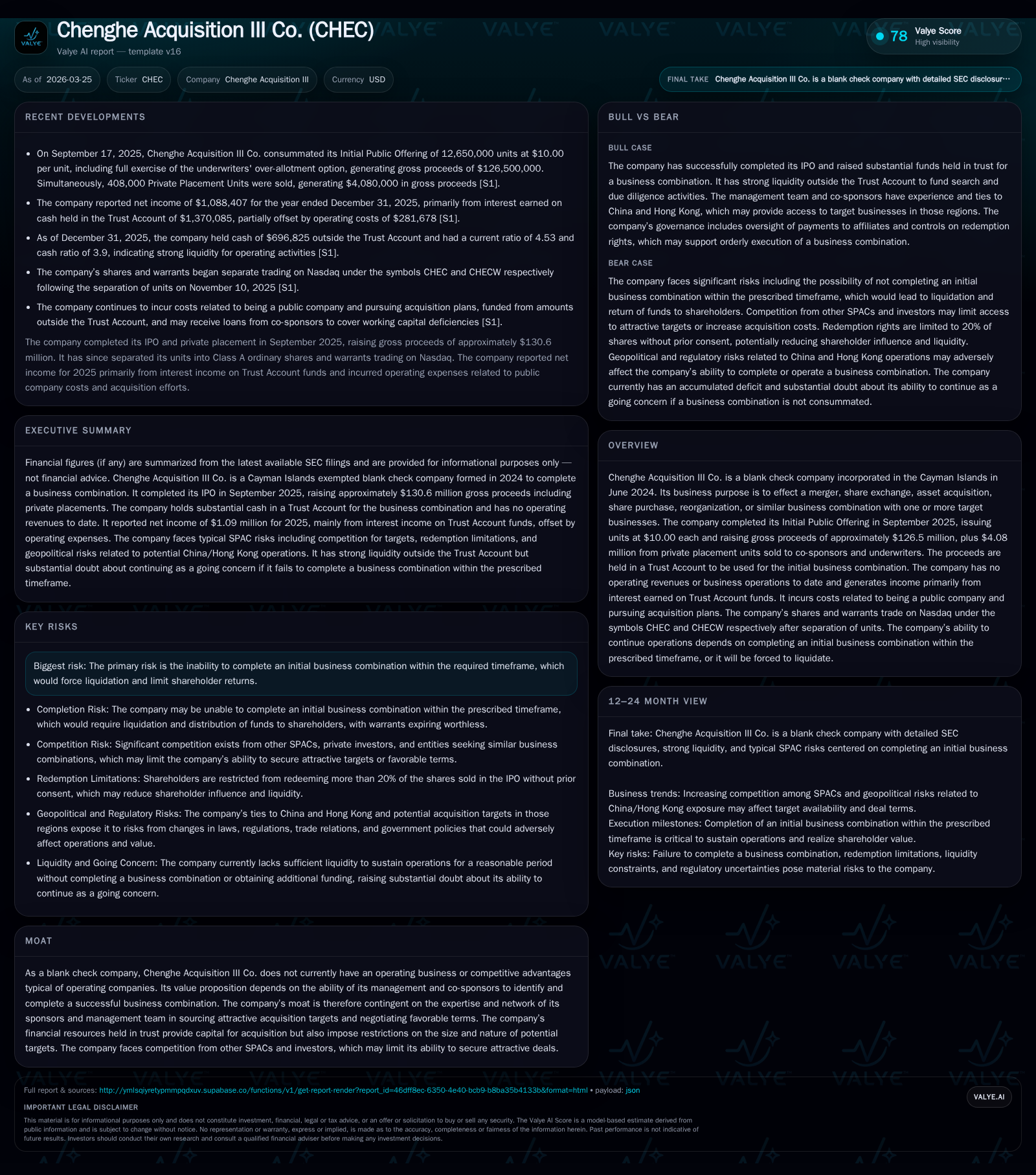
Chenghe Acquisition III Co. launched as a Cayman Islands-registered blank check company in mid-2024 and completed a $126.5 million IPO with additional private placements by September 2025. As a pure SPAC, it currently holds capital in trust with no operating revenues, generating incidental interest income. Its future growth and shareholder returns depend entirely on successfully identifying and completing an initial business combination within the stipulated timeframe. The company faces typical SPAC risks including liquidity constraints, competition among many emerging SPACs for attractive targets, and complex regulatory environments, particularly around potential China-focused deals. As of December 31, 2025, the firm exhibited modest net income from trust interest but negative operating income due to ongoing administrative costs and showed signs of liquidity concerns warranting close monitoring.
Company Overview and Historical Performance
Chenghe Acquisition III Co., incorporated in the Cayman Islands on June 4, 2024, operates as a blank check company (SPAC) formed specifically to identify and consummate a business combination through mergers, asset acquisitions, or similar transactions [S1]. The entity executed its Initial Public Offering (IPO) on September 17, 2025, issuing approximately 12.65 million units (including over-allotment) at $10 each, generating gross proceeds of about $126.5 million [S1]. Alongside this public fundraise, private placement units worth roughly $4.08 million were sold to co-sponsors and underwriters [S1]. The capital raised is primarily held in a Trust Account which currently earns interest; these funds stand earmarked solely for consummation of the initial business combination [S1].
Prior to completing a business combination, Chenghe has no operating revenues or substantive operations beyond those required for organizational maintenance and transaction sourcing [S1]. All financial inflows are derived from investment returns on trust-held funds while costs comprise primarily administrative expenses related to compliance as a newly public entity [S1].
Below is a summary of fiscal year-end financial data that reflects the nascent stage of the company:
Historical performance (annual)
| FY |
|---|
| 2025 |
Source: SEC companyfacts cache [F1].
Net income was positive mainly due to interest income on the Trust Account amounting to approximately $1.37 million in 2025 partially offset by incurred operating costs of about $282k [F1][S1]. Operating cash flow was negative $189.9k reflecting administrative outflows [F1]. The company shows an accumulated deficit exceeding $4.4 million and reported shareholders’ deficit as well implying early-stage losses absorbed through sponsor funding [F1][S7]. As expected for a pre-combination SPAC, these figures are driven more by structure than operational dynamics.
Growth Prospects and Strategic Outlook
Growth prospects for Chenghe hinge wholly on its capacity to identify an attractive acquisition target and successfully complete an initial business combination within the constrained timeline (typically up to 18 months post-IPO) [S1][S15]. The company’s competitive edge depends entirely on its management team’s expertise and sponsor relationships enabling access to high-quality deals.
However, competition among numerous similarly sized SPACs has intensified markedly over recent years raising barriers for finding suitable targets especially given that sizable targets may exceed available financial resources [S15]. The need to offer public shareholders redemption rights in conjunction with any merger further complicates deal negotiations potentially reducing effective deal equity [S15][S27].
From a geographic focus perspective, there is notable sensitivity concerning transactions involving China-based entities where regulatory scrutiny including cybersecurity reviews mandated by PRC authorities presents substantial uncertainty and timing risks post-merger [S8][S16][S18]. Meeting compliance demands under laws such as China’s Cybersecurity Law and Personal Information Protection Law is increasingly complex for foreign-listed companies pursuing such combinations [S9][S16]. These regulatory factors could delay or derail merger completion.
Financial Milestones and What to Monitor
No explicit post-IPO guidance regarding timing or nature of the initial business combination is disclosed beyond standard SPAC timelines [N/A]. Market participants should track proxy materials issuance specifying terms of any proposed merger including redemption mechanisms which influence cash availability.
Investor focus will also be warranted on working capital status given management’s disclosure that liquidity sufficiency over the next twelve months is doubtful absent consummating a business combination or securing incremental funding support [S4][S7]. Sponsor-provided working capital loans up to $1.5 million remain undrawn as of year-end but could be critical if acquisition-related expenses mount unexpectedly [S25][S26].
Given the criticality of timing windows stated explicitly in filings—liquidation triggering after permissible timeframes—it is essential that progress toward target identification and transaction announcement be carefully monitored.
Returns Profile and Capital Allocation Approach
Reflecting its current status as a blank check holding vehicle with no operating assets other than cash equivalents segregated in trust accounts, Chenghe does not distribute dividends or pursue share buybacks at this stage. Instead, available capital is preserved exclusively for acquisition financing or returned pro-rata upon liquidation if no transaction materializes [S12].
Return metrics such as return on equity (ROE) are inherently skewed given accumulated deficits caused by startup costs without offsetting earnings streams; calculated ROE as of end-2025 was negative approximately 24.6% reflecting losses relative to shareholder equity at that date [F1]. This underscores that shareholders’ economic outcomes are fully dependent on realizing value through a successful initial business combination rather than ongoing dividend or buyback programs.
The presence of warrants attached to IPO units introduces dilution potential but also provides leverage upside should post-merger entities trade favorably.
Risks Overview
Core risks faced align with typical SPAC challenges: inability to consummate an initial business combination within established deadlines would trigger mandatory liquidation returning only Trust Account funds less expenses thus limiting shareholder returns significantly [S1][S5][S6][S10].
Competition from an increasingly crowded field exacerbates deal sourcing difficulty while potentially elevating acquisition costs [S15]. Regulatory uncertainties especially relating to China-based targets intersect timing certainty—cybersecurity review delays, antitrust filings, data privacy compliance could stall deals beyond permissible windows causing forced liquidation scenarios despite investor preference otherwise [S8][S9][S16][S18][S20][S21].
Moreover, the Company’s Cayman Islands incorporation may make U.S.-based investors relatively vulnerable when asserting shareholder rights compared with domestic firms due to jurisdictional enforcement limitations stated explicitly under legal risk disclosures [S8]. The absence of certain traditional blank check company investor protections owing to exemptions from SEC Rule 419 also concentrates risk particularly impacting redemptions procedures amid shareholder votes [S27][S28].
Operational risks include loss or deferral of interest income should market rates fluctuate or cash balances temporarily reduce prior to completing a deal.
Industry Context (Analysis)
The special purpose acquisition company space remains heavily saturated with many vehicles targeting diverse industries but often encountering convergence around technology-enabled sectors or China-investment themes given global growth narratives. This dynamic inflates valuations making it harder for new entrants like Chenghe Acquisition III Co., which raised moderate IPO proceeds (~$130M total) compared with mega-SPACs aiming at large-cap deals with hundreds of millions or billions in dry powder.
China regulatory tightening across cross-border listings has elevated due diligence complexity; prospective acquirers face multi-layered approval processes delaying transactions upwards of several months beyond typical U.S.-centric mergers despite accelerated timelines embedded within SPAC agreements—a structural tension influencing bid strategy considerably.
Conclusion
Chenghe Acquisition III Co., as a freshly minted SPAC with substantial capital raised but no operational revenues or assets beyond trust cash balances earning nominal interest, epitomizes both opportunity and precariousness inherent in blank check companies targeting high-growth acquisitions amid evolving geopolitical contexts. Its future depends almost exclusively on acquiring attractive businesses expeditiously within regulatory frameworks while managing liquidity prudently.
Investors evaluating this entity should follow developments closely around target announcements, shareholder vote proxy releases detailing redemption rights mechanics, liquidity status updates especially working capital loan draws if any occur, and emerging legal/regulatory news impacting China-focused transactions.
This report is based solely on publicly available filings up to March 25, 2026 ([F1],[S#]). It does not include investment recommendations or price targets.
Disclaimer: This is research-only, informational analysis and not investment advice. It may include AI-generated interpretation and general industry context. Always verify important details using primary sources.

Comments