
Foresight Autonomous Advances 3D Vision and V2X Safety Amid Narrowing Operating Losses
The company shows progress in commercial partnerships and technology validation while managing ongoing losses and securing cash runway through mid-2026.
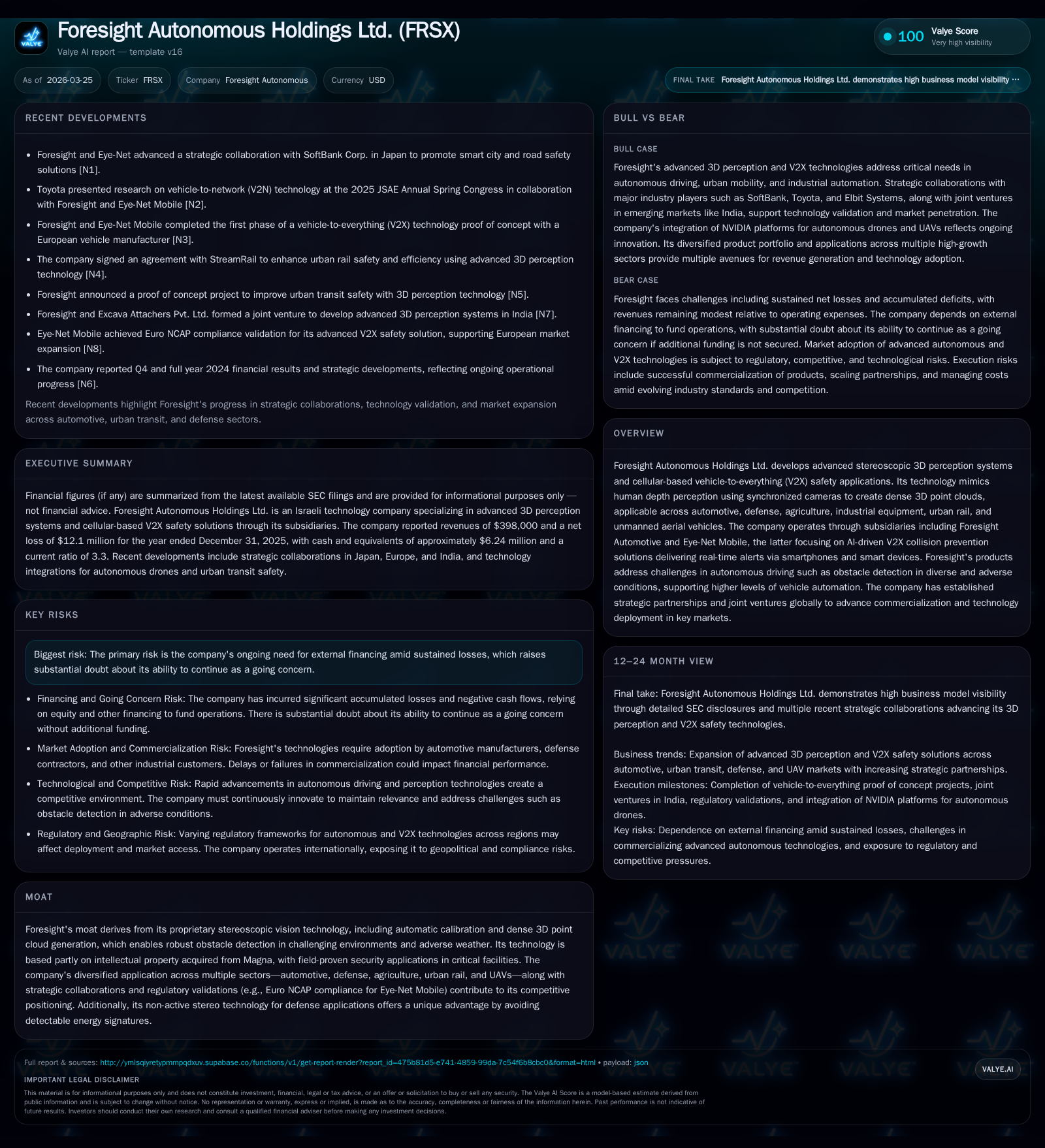
Foresight Autonomous Holdings Ltd. develops advanced 3D perception systems and AI-driven cellular V2X applications targeting automotive, defense, and industrial sectors. Despite ongoing operating losses and minimal revenue, the company has reduced its operating deficit modestly while progressing commercialization through key partnerships. Cash resources are sufficient into mid-2026, but sustained external financing remains essential given persistent negative cash flows. The company’s core value propositions include proprietary stereoscopic vision with dense 3D point clouds and regulatory validations for collision prevention technologies. Risks primarily revolve around capital availability and competitive technological developments.
Historical Financial Performance
Foresight Autonomous Holdings has experienced sustained operating losses typical of early-stage technology developers moving toward commercialization. Operating income losses have improved moderately from -$17.45 million in FY2022 to -$12.18 million in FY2025—a roughly 30% reduction over three years—while net losses narrowed from -$21.68 million to -$12.10 million over the same period [F1].
Revenue remains modest relative to expenses: approximately $120,000 was reported at the end of 2021, with incremental revenues totaling around $398,000 for FY2025 primarily generated from Proof-of-Concept projects with industry players such as Elbit and European Tier-1 automotive suppliers [F1][S13]. Operating cash flow improved slightly but remained negative at about -$10.45 million in FY2025.
Capital expenditures declined substantially from $313,000 in FY2022 to just $25,000 in FY2025, indicating reduced investment aligned with maturing product development stages [F1]. Despite this reduction, free cash flow continues to be deeply negative.
Historical performance (annual)
| FY | Net ($mm) | CFO ($mm) | OpInc ($mm) | Capex ($) | Net YoY |
|---|---|---|---|---|---|
| 2025 | -12 | -10 | -12 | 25000 | -8.7% |
| 2024 | -11 | -11 | -13 | 62000 | +39.5% |
| 2023 | -18 | -15 | -16 | 124000 | +15.1% |
| 2022 | -22 | -17 | -17 | 313000 |
Source: SEC companyfacts cache [F1].
Capital returns and efficiency (annual)
| FY | FCF ($mm) | ROE% |
|---|---|---|
| 2025 | -10 | -194.2 |
| 2024 | -11 | -183.6 |
| 2023 | -15 | -119.6 |
| 2022 | -17 | -76.5 |
Source: SEC companyfacts cache [F1].
Note: Revenue figures for some years are partial or unavailable; emphasis is on operating metrics.
Technology Overview and Market Applications
Foresight's core technology leverages proprietary stereoscopic vision systems that emulate human depth perception using synchronized cameras generating dense three-dimensional point clouds through automatic calibration algorithms robust under adverse weather and lighting conditions [S1].
This technology finds applications across automotive ADAS components advancing autonomous capabilities; defense sectors requiring non-active stereo perception for stealth operations; agriculture and heavy machinery automation enhancing operator safety; urban rail transit obstacle detection; and UAV situational awareness integration.
Their majority-owned subsidiary Eye-Net Mobile develops AI-powered cellular V2X solutions delivering real-time pre-collision alerts through existing cellular networks to smartphones and vehicle-integrated smart devices — extending awareness beyond line-of-sight sensor limitations.
Eye-Net Mobile's solutions have achieved regulatory validation consistent with Euro NCAP standards for automotive safety — an important milestone bolstering commercial credibility [S1].
Commercialization Milestones and Partnerships
Recent progress includes a strategic partnership with a leading Japanese manufacturer focused on deploying smart city infrastructure solutions integrating Foresight's stereoscopic perception technology for enhanced road safety applications [S2].
Additional Proof-of-Concept collaborations involve Eye-Net Mobile working with European Tier-1 automotive suppliers and OEMs on cellular collision prevention systems tested under controlled environments showing promising results for scale-up [S13].
The company also benefits from prior joint development agreements supporting technology transfer within China-Israel innovation ecosystems [S1], positioning it well across diverse geographic markets.
Expense Management and R&D Outlook
Research and development expenses decreased slightly from approximately $9.14 million in FY2024 to $8.63 million in FY2025 due primarily to reductions in payroll-related costs and subcontracted research services [S4][F1]. This reflects a strategic shift toward finalizing commercialization-ready products.
Sales and marketing expenses increased modestly by about 6.9%, supporting expanded commercial outreach activities including exhibitions and consulting engagements linked with new market entries such as Japan and Europe [S4].
General and administrative expenses fell marginally by around $64 thousand (-2.4%), evidencing prudent overhead control during expansion phases [S4].
Capital Structure and Liquidity Position
As of December 31, 2025, the company held approximately $6.3 million in cash and equivalents against current liabilities near $2.07 million — resulting in a current ratio around 3.3x providing short-term liquidity comfort [F1][S8]. However, this is offset by ongoing negative operating cash flows near $10.45 million annually necessitating continued external financing.
Capital expenditures remain low relative to earlier years ($25K vs $313K in FY2022), mostly spent on corporate IT assets and research equipment rather than manufacturing capacity expansion [F1][S13].
Financing activities generated net proceeds of about $9.48 million during FY2025 primarily via equity placements through sales agreements facilitated by AGP/Alliance Global Partners alongside institutional funding rounds targeting Eye-Net Mobile subsidiaries [S8][S18].
Nonetheless, filings disclose "substantial doubt" regarding the company's ability to continue as a going concern without successful future capital raises given accumulated losses exceeding $143 million since inception [S8].
Outlook and Risks
Growth prospects hinge on converting recent partnerships into scalable recurring revenues particularly within emerging smart city infrastructure segments where stereoscopic vision complements IoT connectivity platforms [S2]. Incremental POC successes across European automotive supply chains further support pipeline expansion though conversion timing remains uncertain.
Regulatory certifications such as Euro NCAP approvals enhance product credibility but adoption depends on OEM acceptance cycles amidst stiff competition featuring lidar/radar fusion technologies.
Financial risks center on sustained capital availability given persistent operating deficits; failure to secure funding could constrain R&D progress or force operational downscaling impacting technological competitiveness.
Market risks include evolving regulatory environments across jurisdictions potentially delaying broader deployments despite technical validation.
Key Investor Considerations
Investors should monitor:
- Quarterly cash burn trends relative to current baselines (~$10 million annually),
- Commercial contract announcements especially related to the Japanese partnership,
- Regulatory approvals beyond existing certifications,
- Fundraising outcomes supporting Eye-Net Mobile growth,
- Expense management balancing R&D focus against increased sales activities,
- Competitive dynamics affecting adoption within autonomous vehicle perception markets,
- Updates clarifying going concern status providing visibility into capital runway extensions.
This analysis is based exclusively on SEC filings up to March 25, 2026 ([F1], [S#]) without speculative forecasts or invented data.
Disclaimer: This is research-only, informational analysis and not investment advice. It may include AI-generated interpretation and general industry context. Always verify important details using primary sources.

Comments