
MaxCyte Navigates Revenue Decline Amid Continued Operating Losses and Strategic R&D Investment
MaxCyte leverages its proprietary Flow Electroporation® platform to support cell therapy development, facing financial challenges amid evolving market and regulatory dynamics.
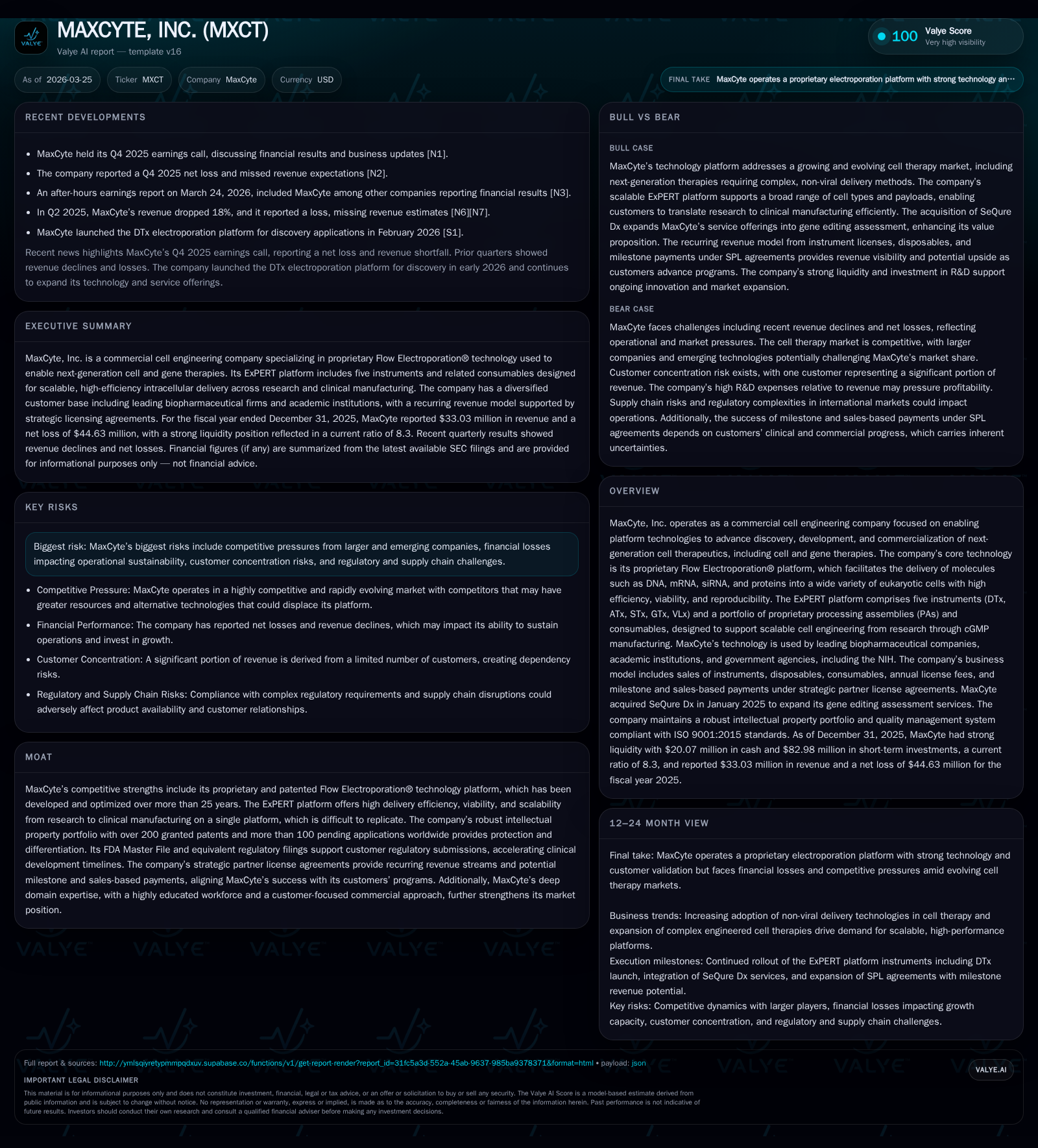
MaxCyte, Inc. operates the Flow Electroporation® platform used in next-generation cell and gene therapies. Despite technological leadership developed over two decades, annual revenue declined from $44.3 million in 2022 to $33.0 million in 2025, with operating losses exceeding $50 million annually. The company faces growth constraints related to customer concentration, competition, and the early-stage nature of its biopharma customers. Investments continue in R&D and manufacturing scale-up, including the recent launch of the DTx platform in early 2026. MaxCyte maintains strong liquidity but remains unprofitable with ongoing negative cash flows.
Historical Performance
MaxCyte has developed its proprietary Flow Electroporation® technology over more than two decades to enable delivery of molecules into living cells for therapeutic and research applications. This technology underpins the ExPERT platform family—comprising five instruments designed to enable scalable cell engineering across discovery through cGMP manufacturing stages.
Financially, MaxCyte’s revenue declined steadily from $44.3 million in FY2022 to $33.0 million in FY2025, a reduction of approximately 25% over four years (see table below). Operating income remained deeply negative during this period, worsening slightly from -$51.2 million in FY2024 to -$51.9 million in FY2025. Net losses totaled approximately -$44.6 million in FY2025, contributing to an accumulated deficit exceeding $261 million as of December 31, 2025 [F1][S1].
Historical performance (annual)
| FY | Rev ($mm) | Net ($mm) | CFO ($mm) | OpInc ($mm) | Rev YoY | Net YoY |
|---|---|---|---|---|---|---|
| 2025 | 33 | -45 | -34 | -52 | -14.5% | -8.7% |
| 2024 | 39 | -41 | -28 | -51 | -6.4% | -8.3% |
| 2023 | 41 | -38 | -22 | -48 | -6.7% | -60.9% |
| 2022 | 44 | -24 | -15 | -27 |
Source: SEC companyfacts cache [F1].
Capital returns and efficiency (annual)
| FY | FCF ($mm) | ROE% |
|---|---|---|
| 2025 | -36 | -26.0 |
| 2024 | -29 | -19.9 |
| 2023 | -25 | -16.3 |
| 2022 | -33 | -9.3 |
Source: SEC companyfacts cache [F1].
Annual figures demonstrate persistent operating losses despite declining capital expenditures.
Business Model and Technology
MaxCyte’s core offering is the patented Flow Electroporation® system embedded within its ExPERT platform series (DTx™, ATx™, STx™, GTx™, VLx™). These instruments facilitate efficient intracellular delivery of genetic materials such as DNA, mRNA, siRNA, and proteins into diverse eukaryotic cells with scalability suited for laboratory research through clinical and commercial manufacturing [S1].
Revenue streams derive from sales and licensing of instruments under strategic partner license (SPL) agreements as well as recurring sales of proprietary processing assemblies (PAs) and consumables [S1][N1]. SPL agreements typically include milestone payments tied to customers’ clinical progress.
The company launched the DTx electroporation platform for discovery applications in early 2026 as part of efforts to expand product offerings [N1][S1]. However, commercial approval of products incorporating MaxCyte’s technology remains limited.
Market Opportunity and Growth Prospects
Cell therapy is a rapidly growing sector within regenerative medicine encompassing gene therapies and immuno-oncology treatments with substantial investment activity—estimated at $11 billion industry-wide raised in 2025 [S1]. MaxCyte’s platform acts as an enabling technology within this ecosystem.
Growth drivers include expanding adoption by academic institutions, biotechnology/pharmaceutical companies, and government agencies such as NIH [S1]. Regulatory filings referencing MaxCyte’s FDA Master File support accelerated clinical development by customers.
Challenges include concentrated customer exposure—with one key customer accounting for more than half of accounts receivable—posing revenue risk [S2][S17]. Competition arises from larger players developing alternative transfection technologies or internal capabilities [S22]. Market dynamics depend heavily on successful clinical outcomes by end-users; any setbacks could reduce milestone revenues and hinder partnerships [S13].
International expansion faces regulatory complexities where establishing Master or Technical Files analogous to U.S FDA filings may be incomplete or absent, limiting uptake outside key markets [S13].
Compliance with evolving healthcare laws—including anti-kickback statutes and data privacy regulations such as HIPAA/CCPA/CPRA—is essential amid increasing operational complexity [S4][S6][S9][S24].
Financial Outlook and Milestones
The company has not provided explicit forward-looking financial guidance recently [N1][N2][S3]. It plans increased research and development spending to support new product introductions and enhancements alongside scaling manufacturing capabilities [S21]. Key performance indicators include:
- Advancement of SPL milestones tied to partner clinical trial progress,
- Adoption rates for new platforms like DTx™ among discovery customers,
- Stabilization or reversal of revenue decline,
- Expansion into additional geographies via regulatory file establishment,
- Management of expense growth aligned with R&D scaling.
Capital Allocation and Cash Flow
At year-end 2025, MaxCyte held approximately $20 million in cash and equivalents with current assets exceeding current liabilities by more than eightfold—indicating solid short-term liquidity despite ongoing losses [F1][S11].
Capital expenditures have fallen sharply from around $18 million in FY2022 to below $2 million annually more recently as infrastructure investments mature [F1]. Operating cash flow remains deeply negative at approximately -$34 million in FY2025 due principally to sustained R&D expenses (~$20 million annually) and operational costs without offsetting profits [F1][S21].
No dividends or share repurchase programs have been announced; capital allocation prioritizes technology development, patent portfolio upkeep (with over 200 patents granted globally), manufacturing scale-up including ISO9001-certified facilities, and marketing expansion including international sales channels [S21][S22].
Investors should monitor potential dilution risks if further financing becomes necessary given ongoing cash burn.
Risks Summary
Risks extensively outlined include:
- Continued financial losses challenging operational sustainability absent significant near-term revenue improvements;
- Customer concentration exposing revenue volatility if major partners reduce engagement;
- Regulatory complexity particularly abroad possibly restricting market access;
- Legal liabilities related to product use or intellectual property disputes;
- Supply chain risks stemming from reliance on single-source suppliers for critical components [S17];
- Competitive innovation pressures amid rapid technological advances;
- Increasing compliance costs related to data privacy/security frameworks affecting clinical data handled by customers [S24].
Conclusion
MaxCyte operates a specialized niche within the advancing cell therapy ecosystem through its proprietary electroporation technology designed for scalable application across research to GMP manufacturing—a defensible position bolstered by extensive intellectual property.
Nevertheless, financial results reflect challenges converting technological advantages into sustainable top-line growth sufficient to offset heavy operational expenditures resulting in persistent net losses exceeding $40 million annually alongside declining revenues.
Customer concentration heightens execution risk while competitive forces further complicate commercial momentum prospects. The introduction of the DTx instrument broadens offerings but meaningful revenue contributions will likely require extended timelines given inherent biopharma development cycles. Liquidity appears adequate for near-term operations; however, sustaining activities depends on leveraging milestone payments linked to partner successes plus potential strategic collaborations or capital raises. Overall, MaxCyte exemplifies a late-stage enabler balancing innovative promise against cyclical industry constraints, regulatory complexities, and capital-intensive operations.
Disclaimer: This analysis is based solely on information available as of March 25, 2026 including SEC filings and publicly released company disclosures; it does not constitute investment advice or recommendations.
Disclaimer: This is research-only, informational analysis and not investment advice. It may include AI-generated interpretation and general industry context. Always verify important details using primary sources.

Comments