
Nexalin Technology’s Transition from Legacy CES to Next-Gen Neurostimulation
From its original cranial electrotherapy stimulation device to developing advanced, high-amplitude bioelectronic neurostimulation products, Nexalin is pursuing FDA clearance amid operational losses and regulatory complexity.
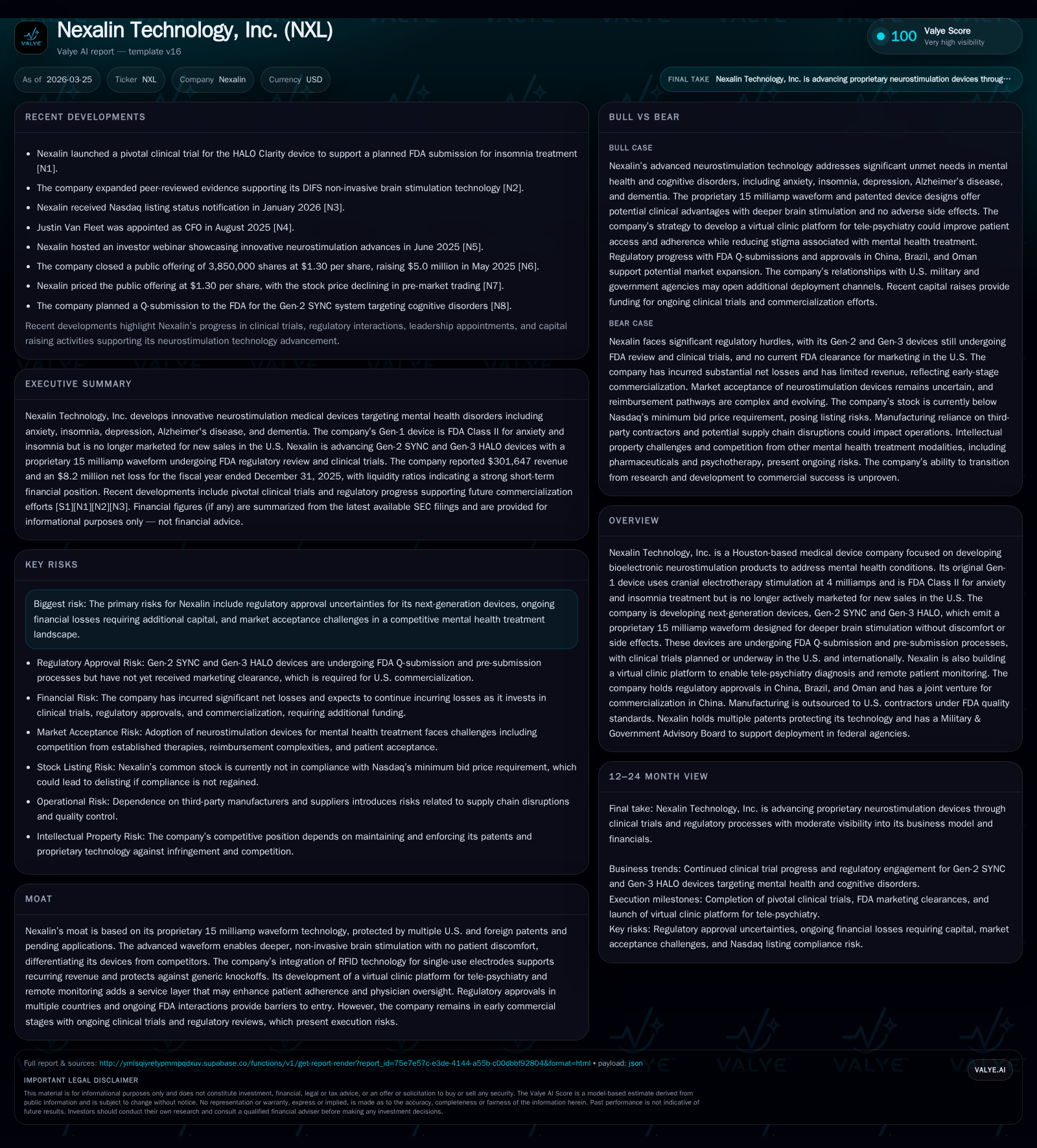
Nexalin Technology, Inc. has experienced modest revenue growth driven by legacy Gen-1 device sales and recurring electrode revenues, despite halting new U.S. sales following the FDA's 2019 reclassification. The company is pivoting toward its proprietary 15 mA waveform devices, Gen-2 SYNC and Gen-3 HALO, currently in FDA Q-submission and clinical trial stages, signaling a significant technological evolution aimed at deeper brain stimulation without discomfort. Financially, Nexalin continues to operate at substantial net losses with constrained cash resources, requiring further capital to support ongoing R&D and commercialization efforts. The firm’s competitive edge rests on patented waveform technology combined with RFID-enabled consumables and an emerging virtual clinic platform designed for telepsychiatry integration.
From Gen-1 to Gen-3: Timeline and Drivers of Growth
Nexalin Technology initially developed its Generation 1 (Gen-1) cranial electrotherapy stimulation (CES) device designed to treat anxiety, insomnia, and depression through non-invasive bioelectronic neuromodulation at a 4 milliamp current output. Following an FDA reclassification in December 2019, the Gen-1 device was designated as a Class II device for anxiety and insomnia treatment but requires Class III approval for depression indications [S1]. As a result, Nexalin ceased active marketing of new Gen-1 units in the U.S., limiting new sales opportunities.
The company continues to generate revenue primarily from licensing fees tied to previously sold or leased Gen-1 devices alongside sales of consumable electrodes embedded with RFID technology that enable single-use tracking—supporting recurring revenue streams despite halted hardware sales [S1].
Financial results reflect this transitional phase with revenues rising from $168.7k in FY2024 to $301.6k in FY2025—a significant approximate 79% year-over-year increase—but still modest relative to development costs and operational expenditures [F1]. This growth stems mainly from incremental consumable sales rather than broad product adoption.
Historical performance (annual)
| FY | Rev ($) | Net ($mm) | CFO ($mm) | OpInc ($mm) | Rev YoY | Net YoY |
|---|---|---|---|---|---|---|
| 2025 | 301647 | -8 | -5 | -8 | +78.8% | -8.1% |
| 2024 | 168721 | -8 | -4 | -8 | +52.3% | -63.6% |
| 2023 | 110748 | -5 | -4 | -6 | -91.6% | -173.8% |
| 2022 | 1321357 | -2 | -2 | -2 |
Source: SEC companyfacts cache [F1].
Capital returns and efficiency (annual)
| FY | ROE% |
|---|---|
| 2025 | -219.4 |
| 2024 | -206.9 |
| 2023 | -145.0 |
| 2022 | -31.0 |
Source: SEC companyfacts cache [F1].
Latest figures indicate ongoing operational losses despite top-line improvements; liquidity remains sufficient while cash runway is limited.
Strategic Shift: Innovation in Device Technology
In response to halted U.S. marketing of its Gen-1 product due to regulatory changes requiring Class III certification for depression treatment devices under the FDA’s framework [S1], Nexalin has developed next-generation devices: Generation 2 SYNC and Generation 3 HALO headsets utilizing a proprietary waveform at approximately 15 milliamps output—significantly higher than prior levels—to achieve deeper cortical stimulation without patient discomfort.
The company is actively engaged with the FDA through the Q-submission process—a formal pre-submission consultation allowing feedback on classification pathways and regulatory requirements—aiming for De Novo clearance where possible rather than more burdensome Premarket Approval (PMA) routes [S1].
Navigating these regulatory complexities involves addressing evidentiary standards for efficacy and safety across mental health indications such as insomnia and anxiety while managing risks inherent to neuromodulation technologies.
Clinical Milestones: HALO Clarity Trial
In February 2026, Nexalin initiated a pivotal clinical trial named HALO Clarity targeting moderate to severe insomnia patients as part of preparation for a planned De Novo submission with the FDA [N1][S3]. This trial is designed to evaluate safety and effectiveness using objective sleep quality metrics alongside patient-reported outcomes.
Successful trial completion represents a critical milestone expected to enhance prospects for marketing approval beyond legacy device usage limited by prior regulatory constraints.
Financial Profile: Losses and Liquidity
Nexalin recorded net losses around $8.22 million in FY2025 compared to $7.61 million in FY2024 reflecting sustained investment in R&D and clinical programs alongside limited revenues [F1]. Operating cash flow declined approximately 25.7% year-over-year to nearly negative $5 million indicating intensified cash burn.
At year-end FY2025 the company reported cash and equivalents of approximately $655k against current liabilities below $900k yielding a strong current ratio near 4.85x but signaling limited absolute cash reserves requiring imminent capital raising efforts to fund ongoing operations [F1][S1].
Competitive Advantages: Patented Waveform & Recurring Revenue Model
Nexalin’s core differentiation lies in its proprietary high-amplitude waveform technology delivering roughly three times the current of legacy CES devices without discomfort—a potential driver of improved therapeutic efficacy across multiple mental health indications [S1].
The integration of RFID-enabled single-use electrodes creates recurring consumable revenue streams while erecting barriers against generic competition.
Additionally, Nexalin is developing a virtual clinic platform incorporating telepsychiatry diagnostics and remote monitoring intended to enhance clinician oversight and patient adherence—extending beyond hardware into digital health service offerings [S1].
Global Regulatory Footprint & Market Strategy
While U.S. commercialization hinges on successful pivotal trials and FDA clearance amidst complex regulatory landscapes [S1], Nexalin holds approvals or strategic presences in jurisdictions including China (via joint ventures), Brazil, and Oman providing diversified market access channels with varying regulatory demands [S1].
Trade tensions such as U.S.-China tariffs may pose supply chain cost pressures but also underscore the importance of multi-jurisdictional strategies [S2].
The company leverages these international footholds alongside digital health initiatives to mitigate dependency on protracted U.S approval timelines.
Outlook & Key Value Drivers
Investors should monitor key catalysts including:
- Pivotal data readouts from the HALO Clarity trial impacting De Novo submission timing,
- Outcomes from ongoing FDA Q-submission engagements clarifying final regulatory pathways,
- Progression towards commercial launch preparations,
- Capital raising activities essential for sustaining development and commercialization efforts,
- Deployment status of the virtual clinic platform augmenting product offerings.
These milestones carry execution risks related to regulatory uncertainties inherent in neuromodulation device categories as well as reimbursement challenges amid healthcare cost containment trends documented in SEC risk disclosures [S15][S16]. Careful assessment of these developments will clarify Nexalin's path toward scaling beyond its current developmental stage.
Disclaimer: This report is based solely on publicly available information including SEC filings dated through March 25th, 2026 and news releases without investment advice or recommendations.
Disclaimer: This is research-only, informational analysis and not investment advice. It may include AI-generated interpretation and general industry context. Always verify important details using primary sources.

Comments