
Hashdex Nasdaq CME Crypto Index ETF’s Transition to New Index and Operational Enhancements Impact Growth Trajectory
The fund’s rebranding, staking infrastructure, and in-kind transaction capabilities underscore evolving strategies to capture crypto market exposure.
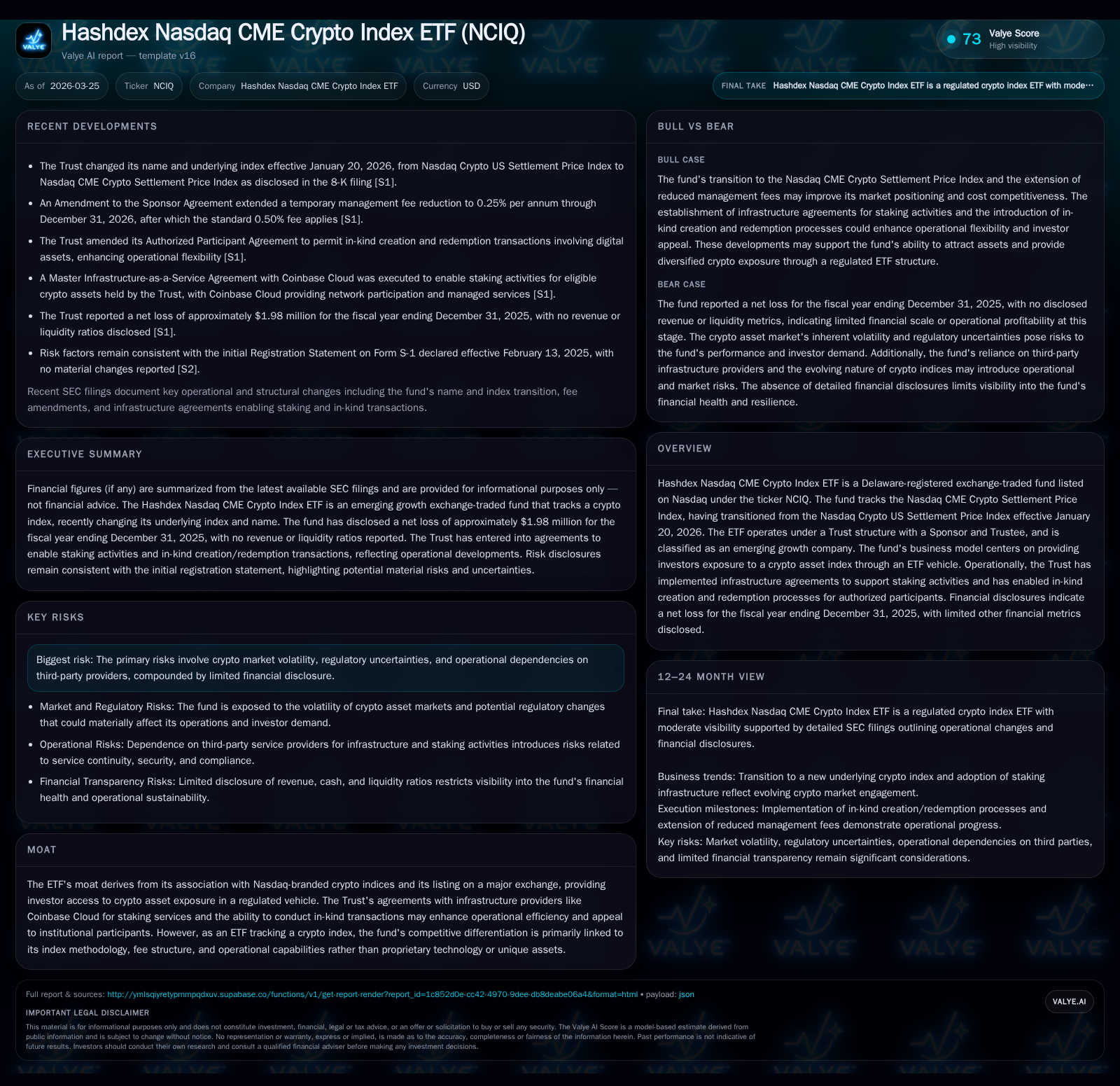
The Hashdex Nasdaq CME Crypto Index ETF (NCIQ), a Delaware statutory trust listed on Nasdaq, shifted its underlying index to the Nasdaq CME Crypto Settlement Price Index as of January 2026, aligning its crypto asset exposure with updated regulatory standards. Despite reporting a net loss for the fiscal year ended December 31, 2025, the Trust has introduced operational improvements including staking activities through Coinbase Cloud and enabled in-kind creation/redemption processes enhancing institutional access. Future growth will depend on crypto market dynamics, regulatory developments, and adoption of these operational enhancements.
Introduction
Launched in July 2024 as a Delaware statutory trust, the Hashdex Nasdaq CME Crypto Index ETF (ticker NCIQ) provides investors with regulated access to a diversified basket of crypto assets via an ETF vehicle listed on the Nasdaq Stock Market [S1]. Originally tracking the Nasdaq Crypto US Settlement Price Index until early 2026, it transitioned to follow the Nasdaq CME Crypto Settlement Price Index on January 20, 2026 [S1][S18]. This transition aligns with exchanges' efforts to harmonize digital asset eligibility criteria according to SEC-approved generic listing standards.
Historical Performance and Growth Drivers
As an emerging growth company, NCIQ's historical performance is limited by its nascent status; however, financial data through fiscal year-end December 31, 2025 show a net loss of approximately $1.98 million [F1]. Operating income for the quarter ending September 30, 2025 was nominally positive at $6 USD, indicative of operational breakeven challenges amid product development and market penetration phases [F1].
The fund's initial growth drivers included brand association with Nasdaq indices and offering U.S.-exchange-listed exposure to crypto assets—an area underserved by traditional ETFs until recently. Key milestones include:
- Formal registration and launch in mid-2024.
- Gradual accumulation of assets under management while managing fee structures.
- Expansion of operating capabilities including custody arrangements with major crypto custodians Coinbase Custody, BitGo Trust Company, and Fidelity Digital Asset Services [S1].
Historical performance (annual)
| FY |
|---|
| 2025 |
Source: SEC companyfacts cache [F1].
Net income reflects full-year results; operating income is reported quarterly through September.
Transition to New Underlying Index
On January 20, 2026, the Trust replaced its former index (Nasdaq Crypto US Settlement Price Index) with the Nasdaq CME Crypto Settlement Price Index [S1][S18]. Both indices apply substantially identical methodologies and maintain similar constituent weightings; however, the new index incorporates enhanced digital asset eligibility aligned with SEC's generic listing standards [S18]. This change primarily updates index branding while maintaining investment objectives.
This transition reflects increasing formalization within crypto-related products aiming to satisfy regulatory expectations and reduces tracking error risk by focusing on robust settlement price inputs provided by CME Group—a major derivatives marketplace known for regulated markets.
Operational Enhancements: Infrastructure & In-Kind Processes
In October 2025, NCIQ entered into a Master Infrastructure-as-a-Service Agreement with Coinbase Cloud Pte. Ltd., enabling participation in staking activities for eligible crypto assets while retaining custody through designated custodians [S9][S14]. The agreement includes managed services such as network upgrades and monitoring; fees paid are based on gross staking rewards earned by the Trust.
Since late 2025, the Trust has also implemented in-kind creation and redemption procedures allowing shares issuance or redemption against transfers of actual crypto assets rather than solely cash settlements [S11][S16][S17]. This capability improves liquidity and facilitates institutional participation through authorized participants such as Virtu Americas LLC under updated procedural handbooks.
These operational improvements lay foundational support for scaling assets under management while managing complexities inherent in digital asset custody and settlement.
Fee Structure & Capital Allocation
In November 2025, management fees were temporarily reduced from the standard annual rate of 0.50% to 0.25% through December 31, 2026 to improve competitiveness amid a crowded market [S11]. Fees are expected to revert post this period unless further amendments occur.
No dividends or share repurchase programs have been disclosed consistent with ETF trust structure focused on NAV alignment rather than earnings distribution [S6][S7][S10][S13]. Cash flow disclosures remain minimal given net losses reported thus far suggest focus remains on capability buildout over capital returns.
Governance & Leadership Changes
In March 2026, leadership changes occurred at Hashdex Ltd., controlling entity of Hashdex Asset Management Ltd., sponsor of NCIQ. Marcelo Sampaio transitioned from CEO/President to Executive Chairman; Bruno Caratori became Global CEO; Mick McLaughlin was appointed U.S. CEO while continuing as Global Head of Distribution [S13][S19]. These changes do not impact day-to-day Trust operations where Bruno Sousa remains principal executive officer supported by Samir Kerbage as principal financial officer.
Industry Context & Risks Analysis
NCIQ operates as a regulated vehicle providing crypto exposure via index tracking leveraging reputable Nasdaq indices and multiple custodial partnerships. Key risks include:
- Volatility in digital asset prices impacting NAV alignment.
- Regulatory uncertainty regarding cryptocurrency-related ETFs.
- Dependence on third-party custodians and infrastructure providers for custody security and technology reliability.
- Limited public financial disclosure restricting insight into profitability or capital deployment strategies [S1][S4].
Forward-Looking Considerations
Future growth is contingent upon institutional adoption rates, cryptocurrency market cycles affecting fund flows, potential expansions or methodological changes in indexing reflecting evolving crypto classes, further blockchain service enhancements including staking or governance participation models, and regulatory developments influencing permissible holdings and trading protocols.
Monitoring future filings for asset growth trends and operational results post-fee normalization will be essential.
Conclusion
Hashdex Nasdaq CME Crypto Index ETF offers regulated U.S.-listed exposure to diversified cryptocurrencies via a recognized index linked closely with leading exchanges. Its transition to a CME-settled benchmark index alongside infrastructure agreements enabling staking rewards extraction and adoption of in-kind transaction processes position it well operationally. However significant challenges remain from market volatility to ongoing regulatory clarity. Early net losses reflect startup pressures while leadership stability at Trust level supports continuity amid sponsor-level strategic shifts. Fee adjustments combined with asset inflows and evolving index methodologies will be key indicators for this emerging growth vehicle's trajectory.
This analysis synthesizes publicly available SEC filings up to March 25, 2026 without investment recommendation or solicitation. Readers should perform due diligence tailored to their circumstances before any securities decisions.
Disclaimer: This is research-only, informational analysis and not investment advice. It may include AI-generated interpretation and general industry context. Always verify important details using primary sources.

Comments