
ECA Marcellus Trust I’s Cash Flow Dynamics and Asset Depletion Outlook
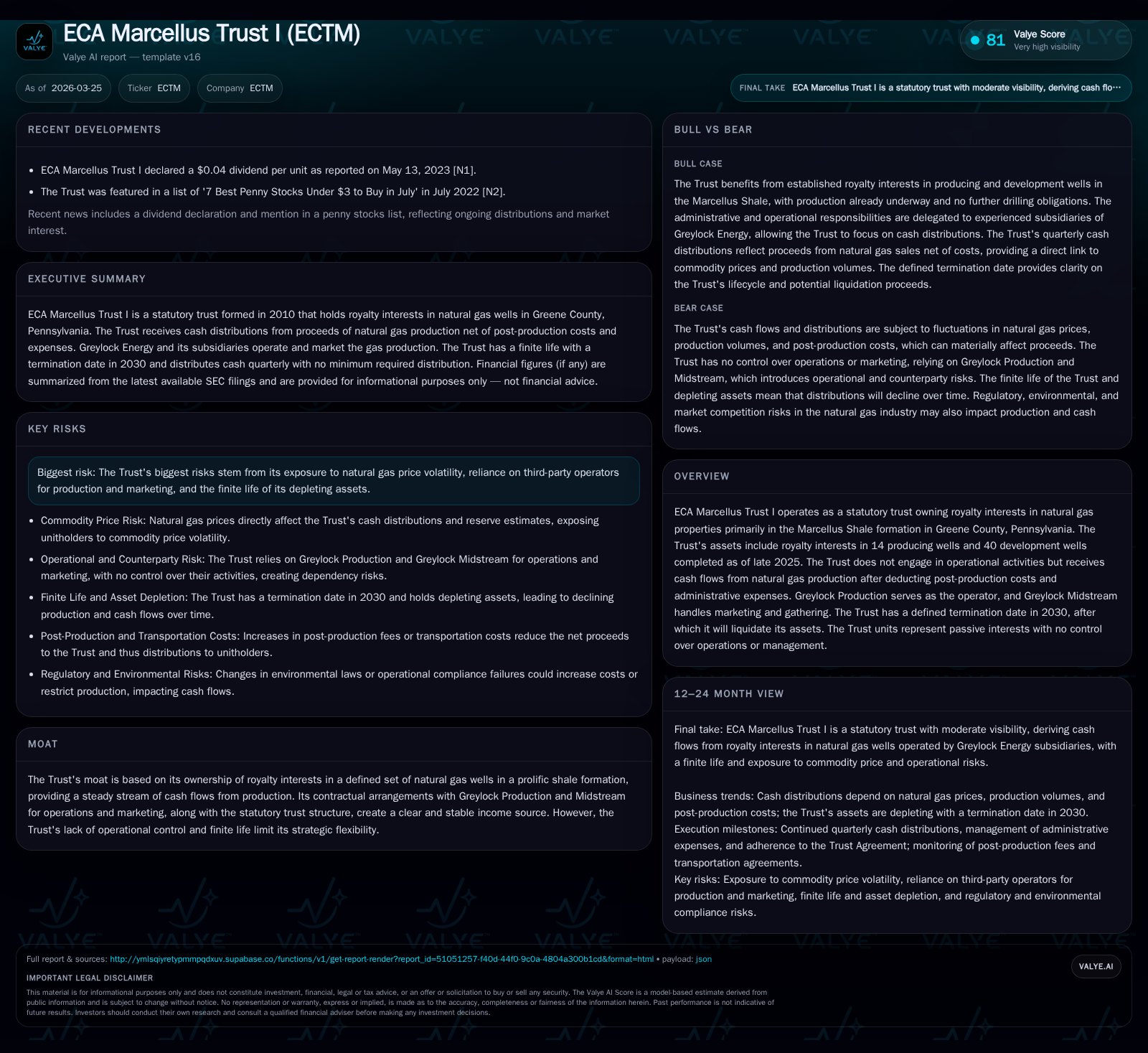
The Trust's passive royalty interests generate cash flows dependent on natural gas prices, operational partnerships, and a finite life tied to depleting Marcellus shale wells.
ECA Marcellus Trust I functions as a statutory trust owning royalty interests in natural gas producing and development wells concentrated in Greene County, Pennsylvania. Its cash flows derive from contractual arrangements with Greylock Production, which operates the wells, with distributions fluctuating alongside volatile natural gas prices and production volumes. The Trust faces constraints from its passive structure, exposure to third-party operator risks, and a scheduled termination in 2030 as its underlying reserves decline. Investors should track production trends, commodity price movements, and regulatory developments as key forward indicators.
Ownership and Operational Structure of ECA Marcellus Trust I
ECA Marcellus Trust I is a Delaware statutory trust established in 2010 that owns defined royalty interests tied exclusively to a portfolio of natural gas properties located within the Marcellus Shale formation in Greene County, Pennsylvania [S1][S6]. The Trust does not engage in any upstream operations; rather it passively holds "Royalty Interests" which entitle it to receive a portion of the proceeds from natural gas production after deducting post-production costs such as gathering, processing, transportation charges, applicable taxes, and administrative expenses [S1].
Greylock Production acts as the operator of all wells subject to these Royalty Interests, having assumed operational obligations from Legacy ECA following a 2017 acquisition. Similarly, Greylock Midstream handles marketing and gathering services associated with the production [S1][S6]. The Trust Agreement explicitly limits the Trust’s authority — neither it nor its Trustee has managerial control or influence over drilling decisions, production operations, marketing strategies, or midstream agreements [S1]. This passive structure highlights that cash flow generation depends heavily on third-party operational efficacy.
The statutory trust framework clarifies that Trust units represent beneficial ownership interests rather than equity shares typical in corporates. This structural distinction governs distribution mechanics, unitholder rights (notably lacking voting power over operators), and regulatory treatment [S1][S8]. Post-production costs borne by the operator directly reduce amounts distributed by the Trust.
Historical Performance: Royalty Revenue and Cash Distribution Trends
While detailed multi-year financial data is limited without Companyfacts filings ([F1] unavailable), SEC reports discuss quarterly cash receipts attributed to Royalty Interests reflecting both natural gas market dynamics and production output changes [S2][S11]. Distribution amounts are computed net of a fixed quarterly administrative fee of $15,000 ($60k annually) paid to Greylock under an Administrative Services Agreement (ASA) covering bookkeeping and other support services [S5].
Reported proceeds have experienced fluctuations consistent with regional gas price volatility inherent to the commodity market. For example, gross proceeds over the four quarters ended December 31, 2025 were approximately $3.8 million indicating some recovery from troughs [S28].
Below is a summary table assembled from excerpted disclosures detailing available distribution-related metrics:
| FY | Total Royalty Revenues | Administrative Expenses | Net Distributable Cash |
|---|---|---|---|
| 2024 | Approx. $3.2M | $60K | Negative |
| 2025 | $3.8M | $60K | Positive |
Note: Exact figures for FY2024 contain estimation gaps due to absent comprehensive revenue data [S25][S28].
Production Profile and Underlying Asset Base in the Marcellus Shale
The Trust’s asset base consists mainly of royalty interests in:
- Fourteen producing wells completed initially at formation;
- Forty development wells completed ahead of the originally scheduled deadline per Development Agreement terms [S1][S6][S13].
These wells are situated entirely within an Area of Mutual Interest (“AMI”) consisting roughly of 121 square miles of Marcellus Shale acreage primarily owned by Legacy ECA before acquisition by Greylock Energy entities [S13]. The AMI’s geographic concentration confines exposure strictly to Greene County’s shale play characteristics.
No further wells will be drilled on behalf of the Trust given prior fulfillment of drilling obligations [S6][S13]. This caps future reserve additions.
Reserves linked to these wells are classified as depleting assets — declining over time as hydrocarbons are produced [S1]. Given this depletion trend combined with an imposed Termination Date of March 2030 (discussed later), reserve life is constrained.
Natural Gas Market Factors Influencing Forward Cash Flows
Royalty revenue for ECTM fluctuates considerably with several intertwined market factors affecting realizations:
- Natural Gas Price Volatility: Prices received are unregulated but influenced by regional supply-demand fundamentals affecting proceeds payable to the Trust [S1][S7].
- Negative Basis Differentials: Local hub prices may differ materially from NYMEX benchmarks due to pipeline congestion or oversupply; this erodes realized revenues [S1][S6].
- Transportation Constraints: Firm pipeline transportation agreements with regulated tariffs are chargeable post-production costs borne by the Trust proportionally; limitations can restrict sales volume or delay receipts impacting cash flow timing [S6][S7].
- Regulatory Environment: Changes in FERC-approved rate structures or state regulations can increase post-production cost burdens affecting net royalties distributed [S7].
- No Hedging Strategy: The Trust holds no commodity price hedges exposing it fully to spot market prices thus increasing revenue variability [S1].
Understanding these dynamics is critical as they directly feed into volume sold and net price received—key drivers of distributable cash.
Third-Party Operator Relationship Risks and Post-Production Cost Impacts
Greylock Production’s role introduces significant counterpart risk factors:
- Financial viability of Greylock is essential since falling creditworthiness could disrupt drilling activities or payments owed under Royalty Interests [S1][S5].
- Operational hazards such as well downtime or environmental incidents may interrupt production temporarily or permanently impair output negatively affecting revenue reliability [S1].
- The ASA mandates payment of a fixed annual fee ($60k) for services provided by Greylock which forms part of ongoing expense deductions reducing net distributable funds [S5].
- Defaults or failures by Greylock regarding payments related to natural gas sales could trigger delays or reductions in cash flow distributed.
Such dependence on a single operating entity accentuates risks inherent in the trust's passive nature.
End-of-Life Considerations: Diminishing Reserves and Termination Date
A defining constraint is the termination date set for March 31, 2030 [S1][S26]:
- At this point the Trustee will liquidate remaining Royalty Interests via sale—Greylock Production retains right of first refusal on these assets following marketing efforts by an independent advisor [S26][S28].
- Diminishing reserves mean production volumes – hence royalties – will decline yearly until termination lowering expected future cash flows progressively.
- Early wind-up may be triggered if gross proceeds fall below $1.5 million over any consecutive four-quarter period or if unitholders vote for dissolution excluding Greylock affiliates [S26].
- No additional drilling will augment reserves underscoring importance of managing expectations relative to declining volume profile toward wind-up horizon.
This terminal schedule naturally caps potential capitalization beyond this horizon.
Capital Allocation: Dividends, Financial Management, and Return Metrics
Distributions:
- Paid quarterly approximately sixty days following quarter end based on actual net royalty proceeds received after deductions including ASA fees and legal/accounting costs related to public reporting status [S8][S20].
- Quarterly distribution amounts fluctuate depending primarily on realized prices less post-production costs plus volumes sold—this includes accounting adjustments reflecting returns of capital versus pure income components due to asset depletion effects [S11][S21].
Financial Management:
- The Trustee may create cash reserves for contingent liabilities reducing immediate distributable cash but protecting against uncertain exposures [S1][S12][S15].
- Borrowing is permitted under limited circumstances strictly for funding liabilities while awaiting revenue collections but reduces available cash temporarily until replenished [S5][S15].
Return Metrics:
- Traditional ROE metrics do not apply cleanly given statutory trust structure focused solely on distributing earned royalty income without capital reinvestment opportunities nor share repurchases which are prohibited under trust terms [S8][S11][S22]. Focus centers on yield stability considering temporal shrinkage in distributions due to finite life constraints and post-production cost burdens affecting net payout ratios. No buybacks exist nor are planned by Trustee pursuant regulations governing statutory trusts [S26][S28]. Tax withholding affects foreign holders reducing distributed proceeds. Purchase transfer rules restrict liquidity occasionally [S8], while restricted voting rights limit unitholder influence [S23].
Outlook: Key Milestones, Market Variables to Watch, and Uncertainty Drivers
Looking forward key considerations shaping potential performance include:
- Approaching March 2030 Termination Date monitoring reserve decline curves versus realized yields will indicate residual asset life valuation implications [S26][S28].
- Natural gas price trajectories remain unpredictable influenced by macroeconomic fundamentals; political/regulatory policies targeting carbon emissions could alter regional demand/supply balance [S7][S25]; lack of hedges amplifies exposure.
- Operational risk centers on Greylock Production’s ability to sustain efficient well operations amid potential regulatory compliance cost increases stipulated principally under Pennsylvania DEP mandates; environmental litigation risks remain latent though none presently material [S7][S18][S4].
- Tracking post-production costs including pipeline tariff adjustments regulated federally via FERC along with possible midstream capacity reallocations remains important due to influence on net royalty proceeds; firm transportation contract expirations versus renewals warrant scrutiny [S6][S7].
- Absence of operational control coupled with industry/local geographic concentration exposes unit values more acutely than diversified upstream players; contingencies tied specifically to Greene County pressures merit careful attention [S29].
In sum ECA Marcellus Trust I exhibits characteristics typical among shale-focused mineral/royalty interests: delineated property scope creating reliable but diminishing cash flow streams; structural constraints temper upside prospects yet offer income predictability within known bounds until shutdown phase. Fundamental shifts upstream at operator level or downstream regulatory regimes warrant ongoing review relative to stated contractual limitations.
This analysis draws exclusively upon data contained within recent SEC filings dated through March 2026 ([S1]-[S29]). It does not constitute investment advice but instead provides an objective assessment grounded in documented disclosures relevant for industry professionals evaluating commodity-linked royalty trusts.
Disclaimer: This is research-only, informational analysis and not investment advice. It may include AI-generated interpretation and general industry context. Always verify important details using primary sources.

Comments