
Ucommune International’s Strategic Shift to Asset-Light Model Challenges Revenue Recovery
Significant revenue contraction and recurring losses highlight urgent liquidity and operational challenges for China’s recognized agile workspace brand.
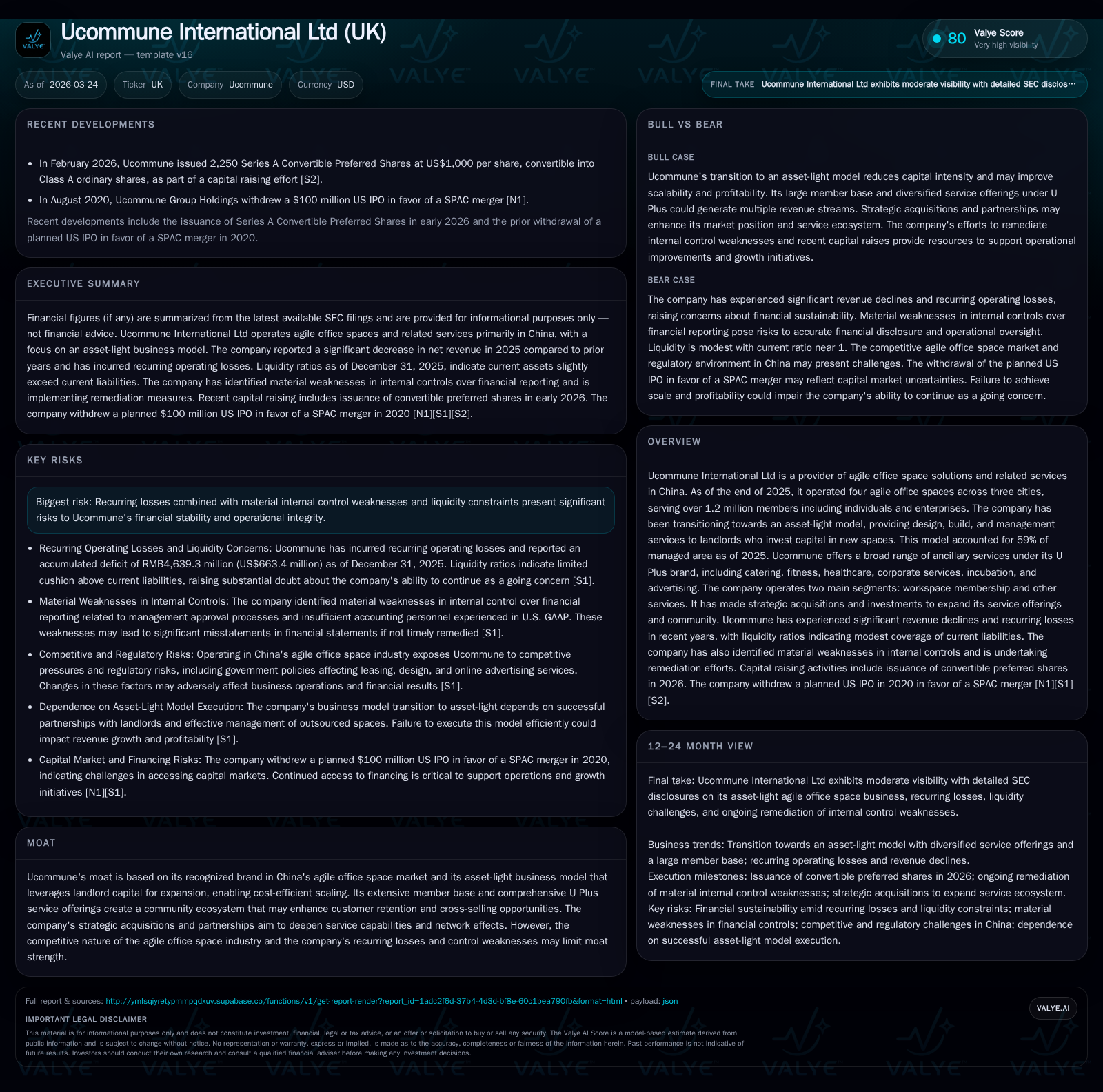
Ucommune International Ltd, a prominent player in China’s agile office space market, has experienced steep revenue declines from $64.8M in 2023 to $3.7M in 2025, amid a deliberate transition from asset-heavy to asset-light operations. The company now operates four agile spaces with over 1.2 million members but remains burdened by recurring operating losses and cash flow deficits. While management is focused on scaling its asset-light model—leveraging landlord capital and expanding ancillary U Plus services—severe liquidity constraints, material internal control weaknesses, and a stringent Chinese regulatory environment pose significant risks to sustained profitability and growth.
Company Overview
Ucommune International Ltd stands as one of China's recognized brands offering agile office space solutions and related services primarily across three cities with four operational locations at the end of 2025 [S1]. The company markets its spaces mainly through monthly memberships encompassing both individuals (approx. 1.17 million) and enterprises (approx. 40 thousand), totaling over 1.2 million members [S1]. Its business encompasses two overarching segments:
- Workspace membership services: Flexible office space rental revenues generated mostly via membership contracts or workstation leases.
- Other ancillary services grouped under the U Plus umbrella: Corporate secretarial services, HR support, catering, fitness centers, incubation programs, advertising and branding [S1][S22].
Since inception starting with its first space in September 2015, Ucommune's agile office network has evolved progressively but witnessed significant portfolio contraction as it disposes of underperforming self-operated assets during its shift towards an asset-light model.
Historical Financial Performance
A notable feature of Ucommune's recent financial history is the precipitous decline in top-line revenue alongside persistent operating losses:
Historical performance (annual)
| FY | Rev ($mm) | Net ($mm) | CFO ($mm) | OpInc ($mm) | Rev YoY | Net YoY |
|---|---|---|---|---|---|---|
| 2025 | 4 | -2 | -6 | -84.4% | ||
| 2024 | 24 | 1 | -7 | -63.1% | ||
| 2023 | 65 | -1 | 2 | -18 | -32.4% | +98.4% |
| 2022 | 96 | -42 | -26 | -51 | +87.5% |
Source: SEC companyfacts cache [F1].
Capital returns and efficiency (annual)
| FY | FCF ($mm) | ROE% |
|---|---|---|
| 2025 | -3 | |
| 2024 | 0 | |
| 2023 | 0 | -7.9 |
| 2022 | -28 | -568.9 |
Source: SEC companyfacts cache [F1].
(Source: [F1])
Revenues collapsed from nearly $96 million in FY2022 to under $4 million by FY2025—a reduction exceeding 95% driven by the systematic disposal of costly self-operated spaces (21 spaces closed/disposed during FY2024 alone) and contraction of revenue-sharing contracts under the asset-light platform [S18][S23].
Operating losses narrowed somewhat but remained substantial at $5.8 million for FY2025 compared to losses exceeding $51 million in FY2022 reflecting significant cost-cutting efforts yet continued challenges generating positive operating leverage at reduced scale [F1]. The company generated negative operating cash flow ($2.0 million) in FY2025 compared to positive cash flow ($2.4 million) back in FY2023 evidencing deteriorating core business cash conversion amidst restructuring [F1]. Capital expenditures declined moderately as new investments slowed while efforts focused on developing management capabilities rather than owning real estate outright.
Business Model Transition: Asset-Heavy to Asset-Light
Historically reliant on an asset-heavy model through direct leasing and management of properties known as U Space category locations providing workstations directly to members under long-term lease agreements with fixed costs exposure [S12], Ucommune shifted strategically toward an asset-light approach that accounts for approximately 59% of managed area by year-end 2025 (approx. ~15k sqm out of ~25k sqm total) [S1]. Under this model:
- The company provides design/build/management services.
- Landlords furnish upfront capital expenditures.
- Revenue is primarily driven by management and service fees or revenue sharing with landlords rather than rental income.
While reported operating profits were seen briefly in the asset-light subsidiary during FYs 2023–24, the segment posted an operating loss again in FY2025 suggesting ongoing scale-up challenges or competitive pressures impacting margins amid fewer active spaces compared to prior periods [S1][S13]. This strategy intends to conserve capital expenditure requirements but exposes growth potential heavily dependent on landlord partnerships and external market demand.
Unit Economics & Pricing Power Dynamics
Workspace membership remains core revenue contributor despite drastic scale-back:
- Membership revenues decreased by roughly two-thirds between FY24 ($68.6M RMB) and FY25 ($22.6M RMB).
- Pricing is influenced by location quality, brand strength recognized nationwide within China's emerging internet economy clientele demographic seeking flexible office environments.
- Utilization rates diminished significantly due to space closures while some recovery occurred as individual members using workstations increased marginally from ~4.5k to ~4.9k by end-2025 after prior declines from post-COVID adjustments [S19][S21][S29].
Other service revenues encompass various value-added offerings including SaaS/IOT technical support and are delivered both directly and via more than seven hundred business partners under cooperative models [S1][S22]. Yet these ancillary revenues declined nearly 60% year-over-year highlighting the impact of footprint downsizing on cross-selling opportunities.
Cost structure improvements accompanied these trends—with total cost of revenue falling significantly in tandem with sales contraction albeit resulting margins still challenged given reliance on fixed expenses such as leases for remaining self-operated sites prior to divestiture completion [S10][S11][S13].
Market Position & Competitive Moat Considerations
Ucommune's moat lies predominantly in its recognized brand identity within China's arena for agile offices combined with its expansive member base today exceeding one million users spanning SMEs up through large enterprises across key urban cities [S1]. This large community underpins its ecosystem approach leveraging U Plus value-added services that extend beyond physical office provision into corporate support functions aiming at stickiness and higher customer lifetime value through shared services like HR management or corporate venturing programs.
However, intense competition against global and local co-working operators plus traditional commercial real estate providers creates a challenging pricing environment dampening margin expansion potential [N/A industry analysis based on sector knowledge]. The move toward an asset-light model attempts to mitigate capital consumption but places operational execution demands high amidst managing multiple landlord relationships.
Capital Structure & Liquidity Analysis
Liquidity metrics underline material challenges for Ucommune despite recent equity injections:
- Cash & equivalents totaled approximately $5.2M at year-end FY25.
- Current ratio hovered around a marginally positive level near ~1.07 reflecting tight short-term coverage given current liabilities tallying ~$8.3M versus current assets near ~$8.9M [F1].
- Accumulated deficit ballooned past RMB4.6 billion (~$663M), underscoring cumulative losses since inception.
- No unused credit lines were available at period end adding vulnerability if operating cash demands spike unexpectedly.[F1]
Recent capital market activities reflect efforts to secure funding through issuance of Series A convertible preferred shares totaling millions USD with associated convertible features aimed at providing treasury relief while diluting shareholders indirectly as conversion happens [S2][S3]. Debt financing arrangements disclosed include intercompany loans among subsidiaries subject to regulatory approval constraints which complicate rapid fund deployment within China-based entities requiring SAFE approvals for cross-border Renminbi conversions or foreign exchange remittances adding layers of risk regarding agility during cash crunch scenarios.
Risks highlighted include ongoing internal control deficiencies delaying accurate financial disclosures,[S1] which may erode investor confidence further amid heightened scrutiny associated with Chinese offshore companies listed abroad.
Future Growth Prospects & Strategic Milestones
Looking ahead beyond immediate liquidity concerns:
- Management highlights the push toward expanding the asset-light business as a sustainable growth engine by replicating design/build/management services for landlords rather than capital-intensive leasing.[S1]
- There are plans for selective acquisitions or strategic partnerships aimed at broadening service capabilities within the U Plus framework targeting increased member-centric offerings.[S22]
- Improvements in operational efficiency through technology adoption intend to shorten turnaround time from premises acquisition to readiness below industry average improving go-to-market speed.[S12]
- Market-facing risks include evolving PRC regulations affecting leasing practices and internet content governance impacting both physical real estate operations and online branding/service delivery aspects.[N/A sector context]
- Future financing success will be critical; inability to raise funds timely could jeopardize scalability objectives given weak free cash flow generation currently.[F1][S4]
No explicit long-term guidance was provided; investors should watch near-term quarterly updates for trajectory indications regarding:
- Revenue stabilization post asset divestiture,
- Margins trending positively on new assets managed,
- Progress on cost discipline measures,
- Liquidity status updates including financing rounds completed,
- Developments around regulatory compliance enhancements including internal controls remediation.
Returns & Capital Allocation Policy
Given persistent net losses with approximate return on equity around negative low single digits (~ -3.7%) due largely to cumulative deficits,[F1] returns have been negative since inception without dividend payments or share repurchases documented recently.[F1][S9] Capital allocation decisions focus on preserving working capital amid continuous restructuring along with funding strategic investments meant to deepen service offerings.[S9][S22] Debt levels remain modest but access constrained by regulatory transfer restrictions limiting operational flexibility.[F1][S16] Improving free cash flow remains a priority but is unlikely near term absent substantial scale restoration or margin expansion.[F1]
Conclusion: A Brand Facing Structural Challenges Amid Industry Realignment
Ucommune International Ltd embodies a high-profile participant within China's emerging agile office space sector confronted by pronounced transitional pressures moving away from traditional capital-intensive holdings toward flexible management service models relying on third-party landlord investment. Revenue erosion exceeding eighty percent over three years amid disposals signals acute adjustment pains while recurring losses underscore the tough path toward profitability despite operational efficiencies gained. Strong brand presence coupled with a vast member base supports future prospects if scaled effectively through ancillary U Plus services creating platform stickiness. However substantial financing constraints alongside lingering internal control issues create immediate headwinds undermining momentum. Success hinges on prudent execution of its asset-light roll-out strategy complemented by well-managed expansion into adjacent service verticals while navigating complex regulatory frameworks unique to China’s market dynamics. Given these factors stakeholders must monitor closely liquidity developments alongside operational milestones over upcoming reporting cycles; risk appetite should consider these multifaceted pressures inherent within this early-stage restructuring enterprise.
Disclaimer: This analysis does not constitute investment advice or recommendations regarding securities of Ucommune International Ltd or any other entity.
Disclaimer: This is research-only, informational analysis and not investment advice. It may include AI-generated interpretation and general industry context. Always verify important details using primary sources.

Comments