
MV Oil Trust's Finite Horizon Casts Focus on Cash Flow and Distributions
MV Oil Trust’s long-lived oil assets generate steady cash flow but the trust's impending termination after June 30, 2026, shapes its distribution profile and investor considerations.
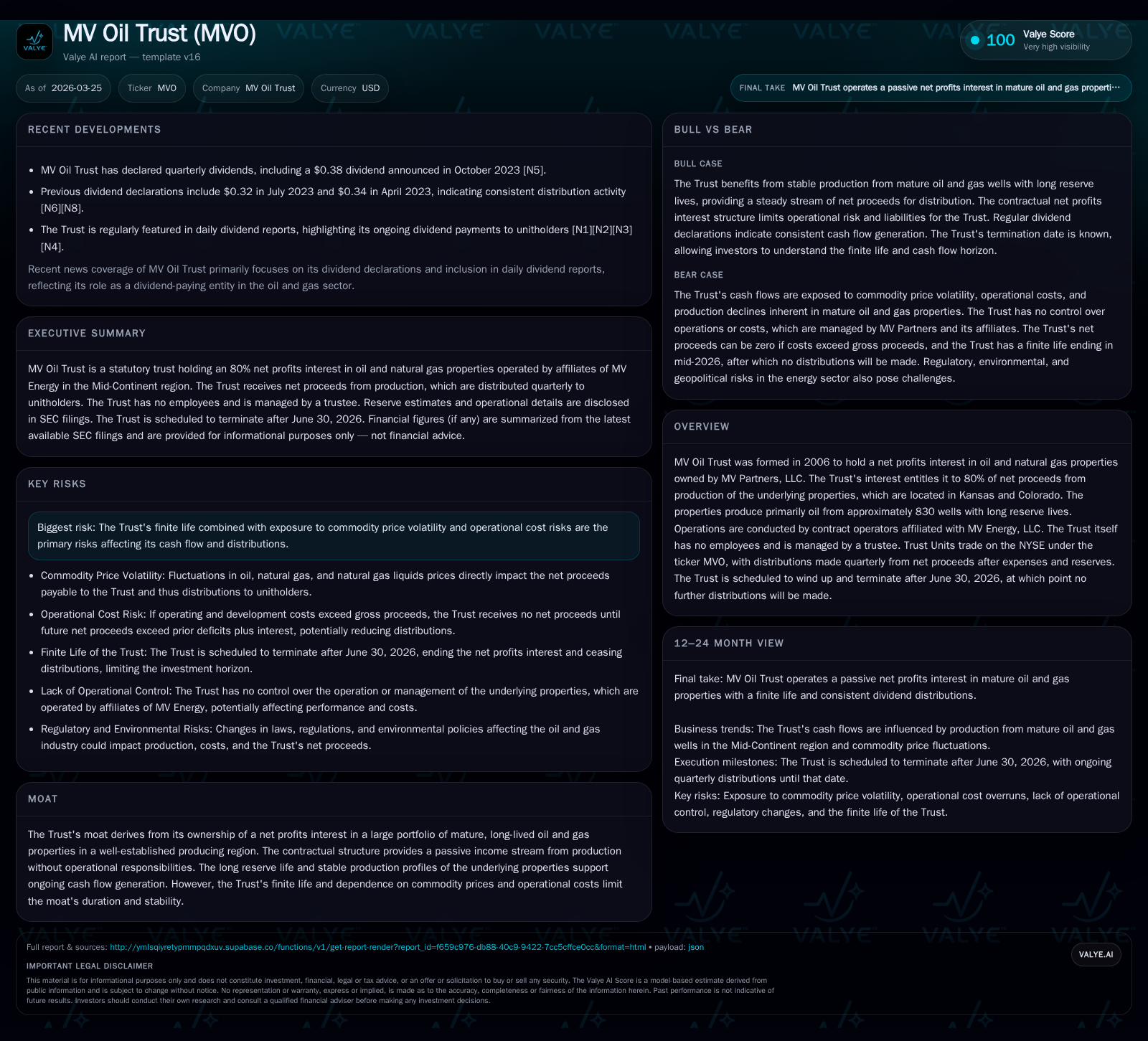
MV Oil Trust holds an 80% net profits interest in mature oil properties primarily in Kansas and Colorado, producing from approximately 830 wells with over 28 years of reserve life remaining. As a passive entity with no operational role, the trust relies on contractual operators affiliated with MV Energy to manage underlying assets. Despite stable production, distributions and cash flows are influenced by commodity price swings and capped capital expenditures. With the scheduled wind-up following the minimum production threshold realized in mid-2026, unitholders face a finite investment horizon emphasizing near-term cash flow extraction and return of capital considerations.
Legacy Asset Portfolio and Historical Cash Flow Generation
MV Oil Trust was established in August 2006 through an arrangement with MV Partners, LLC to hold an exclusive term net profits interest in oil and natural gas properties situated in the Mid-Continent region—specifically Kansas and Colorado [S1][S5]. This net profits interest grants the trust a right to receive 80% of net proceeds calculated from production revenue after deducting operational expenses, capital expenditures, production taxes, post-production costs, and reserves necessary for ongoing upkeep [S26].
These underlying properties encompass about 830 wells as of December 31, 2025, producing predominantly crude oil (~99%) with minor contributions of natural gas and natural gas liquids (NGLs). Independent engineering evaluations report proved developed producing reserves exclusively at year-end 2025 with estimated reserve life exceeding 28 years [S20][S25]. The mature nature of these fields denotes that most reserves have been in steady extraction phases while presenting incremental recompletion or workover opportunities typical of long-lived Mid-Continent plays [S11][S20].
The historical cash flows driving distributions rested primarily on stable production levels supported by legacy development activity balanced against natural decline trends common for mature conventional reservoirs. The trust’s net operating income calculation before taxes corroborates this steady profitability generated from oil-centric production volumes [S25]. However, as the trust approaches its sunset date based on total produced volume meeting contracts' finite terms, growth levers naturally decelerate.
| Fiscal Year | Capex ($k) |
|---|---|
| Ending June 30, 2023 | $2,336* |
*Average Annual Capital Expenditure Amount for period ending June 30, 2026 [S4]
Operating Structure and Passive Revenue Model
MV Oil Trust is a passive statutory trust with no employees or direct involvement in field operations. Operational activities are handled exclusively by MV Partners through contract operators — Vess Oil Corporation and Murfin Drilling Company — affiliates under MV Energy LLC management [S1][S9]. The relationship exists under defined agreements where overhead fees are paid based on monthly charges per active well.
This operating agreement overhead escalates annually indexed to average weekly earnings for petroleum workers reflecting labor market pressures [S28]. The absence of control or operational responsibility by the trust places all execution risks onto MV Partners while the trust captures economic returns via its net profits interest [S9]. This structure reduces operational leverage risk but exposes unitholders to operator efficiency and cost pass-through risks.
Impact of Commodity Price Volatility on Distribution Stability
Net proceeds payable rely heavily on realized sales prices benchmarked primarily against West Texas Intermediate (WTI) crude pricing — adjusted quarterly based on actual receipts net of deductions [S26]. Volatility in global oil markets transmits swiftly into quarterly distributions impacting predictability.
Risk disclosures acknowledge that during periods when operating costs plus capital outlays exceed gross proceeds, the trust receives no payments until subsequent positive net proceeds offset deficits plus prime rate interest [S10][S26]. This dynamic creates cash flow variability driven by commodity cycles inherent to extractive businesses even if underlying volumes remain stable.
Capital Expenditure Constraints and Operating Cost Dynamics
Capital spending follows strict caps defined under the trust agreement balancing maintenance drilling/workovers without excessive reinvestment that might delay return of capital timelines [S4]. The Average Annual Capital Expenditure Amount was $2.34 million for the twelve months ending June 30, 2026, adjusted upwards annually at a fixed inflationary rate [S4]. This cap includes approved workover and recompletion activities intended to support production sustainability but not material expansion.
Operating expenses paid to contract operators have risen incrementally—from $3.4 million in 2023 to $3.8 million reported in 2025—consistent with indexed wage escalations for petroleum services laborers [S28]. Such overhead adds fixed cost layers impacting net proceeds especially during softer price environments.
Imminent Termination: Implications for Unitholders
A defining feature shaping valuation and distribution outlook is that the trust’s net profits interest terminates definitively after June 30, 2026 once a cumulative production threshold is achieved: sale of at least 14.4 million barrels of oil equivalent gross attributable to underlying properties consistent with the initial conveyance [S19][S26].
Upon reaching this milestone—anticipated imminently given historical production—the trust dissolves. This cessation ends further distributions as no residual value exists beyond asset depletion milestones contractually established. Post-termination involves winding up affairs including a possible last distribution followed by unit cancellation [S19][S16].
For unitholders, this finite horizon means value crystallizes primarily through near-term cash flow rather than longer-term growth or reserve accretion strategies common in traditional upstream enterprises.
Distribution Policy and Return of Capital Considerations
Distributions occur quarterly subject to availability of excess funds received after administrative expenses including trustee fees and any reserve buffers held against future obligations [S9]. Each distribution may include portions classified as return of original investment reflecting cumulative depletion effects since account balances correspond increasingly to asset retirement rather than pure income generation [S9].
Calculation of "available funds" accounts for receivables from MV Partners plus residual earnings from prior periods after discounting anticipated needs. Reserve methodology provides prudent safeguards ensuring continuity until termination date [S9].
Liquidity, Financial Position, and Cash Flow Trends
The trust maintains a conservative financial posture devoid of debt obligations; liquidity is provided entirely through timely receipt of royalties representing its proportionate share per the net profits interest arrangement [S5][S11]. Working capital consists primarily of cash acquired from MV Partners less normal payment cycle liabilities.
Year-over-year cash flow from operations remains adequate to support capital expenditures aligned with contractual caps. Capital spend constraints help limit unproductive investments into aging fields; free cash available for distribution sustains even amid volatile pricing although moderated during low pricing scenarios due to structural coverage limits imposed by overhead cost floors [S4].
Risks Highlighted in Recent SEC Filings
Principal risks include:
- Commodity price volatility causing swings in payable net proceeds limiting reliable forecasting.
- Operating cost escalation including overhead fees potentially compressing margins unexpectedly.
- Finite life risk as resource extraction milestones irrevocably terminate the trust eliminating future upside.
- Dependence on third-party operators raises counterparty risk since poor operational execution could impair efficiency or increase maintenance costs.[S6][S7][S8][S10]
- Regulatory environment evolving around extractive activities along with geopolitical uncertainties affecting demand-supply balances.
- Limitations exist regarding hedging abilities restricting tools available for mitigation against price fluctuations.
What Investors Should Monitor in the Final Year
As liquidation approaches post-June 2026 termination date:
- Monitor quarterly reported production volumes closely for irregular fluctuations impacting revenue streams.
- Track WTI crude benchmarks as dominant drivers inflating or deflating distributable amounts.
- Assess announcements relating to changes in estimated remaining reserves or unrecovered capital expenditure commitments potentially altering terminal cash flows.
- Observe trustee communications about final distribution schedules or possible accelerated wind-up actions voted by unitholders.
- Evaluate operating cost trends relative to revenue margins which might pressure last phases’ payout levels. These indicators collectively frame viability profiles shaping ultimate realized returns prior to unit cancellation.
Disclaimer: This report is provided solely for informational purposes without any recommendation regarding securities. All data references are drawn strictly from available public filings corresponding to disclosed facts.
Disclaimer: This is research-only, informational analysis and not investment advice. It may include AI-generated interpretation and general industry context. Always verify important details using primary sources.

Comments