
Galaxy Enterprises’ Challenge of Building Scale in a Fragmented Market
Galaxy Enterprises faces uphill battles establishing operations and financial footing in the competitive Las Vegas real estate services sector.
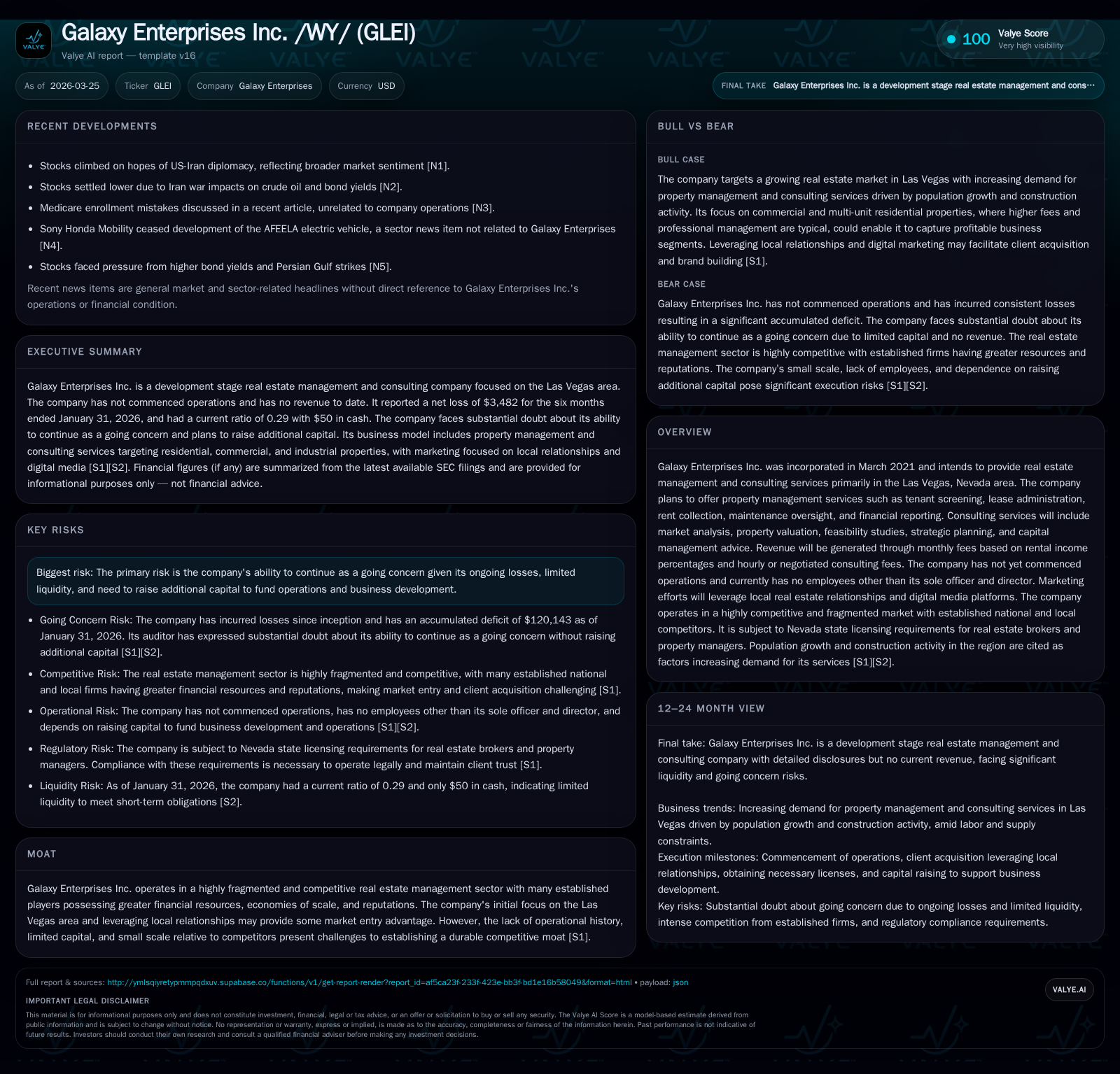
Founded in 2021, Galaxy Enterprises Inc. plans to provide property management and consulting services focused on the Las Vegas area but has yet to commence revenue-generating activities. The company’s historical financials reveal substantial and ongoing net losses and operating cash burn, raising serious liquidity and going concern risks. Its strategic emphasis on leveraging local expertise in commercial and multi-unit residential properties is balanced against tight capital constraints and a highly fragmented competitive environment dominated by established players.
Inception and Service Offering Blueprint
Galaxy Enterprises Inc., incorporated in March 2021, has outlined plans to enter the real estate management landscape focused on the Las Vegas market. The company's service blueprint bifurcates into two core areas: property management and consulting [S1]. Property management offerings are detailed and encompass tenant screening, lease administration including preparation and enforcement of lease agreements, rent collection alongside chasing late payments, routine maintenance oversight ensuring property condition compliance, move-in/move-out inspections, and comprehensive financial reporting such as monthly cash flow statements and annual tax documentation [S1][S19].
On the consulting front, Galaxy aims to advise clients through services including market analysis with modeling forecasts, site selection studies, feasibility assessments for acquisitions or developments, strategic planning for asset portfolios, organizational design inputs, as well as capital management recommendations [S17]. The company intends to generate revenues mainly by charging property owners monthly fees calculated as a percentage of rental incomes for management services, supplemented by hourly or negotiated fees for consulting engagements [S1][S17]. Geographic targeting exclusively centers on the dynamic Las Vegas real estate ecosystem leveraging the proximity of its leadership team to this market [S1]. This granular offering scope aligns with a strategic focus on Class A-C office spaces, multi-unit residential buildings (such as apartment complexes), industrial facilities including manufacturing and warehousing setups, retail locations, and mixed-use commercial properties [S1][S6][S12].
Tracking Growth: Financial Performance and Historical Losses
Despite nearly five fiscal years since incorporation through July 2025 (end-FY), Galaxy Enterprises has yet to report any revenues stemming from client operations as it remains in the developmental phase [F1][S6][S12]. Over this timeframe, the company has accumulated substantial net losses amounting to $9,748 for FY2025 alone after previously recording -$20,135 (FY2024) and -$7,651 (FY2023), signaling progress toward reducing annual losses but maintaining negative profitability [F1]. The year-over-year net income improvement between FY2024 (-$20.1K) and FY2025 (-$9.7K) reflects a reduction in net losses by approximately 51.6%, likely driven by disciplined operational cost control rather than organic revenue growth given no reported sales [F1].
Operating cash flows exhibit persistent negative trends consistent with development-stage companies’ burn patterns: outflows totaled -$453 in FY2025 following -$120 (FY2024) and significantly larger outflows in earlier years (-$14K FY2023; -$26K FY2022) [F1]. Such figures underscore continued consumption of resources primarily funding administrative overhead without offsetting operating income. Equity levels illustrate deteriorations indicative of retained losses surpassing invested capital; equity dropped from positive $4.3K in FY2022 to negative $33.3K by end-FY2025 [F1].
Historical performance (annual)
| FY | Net ($) | CFO ($) | Net YoY |
|---|---|---|---|
| 2025 | -9748 | -453 | +51.6% |
| 2024 | -20135 | -120 | -163.2% |
| 2023 | -7651 | -14037 | +83.0% |
| 2022 | -45122 | -26068 |
Source: SEC companyfacts cache [F1].
Capital returns and efficiency (annual)
| FY | ROE% |
|---|---|
| 2025 | 29.3 |
| 2024 | 85.6 |
| 2023 | 226.4 |
| 2022 | -1056.5 |
Source: SEC companyfacts cache [F1].
This snapshot highlights ongoing operating losses alongside negative cash generation capacity that paint a challenging path toward achieving financial sustainability.
Operating Challenges: Market Competition and Liquidity Pressures
Galaxy Enterprises is embarking within a highly fragmented real estate services sector that features many entrenched incumbents with established brands possessing broad-scale infrastructure advantages including economies of scale typical in property management operations [S1]. Competitors often leverage larger portfolios enabling distribution of fixed costs across numerous assets while deploying tenant retention programs that reduce vacancy risks—a critical differentiator in fee-based rental income models common industry-wide. Against this backdrop, Galaxy’s nascent scale with minimal capital resources limits immediate competitive leverage [S1].
Liquidity constraints weigh heavily with current assets totaling roughly $15K contrasted against liabilities near $52K as of January 31, 2026—yielding a razor-thin current ratio approximating 0.29 that signals short-term solvency risk [F1][S26]. The bulk of liabilities comprise accounts payable related to accrued professional fees—primarily accounting and legal expenses—reflecting delays or challenges managing operational overhead amidst constrained funding availability [S5][S7][S12]. Auditor statements repeatedly emphasize substantial doubt about continued operations absent fresh capital injections as losses accumulate without incoming operating cash flow support [S3][S5][S7].
There are no documented written or verbal commitments from shareholders or insiders pledging additional liquidity support at present heightening existential funding risk [S3][S7]. As such, the company depends entirely upon external financing avenues—including equity or debt offerings—to bridge its working capital deficits moving forward.
Strategic Focus on Las Vegas Commercial and Residential Sectors
Galaxy’s management has intentionally pinpointed Las Vegas’ commercial real estate market alongside multi-unit residential properties as initial entry verticals aligned with their proven operational experience managing prominent shopping centers and apartment buildings locally [S6][S8][S12]. This geographic concentration leverages proprietary networks facilitating client sourcing while tapping into higher-margin sectors due to scale complexities inherent in larger property types that command specialized expertise.
Marketing execution centers on digital initiatives comprising internet presence optimization via electronic brochures complemented progressively by print media campaigns tailored as business momentum builds [S6][S8]. Noteworthy is an emphasis on social media strategies utilizing online video advertising coupled with testimonials from early engagements plus virtual tours designed to bolster brand visibility among decision-makers seeking property managers who offer innovative engagement modalities beyond traditional listings—all key marketing levers in today’s tech-savvy real estate clientele ecosystem [S8][S12].
These tactics reflect contemporary trends emphasizing tenant attraction technology platforms enhancing leasing velocity metrics which often influence property owner satisfaction scores directly impacting recurring income streams.
Capital Structure, Cash Burn, and Going Concern Assessment
The corporate capital structure authorizes up to 100 million shares of common stock at nominal par value ($0.0001 per share), though only approximately 4.17 million shares were outstanding as of late 2025 representing the sole equity stake count reflecting cumulative issuances thus far without dilution events involving stock options or warrants . There have been no debt instruments issued nor material financing transactions affecting long-term capitalization recorded over recent periods confirming purely equity-based funding origins amid lack of external borrowing arrangements [S3][S5][S7].
Cash balances dwindle perilously low at $50 as of January 31, 2026; meanwhile current liabilities ballooned to over $51K driven by accrued obligations primarily related to professional fees—accounting for an increasingly stretched short-term balance sheet position exacerbated during operating fund depletion phases characteristic of pre-revenue startups pursuing go-to-market preparations without revenues inflows yet realized [F1][S26].
Multiple quarterly filings prominently highlight auditor concerns signaling 'substantial doubt' over Galaxy's ability to persevere absent successful capital raises within ensuing fiscal periods underpinning fundamental liquidity distress narratives pervasive throughout periodic reports since inception sample periods spanning calendar years 2024–26 inclusive [S3][S5][S7][S10][S23]. These disclosures candidly reveal governance challenges balancing regulatory reporting obligations against operational funding realities requiring urgent remedial financing strategies.
Prospective Growth Drivers and Expansion Constraints
Although Galaxy has yet to launch revenue-generating operations formally per available filings through Q2 FY26 reporting cycles [F1], anticipated growth catalysts center on localized population projections from regional research bodies forecasting Clark County expansion notably via demand spikes in multi-family residential units propelled by supply shortages linked partly to labor constraints impacting new construction timing horizons—a development potentially priming supportive tailwinds for third-party property management adoption rates elevated above historic baselines [S17][S18][S24]
Management intends cost-efficient operational frameworks emphasizing tight expense control while maximizing tenant retention rates underpinned by comprehensive landlord service coverage positioning geared towards scalable margin improvements contingent upon successful client onboarding ramp-ups currently pending realization within projected near-term windows but entirely contingent on bridging working capital deficits through fresh financing rounds explicitly acknowledged within regulatory commentaries outlining these prerequisites explicitly labeled crucial before break-even milestones can manifest meaningfully [S5][S7]
Sector-specific headwinds tied to entrenched competitor cost advantages exacerbate these scaling challenges given incumbent firms command purchasing power advantages wielded effectively over service vendors curtailing new entrants’ margin expansion capabilities necessitating inventive differentiation typically hinging upon localized agility—not merely price competition—to prevail sustainably.
Key Milestones to Monitor for Operational Kickoff
In absence of published explicit guidance or time-bound forecasts from company disclosures regarding imminent revenue commencement dates or customer procurement milestones—which remain undeclared—the critical indicators warranting investor attention include:
- Successful closure of new equity or debt financing rounds infusing necessary working capital reserves.
- Hiring expansions adding key personnel capable of delivering scaled service capabilities beyond founding officers.
- First contractual agreements with property owners generating recurring monthly fee streams marking transition from conceptual stage toward operating entity status.
- Observable marketing traction measures such as engagement analytics from digital campaigns related to prospect pipelines.
- Timely execution against planned digital media rollout schedules enhancing brand awareness unique among similarly sized startups. These items represent measurable developmental benchmarks serving as harbingers for subsequent incremental financial performance inflection points.
Capital Allocation Approach: Absence of Dividends and Buybacks
Given the early-stage status typified by ongoing net operating losses coupled with repeated negative cash flow realizations no distributions in forms of dividends or share repurchases have occurred historically or are indicated prospectively until consistent positive cash flows materialize worthy of shareholder returns consideration[F1]. Rather all available funds are predominantly reinvested to cover general administrative costs necessary for maintaining registration compliance while building foundational capabilities preparatory for commercial activity initiation[S12][S18]. Such full reinvestment aligns with normative private company early development paradigms wherein maximizing retained liquidity supersedes external payout commitments until business scale justifies alternate capital deployment strategies.
Analyst Takeaway: Viability in a Fragmented Property Services Market
Galaxy Enterprises confronts profound viability questions stemming primarily from its limited capitalization juxtaposed against highly competitive fundamental market dynamics marked by dominant incumbents exploiting economies of scale influencing tenant retention efficacy critical for sustaining profitable fee-based revenues typical across diversified real estate portfolios[S1][S6]. Liquidity scarcity precipitates acute operational constraints reflected across consecutive quarterly disclosures flagged repeatedly via auditors’ going concern warnings compelling swift capital acquisition upstream imperative. While localized population growth trajectories favorably shape demand contours potentially expanding addressable markets encouraging third-party property management adoption fueling technical growth opportunities unexploited amid rising supply chain labor bottlenecks experienced broadly throughout regional construction sectors these macro drivers only partially mitigate micro structural challenges confronting Galaxy’s nascent business model requiring superior execution capacity not yet demonstrated. Striking a balance between pressing funding urgency versus strategic marketing innovation employing digital tools represents an essential tactical avenue intended by management nonetheless outcomes remain speculative absent tangible operational progress metrics. Stakeholders should carefully track financing developments along planned hiring expansions plus emerging client contract captures viewing these metrics collectively as bellwethers determining whether Galaxy can transcend its small-scale startup limitations amid sector headwinds versus succumbing prematurely given probabilistic funding gaps exacerbated periodically since incorporation.
This report utilizes publicly disclosed SEC filings up through March 25th, 2026 alongside companyfact datasets reflecting historical financial trends without speculative extrapolations beyond documented evidence. It reflects an objective appraisal contextualizing risks inherent in early-stage real estate services ventures contending within mature fragmented competitive markets balanced against urban demographic growth vectors common within Las Vegas metropolitan zones.
Disclaimer: This is research-only, informational analysis and not investment advice. It may include AI-generated interpretation and general industry context. Always verify important details using primary sources.

Comments