
UiPath’s Transition from Automation Pioneer to AI-Enabled Growth Engine
UiPath evolved from a legacy automation software provider to a profitable AI-driven platform innovator, balancing growth with capital discipline amid global uncertainties.
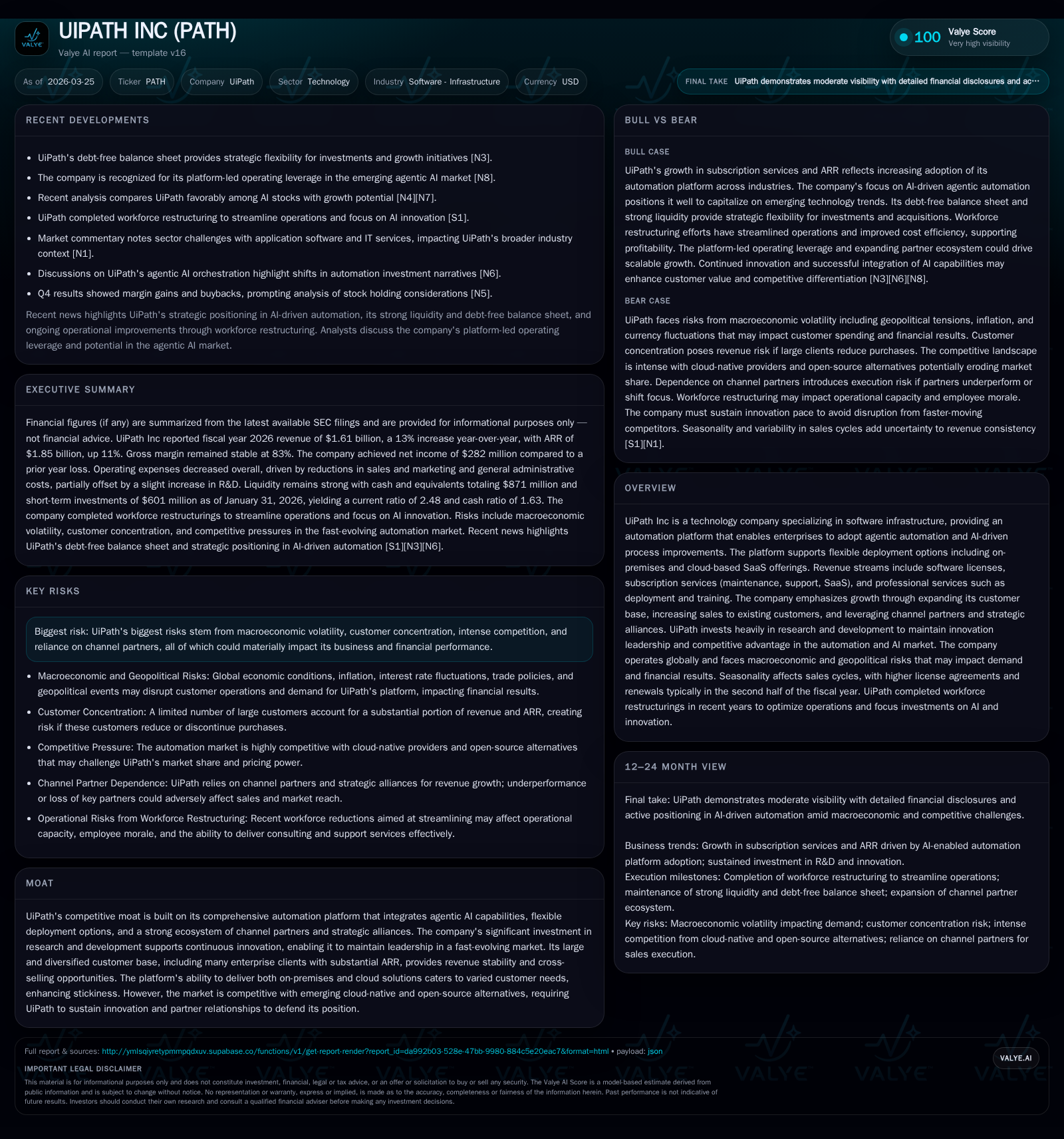
After enduring years of operating losses, UiPath achieved positive net income and operating income by FY2026, driven by product innovation and strategic cost management. Its revenue and ARR growth stemmed from expanding agentic automation adoption, channel ecosystem development, and a transition to cloud-based SaaS offerings. Robust cash flow generation fueled substantial buybacks and reinforced a strong balance sheet with minimal leverage. Headwinds include geopolitical risks, competition from cloud-native and open-source alternatives, and complex regulatory environments, especially in government sectors. The company’s appointment of a new Chief Product and Technology Officer underscores its commitment to sustaining innovation leadership in autonomous automation.
Historical Financial Turnaround: From Operating Losses to Positive Net Income
UiPath's financial journey over the past four fiscal years demonstrates a remarkable operational turnaround. In FY2023, the company reported an operating loss of approximately $348 million and a net loss exceeding $328 million. By FY2026, these figures flipped decisively with operating income reaching nearly $57 million and net income soaring to $282 million—representing improvements of roughly 135% and 483%, respectively [F1]. This trajectory reflects successful workforce realignment initiatives executed across FY2023–FY2025 that streamlined sales productivity and reduced fixed costs without sacrificing growth engines [S1]. Concurrently, the company shifted its cost structure emphasizing scalable platforms which contributed to unlocking significant operating leverage.
Historical performance (annual)
| FY | Net ($mm) | CFO ($mm) | OpInc ($mm) | Capex ($mm) | Net YoY |
|---|---|---|---|---|---|
| 2026 | 282 | 371 | 57 | 19 | +483.1% |
| 2025 | -74 | 321 | -163 | 15 | +18.0% |
| 2024 | -90 | 299 | -165 | 7 | +72.6% |
| 2023 | -328 | -10 | -348 | 24 |
Source: SEC companyfacts cache [F1].
Capital returns and efficiency (annual)
| FY | Buybacks ($mm) | FCF ($mm) | ROE% |
|---|---|---|---|
| 2026 | 329 | 352 | 13.6 |
| 2025 | 391 | 306 | -4.0 |
| 2024 | 103 | 292 | -4.5 |
| 2023 | -34 | -17.1 |
Source: SEC companyfacts cache [F1].
Note: Revenue absolute figures only available for FY2026; operating income and net income reflect sharp reversals from losses to profitability [F1].
Drivers of Past Revenue and ARR Growth with Product and Go-to-Market Evolution
The fiscal year ended January 31, 2026 saw UiPath’s revenue climb by 13% year-over-year to $1.61 billion while Annual Recurring Revenue (ARR) rose by 11% to $1.85 billion [S1]. This healthy top-line progression was anchored by growing market penetration of agentic automation—a shift away from traditional rule-based automation solutions toward intelligent systems capable of autonomous decision-making embedded within workflows. UiPath's flexible deployment models including SaaS offerings fueled this expansion amid customers' preferences for adaptable cloud integrations.
Moreover, channel partnerships played an instrumental role in extending reach especially into smaller enterprises and geographies where direct sales presence was limited. Simplification of the go-to-market strategy via workforce restructuring streamlined sales cycles enabling better conversion efficiency [S21][S1]. The combination of widening customer footprints—including over 2,565 clients with ARR above $100K—and enhanced upsell execution within existing accounts boosted recurring revenue stability [S7].
Strategic Investment in Agentic Automation: Platform Innovation and R&D Focus
UiPath's moat hinges on persistent innovation intertwined with substantial reinvestment into research and development (R&D). Capital expenditures related to platform advancement expanded by about 28% year-over-year from $15 million in FY2025 to $19 million in FY2026 reflecting deeper engineering efforts focused on integrating autonomous AI capabilities [F1][S5]. This supports scaling enterprise deployments with embedded decision autonomy rather than simple process automation.
The synergy gained from strategic acquisitions complemented organic research initiatives enabling accelerated feature rollouts and ecosystem enrichment through third-party integrations. Such continuous technological refinement maintains UiPath’s leadership edge amidst rising threats posed by cloud-native vendors offering competitive low-cost alternatives, as well as open-source tools gaining traction among cost-sensitive segments [S11][S28].
Current Macroeconomic Challenges and Their Implications for Demand
Operating globally exposes UiPath to persistent macroeconomic headwinds including fluctuating inflationary pressures, interest rate volatility, foreign currency swings, and geopolitical uncertainties impacting procurement behaviors [S1][S4][S17]. As pricing is conducted often in non-functional currencies across markets, currency depreciation episodes can distort near-term revenue comparability with prior periods.
Furthermore, enterprise procurement seasonality affects licensing deal flows with a higher concentration typically observed during second halves of fiscal years linked to budgeting cycles. This variability produces irregular revenue recognition patterns challenging demand predictability. Customer discretionary spending constraints induced by economic tightening also modulate ARR expansion cadence reflecting broader market caution toward technology investments during uncertain times.
Future Outlook: Growth Opportunities, Customer Expansion, and Market Penetration
Looking ahead, management emphasizes scaling its sales force domestically and internationally alongside accelerating SaaS adoption rates which deliver more predictable subscription revenue streams [N2][S17]. Expansion of channel ecosystems remains pivotal for extending penetration beyond large enterprises into mid-market segments that increasingly seek automated scalability.
New leadership appointments—specifically the elevation of Raghavendra Malpani as Chief Product and Technology Officer—highlight a sharpened focus on product velocity aiming at seamless AI-driven innovation deployments across verticals [S3][N3]. Additionally, strategic alliances forged with other tech leaders enable timely integration opportunities bolstering UiPath’s agentic automation breadth.
Potential restraints include intensifying competition from established cloud providers moving downstream into automation, evolving regulations particularly affecting government contracts, and possibly elongated sales cycles as buyers scrutinize incremental AI capabilities against cost justification benchmarks.
Capital Allocation Discipline: Buybacks, Cash Flow Strength, and Return on Equity
Robust free cash flow generation underpins UiPath's capital return strategy: operating cash flow amounted to approximately $371 million versus capex of $19 million producing roughly $352 million in free cash flow in FY2026 [F1]. This financial strength enabled share repurchases nearing $329 million within the same period supporting shareholder value creation narratives [N2].
Cash balances held were solid at over $871 million while current liabilities stood substantially lower yielding a current ratio around 2.48 signaling strong liquidity buffers [F1]. Leverage remains minimal with no reported debt financing enhancing strategic flexibility amid volatile tech funding landscapes [N3][S12]. An approximate return on equity near 14%, derived from FY2026 net income relative to equity base, reflects improving effective capital utilization measures post-turnaround [F1].
Risks at the Intersection of Market Competition, Regulation, and Execution
Despite strengths several risk vectors could impact sustained momentum:
- Competitive threats from low-cost cloud-first incumbents aiming at commoditizing core automation functionalities potentially eroding pricing power.
- Reliance on channel partners that operate on non-exclusive contracts creates exposure if partners align more closely with competitors or reduce promotional efforts [S23].
- Intellectual property litigation risk amplified by opaque patent landscapes typical within software autonomy space could trigger expensive legal defenses or injunctions hindering product offerings [S18][S22].
- Compliance burdens heighten notably selling into regulated government agencies requiring frequent audits while navigating anti-corruption statutes such as FCPA/U.K Bribery Act adds operational complexity that can delay deals or increase costs significantly if missteps occur [S4][S10][S14].
- Potential restructuring fatigue impacting employee morale or retention beyond intended workforce adjustments may threaten execution capabilities during critical growth phases [S6].
Key Milestones Ahead: Leadership Changes and Technology Roadmap Highlights
Recent executive shifts underscore strategic intent; Mr. Malpani’s dual role melding product vision with technology stewardship commenced March 25, 2026 brings seasoned experience from prior senior positions at Microsoft and Meta emphasizing scale software development excellence [S3][N3]. Under his guidance upcoming releases are expected to deepen autonomous reasoning capabilities aligned with enterprise security governance mandates while optimizing multi-cloud deployment scenarios noted as future priorities by management commentary [N2][S17].
Tracking quarter-to-quarter progress on SaaS migration pace alongside measuring adoption metrics for next-gen agentic AI features will offer tangible checkpoints into how effectively innovation translates into commercial traction.
What Investors Should Monitor: Metrics, Adoption Rates, and Competitive Dynamics
Key performance indicators include ARR growth comparisons relative to peer group automation software vendors which signal competitive share shifts; client count expansions especially mid-market segment progressions; free cash flow margin trends combining operating cash flow versus capital expenditures; pace of share repurchases reflecting confidence levels; bookings seasonality effects influencing pipeline quality; Q-o-Q margin expansion illustrating operating expense leverage; plus evolving channel partner contributions serving as distribution multipliers [N2][F1].
Meanwhile analyst sentiment describing UiPath as a potential long-term momentum stock reflects underlying confidence tempered by valuation pressures common across AI-enabling software companies during periods marked by recent sector-wide selloffs (~30% stock decline YTD noted) yet positioning for multiyear thematic upside if execution adheres closely to stated plans [N10][N1].
This analysis is based exclusively on publicly available filings including annual reports (10-K), quarterly disclosures (10-Q), Form 8-K announcements along with recent industry news sources without any speculative extrapolation beyond cited data sets or management commentary. It is intended as an informational memorandum emphasizing nuanced company-specific financial developments alongside strategic contextual interpretation rather than investment advice.
Disclaimer: This is research-only, informational analysis and not investment advice. It may include AI-generated interpretation and general industry context. Always verify important details using primary sources.

Comments