
American National Group Shifts Focus to Annuitization, Navigates Market Derivative Volatility
Recent strategic moves and market influences reshape American National Group’s operating profile in its life insurance and annuities business.
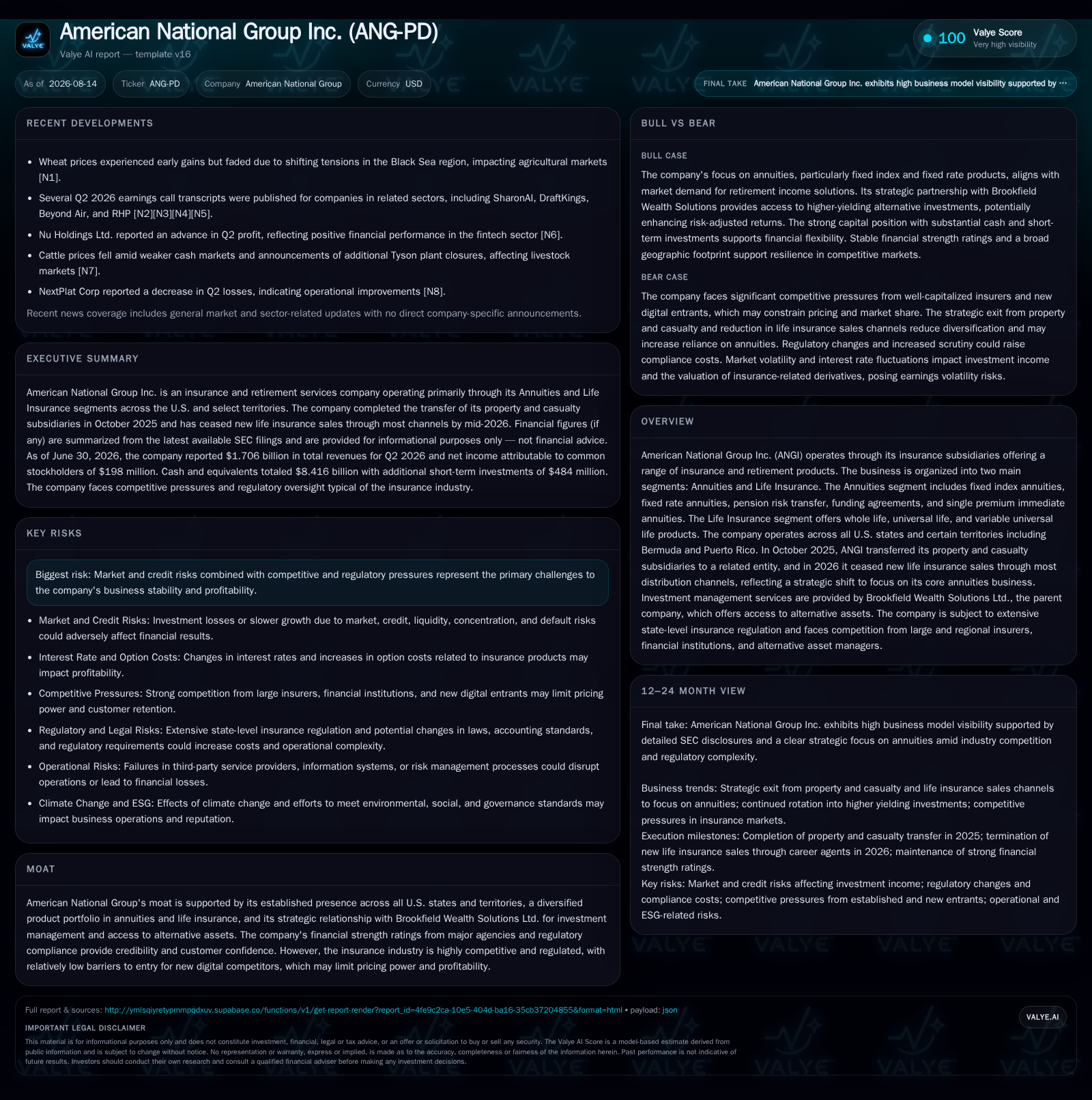
American National Group Inc. (ANGI) has recently crystallized a strategic pivot by exiting new life insurance sales across most channels to concentrate on its core annuities segment, reflecting industry pressures and evolving competitive dynamics. The latest 10-Q filing reveals that while deferred acquisition costs rose due to new annuity contracts, the company faced sizable negative swings in embedded derivatives’ fair value driven by interest rate and equity market movements. This underlines ongoing market risks typical for insurers with equity-indexed products. Backed by a robust capital base and strategic investment partnerships, ANGI operates in a highly regulated, competitive environment marked by shifting customer preferences towards retirement income solutions.
Recent Operating Update Highlights
ng factors [S2].
This volatility underscores persistent exposure common among insurers offering fixed index annuities with embedded guarantees tied to equity indices—a product segment where changes in market yields can swing liabilities materially quarter-to-quarter. The firm also reported a $25 million decline in deferred tax assets from year-end 2025 through June 2026 primarily due to Bermuda corporate income tax changes [S2], highlighting some geographic regulatory impact.
Another key recent event was the October 2025 transfer of all property & casualty subsidiaries—including American National Property And Casualty Company—to a fellow Brookfield Wealth Solutions Ltd. subsidiary [S1]. This corporate simplification reflects a sharpened strategy focusing ANGI’s efforts on its core life insurance and annuities segments.
On corporate finance matters, ANGI’s Board declared a quarterly dividend on Series D Preferred Stock payable July 15, 2026 at $0.4609375 per depositary share consistent with established payout policies [S3]
Business Model
ANGI derives its revenues primarily through underwriting fixed index annuities (FIAs), fixed rate annuities, pension risk transfers, funding agreements, single premium immediate annuities within its Annuities segment; alongside life insurance policies including whole life, universal life, and variable universal life products sold under its Life Insurance segment [S1]. Premiums collected from policyholders generate initial fee income but profitability depends heavily on ongoing investment income earned on reserves held against long-term obligations.
Crucially, ANGI leverages deferred policy acquisition costs accounting standards allowing capitalization of certain upfront marketing and underwriting expenses recoverable over time as contracts mature [S2]. This balance's growth signals active new contracts issuance despite ceasing most new life product sales in 2026—a deliberate move signaling recognition that competitive economics and regulatory burdens render that segment less attractive currently [S1].
The company generates revenue streams via premiums paid directly or via brokers/independent marketing organizations (IMOs), investment income from invested premiums—often including access to alternative assets through Brookfield Wealth Solutions—and also benefits from reinsurer arrangements mitigating underwriting risk exposures.
Margins are pressured by claims experience (claims ratio), persistency (policy renewal rates), expense ratios including commissions paid for IMOs or agents acquiring customers, as well as fluctuating investment yields sensitive to interest rate trends.
Industry Structure and Competitive Position
The U.S. life insurance and annuities industry is characterized by intense price competition compounded by complex regulatory oversight at state and federal levels [S1]. Large diversified insurers such as MetLife or Prudential Financial command scale advantages across multiple product lines but face similar challenges regarding legacy blocks of business burdened with onerous reserves.
In comparison, ANGI operates as a more focused specialist particularly after shedding P&C operations in late 2025 [S1]. This specialty allows nimbleness but also exposes risks tied closely to FIA product durability amid changing consumer preferences. The increasing commoditization of fixed index annuities—competing against digital direct models—and stricter capital reserving demands compress industry-wide ROEs.
Strategically marrying insurance underwriting with Brookfield’s asset management expertise provides ANGI differentiated investment capabilities not universally available among peers. This relationship facilitates access to alternative investments that can enhance yield even in low-interest-rate environments [S1]. However, credit risk remains as counterparties’ stability may fluctuate impacting reinsurance or derivatives hedges.
Growth Drivers
Key growth drivers for ANGI center on demographic trends fueling demand for retirement solutions offering lifetime income guarantees rather than pure risk protection. Increasing longevity elevates consumer appetite for products mitigating longevity risk which aligns well with ANGI’s FIA offerings.
Furthermore, rising financial literacy around retirement planning is broadening potential customer bases receptive to hybrid products providing both accumulation and income phases underpinned by steady distribution channels like independent marketing organizations [S1]
Product innovation focused on indexed returns coupled with downside protection may capture further market share versus traditional universal or variable universal life products whose sales have slowed leading up to the recent cessation announcement [S2]. Regulatory encouragement for lifetime income disclosures also supports annuity sales momentum across many states.
Lastly, geographic diversification within all US states plus territories such as Puerto Rico and Bermuda provides incremental avenues for expansion beyond crowded traditional markets.
Risks and Growth Constraints
ANGI faces several material risks endemic to the insurance sector: first among them is market risk stemming from adverse movements in interest rates and equity markets which significantly impact valuation of embedded derivatives present within FIAs [S2]. These fluctuations cause earnings volatility posing forecasting challenges.
Credit risk emanates from reinsurance counterparties failing obligations or derivatives counterparties not meeting hedge commitments potentially exposing ANGI to higher-than-expected liability outflows [S1]. Regulatory risk around capital adequacy ratios may tighten further compelling additional collateral reserves limiting free capital deployment.
Competitive pressure from new entrants particularly digitally native insurers offering faster customer onboarding at lower acquisition cost may erode pricing power especially for life insurance products now deemphasized internally [S1]. Also operational risks such as cybersecurity breaches or system outages pose reputational dangers relevant given growing digital connectivity needs
Liquidity constraints could arise under stressed cash flow scenarios if claims spike unexpectedly though current robust liquidity mitigates near-term concern [S2]. Lastly, legal contingency risks including litigation related to claim disputes or compliance investigations remain ever-present within large insurance firms.
What To Watch Next
Key upcoming milestones include:
- Monitoring quarterly trajectory of DAC/VOBA balances indicating sustained new contract writing activity primarily in annuity lines.
- Persistency rate trends revealing customer retention strength amidst evolving product mix.
- Sensitivity analyses around embedded derivative valuations as interest rate scenarios evolve reflecting liability adequacy.
- Updates on reinsurance arrangements and any changes influencing net risk exposure or cost structures.
- Further strategic moves clarifying future emphasis on digital distribution channels or product innovation pipelines.
- Dividend declarations will signal management’s confidence about near-term cash flow sufficiency post volatile market impacts [S3].
- Capital adequacy filings indicating status relative to regulatory minimums especially given derivative valuation swings impacting surplus calculations.
- Competitive positioning developments vis-à-vis other FIA-focused peers such as American Equity Investment Life Holding Company may provide comparative insight into growth sustainability.
Financial Profile Discussion
This article synthesizes publicly available regulatory filings without providing investment research views or forecasts. The analysis relies strictly on verifiable disclosures through SEC filings dated up to August 13, 2026.
Disclaimer: This is research-only, informational analysis and not investment advice. It may include AI-generated interpretation and general industry context. Always verify important details using primary sources.

Comments