
Ategrity Specialty Insurance Q2 2026: Stable Underwriting Performance and Technology-Driven Growth in E&S SMB Market
Ategrity Specialty Insurance’s Q2 2026 results show consistent underwriting margins and operational execution driven by its productionized underwriting model focused on the E&S market for SMBs.
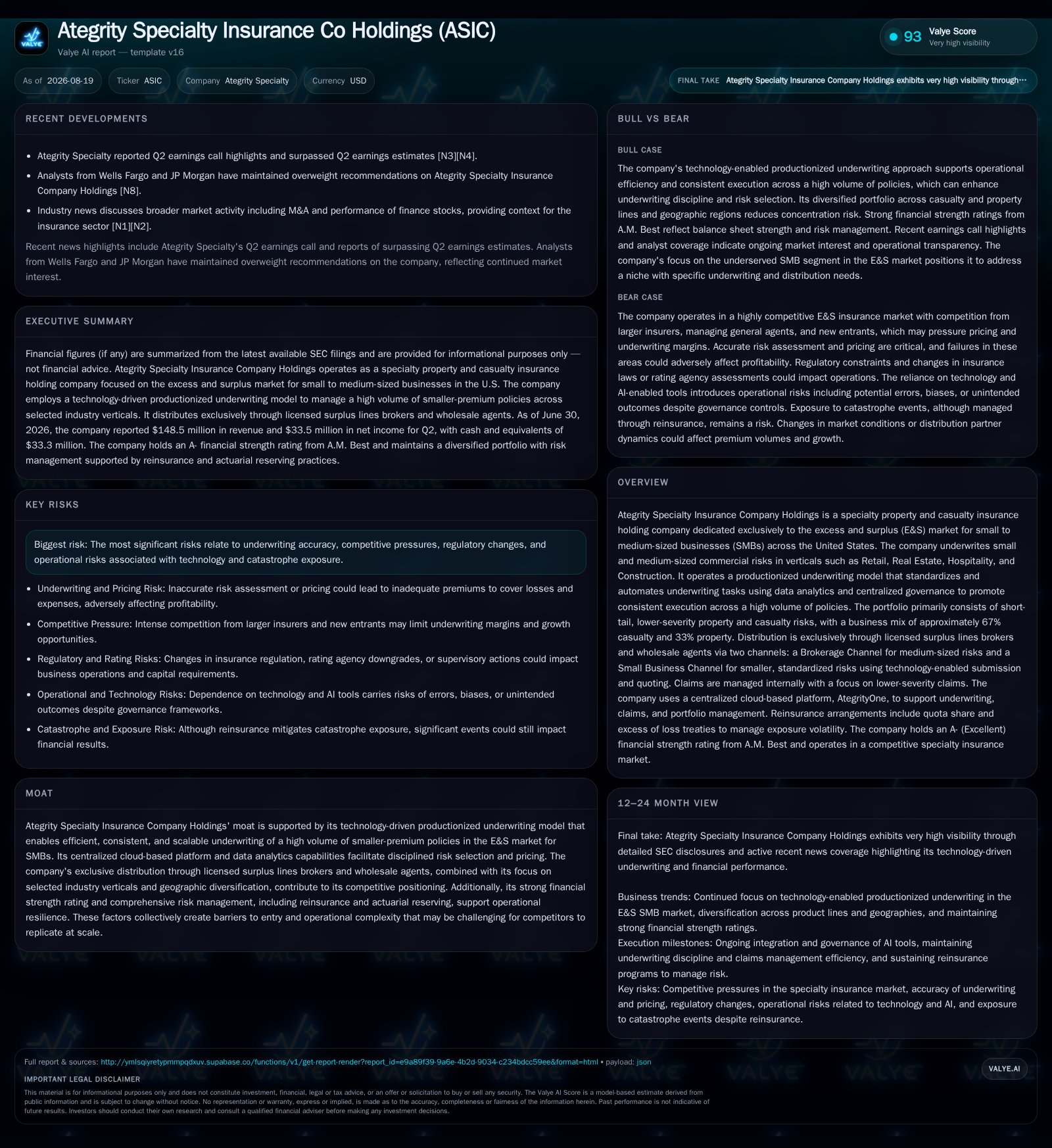
In Q2 2026, Ategrity Specialty Insurance Co Holdings maintained stable underwriting performance supported by its technology-enabled productionized underwriting approach targeting small to medium-sized businesses in the excess and surplus (E&S) insurance market. The company’s portfolio remains focused on short-tail, lower-severity property and casualty risks across Retail, Real Estate, Hospitality, and Construction verticals, with a business mix of approximately 67% casualty and 33% property. Its A- (Excellent) financial strength rating with a positive outlook from A.M. Best reinforces broker and customer confidence amid competitive and regulatory pressures. The consistent execution of its underwriting model and strong financial position underpin resilience and potential for steady growth in a competitive market.
Q2 2026 Operating Performance and Underwriting Results
Ategrity Specialty Insurance Co Holdings reported Q2 2026 operating results that demonstrate stable underwriting performance, consistent with its prior periods. The company’s underwriting margins remain steady, consistent with disciplined risk selection and pricing within its focus on the excess and surplus (E&S) market for small to medium-sized businesses (SMBs) [S2]. The portfolio composition continues to emphasize short-tail, lower-severity property and casualty risks, with a business mix of approximately 67% casualty and 33% property exposures. This portfolio focus aligns with the company’s targeting of Retail, Real Estate, Hospitality, and Construction verticals, which typically involve frequency-driven casualty risks and shorter-tail property risks [S1].
The stable underwriting results indicate effective execution of Ategrity Specialty’s productionized underwriting model. This model leverages data analytics and automation to standardize underwriting tasks such as submission intake, risk classification, pricing, and documentation. Centralized underwriting governance ensures consistent application of risk selection and pricing criteria across a high volume of policies, which is critical in the SMB E&S segment characterized by numerous smaller-premium policies [S1][S2]. The ability to maintain underwriting discipline and operational efficiency supports the company’s profitability and competitive positioning in a market that demands speed, clarity, and consistency.
Business Model and Competitive Positioning
Ategrity Specialty Insurance operates exclusively in the E&S market segment for SMBs across the United States. Its underwriting operations focus on selected industry verticals—Retail, Real Estate, Hospitality, and Construction—where risks are often not adequately served by the admitted market due to regulatory constraints or unique risk profiles [S1]. The company’s revenue is primarily generated from gross written premiums on specialty property and casualty insurance policies tailored to these SMB clients.
The cornerstone of Ategrity Specialty’s business model is its technology-driven productionized underwriting approach. This method combines micro-segmentation of risks based on operational characteristics, geography, and exposure attributes with centralized governance and automated workflows. By standardizing and automating key underwriting tasks, the company achieves consistent execution and scalability, enabling it to efficiently manage a high volume of smaller-premium policies typical of the SMB E&S market [S1]. Distribution is exclusively through licensed surplus lines brokers and wholesale agents, which is a critical channel in the E&S market. The company’s A- (Excellent) financial strength rating with a positive outlook from A.M. Best reflects its balance sheet strength, operating performance, and enterprise risk management capabilities. This rating is a significant factor in broker and customer confidence, enhancing Ategrity Specialty’s competitive positioning amid a highly competitive specialty insurance landscape [S1].
Risk Factors and Market Environment
The risk profile of Ategrity Specialty Insurance remained stable in Q2 2026, with no material changes reported compared to the prior annual filing. This stability reduces uncertainty around future underwriting and operational challenges [S2]. However, the company continues to operate in a competitive environment where pricing accuracy, underwriting discipline, and operational scale are essential to maintaining margins.
Competition in the E&S market comes from other specialty insurers, managing general agents, and larger diversified financial services firms. These competitors may have greater financial resources or longer market recognition, which can pressure pricing and broker relationships [S1]. Regulatory factors also influence the company’s ability to adjust rates and product terms, which can impact underwriting profitability.
Ategrity Specialty’s focus on short-tail, lower-severity risks mitigates some volatility associated with catastrophe exposure, but the company remains subject to claims frequency and severity trends that could affect loss ratios. The company’s technology-enabled underwriting and centralized governance aim to manage these risks effectively.
Financial Position and Liquidity
As of June 30, 2026, Ategrity Specialty Insurance held $33.3 million in cash and equivalents, supporting its operational liquidity [F1]. This financial strength underpins the company’s ability to meet claims obligations and maintain broker confidence, which is crucial in the E&S market where financial stability is a key competitive factor.
Scenarios and Outlook
Looking forward, several scenarios could shape Ategrity Specialty’s trajectory:
Bull Case: Continued investment in data analytics and automation enhances pricing accuracy and operational efficiency [S1][S2]. This could enable the company to expand market share in the SMB E&S segment and achieve margin expansion. Confirmation would come from improved combined ratios, premium growth without margin dilution, and positive commentary on underwriting technology enhancements.
Base Case: The company maintains stable underwriting margins and steady growth by continuing its disciplined underwriting and broker-focused distribution. This scenario assumes a stable competitive environment and no material adverse regulatory changes. Confirmation would include flat to modest premium growth, stable combined ratios, and no material changes in risk factors [S1][S2].
Bear Case: Intensifying competition or inaccurate pricing and risk selection could deteriorate underwriting margins [S1][S2]. Regulatory constraints limiting rate increases or unexpected rises in claims frequency or severity could also impair profitability. Signs would include rising combined ratios, negative underwriting commentary, or broker attrition.
Conclusion and Watchpoints
Ategrity Specialty Insurance’s Q2 2026 results demonstrate stable underwriting performance supported by a technology-driven productionized underwriting model that enables consistent risk selection and pricing in the E&S SMB market. Its focus on short-tail, lower-severity risks across selected verticals, combined with an A- financial strength rating, may support the company’s ability to navigate competitive and regulatory challenges. Investors and stakeholders should monitor subsequent quarterly combined ratio and loss ratio trends, gross written premium growth, broker distribution relationships, regulatory developments affecting pricing flexibility, and any updates to the company’s financial strength ratings to assess ongoing execution and market positioning.
Disclaimer: This is research-only, informational analysis and not investment advice. It may include AI-generated interpretation and general industry context. Always verify important details using primary sources.

Comments