
Atea Pharmaceuticals Advances Oral Antivirals with Critical Phase 3 Updates
Latest quarterly disclosures highlight progress in hepatitis C Phase 3 trials and secure financial footing ahead of pivotal NDA submission.
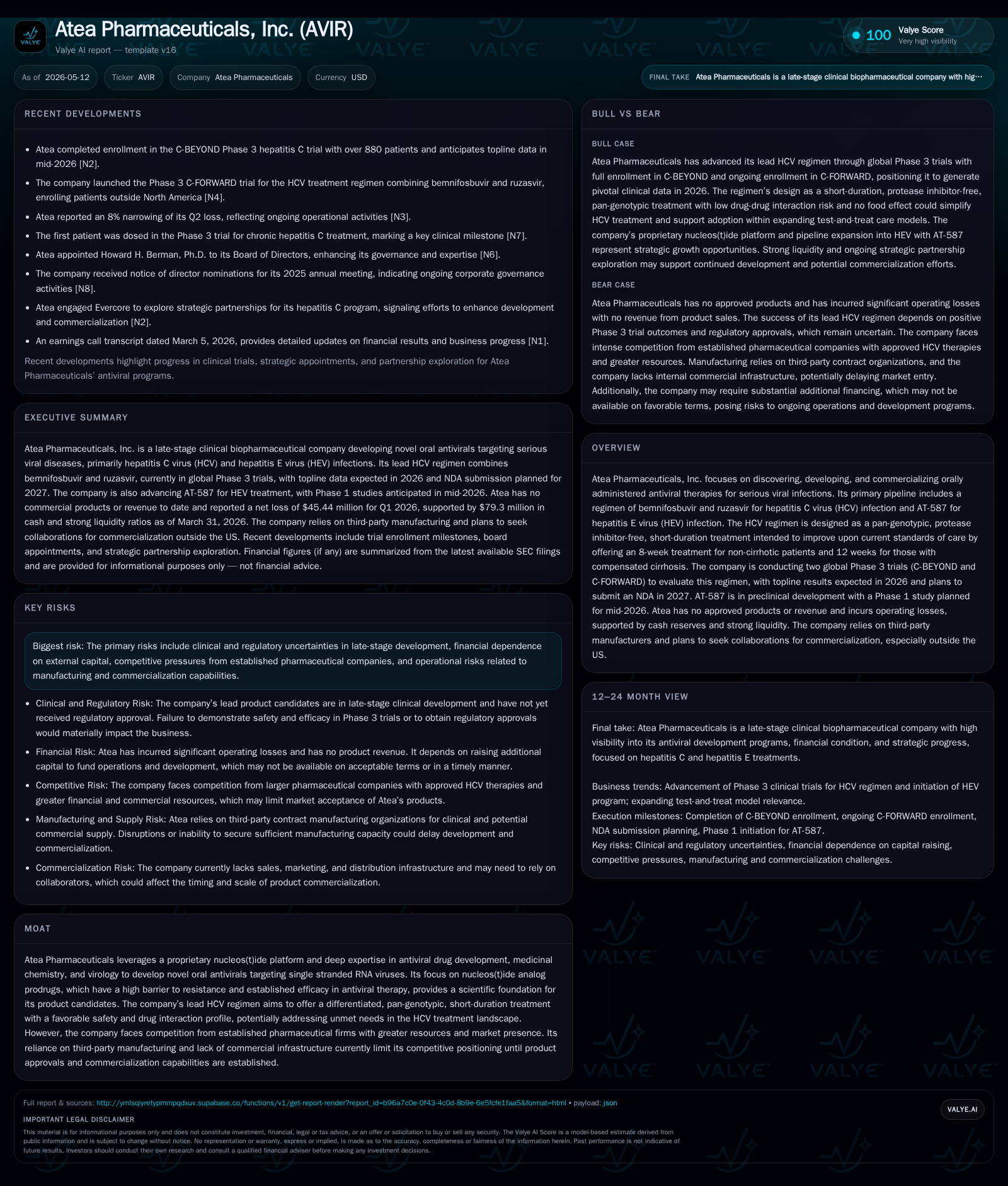
Atea Pharmaceuticals' May 2026 quarter filings confirm full enrollment of the C-BEYOND Phase 3 trial with topline results expected mid-year, alongside ongoing enrollment in C-FORWARD scheduled for year-end data. The company is progressing toward a planned NDA submission in early 2027 for its bemnifosbuvir/ruzasvir regimen targeting hepatitis C virus infection. Supported by a strong cash position and low current liabilities, Atea maintains runway to advance late-stage development despite no commercial revenue to date. Its nucleos(t)ide prodrug strategy aims to deliver a differentiated, protease inhibitor-free, pan-genotypic oral antiviral with shorter treatment duration – potentially disrupting established HCV therapies. Key risks include regulatory uncertainties, competition from large pharmaceutical incumbents, and scaling commercialization operations.
Recent Quarterly Update Frames New Near-Term Milestones
The latest quarterly report filed May 12, 2026 (10-Q) provides a definitive operational update on Atea Pharmaceuticals’ hepatitis C virus (HCV) drug pipeline. The critical C-BEYOND Phase 3 trial completed full enrollment with over 880 patients primarily across North America, marking a significant milestone toward generating pivotal efficacy and safety data. Topline results from this study are expected by mid-2026, which will set the tone for regulatory submission strategy. Concurrently, enrollment in the C-FORWARD global Phase 3 trial continues outside North America with an additional cohort of approximately 880 patients aiming for topline data release by year-end.
The company reaffirmed its plan to submit a New Drug Application (NDA) around the first half of 2027 to the U.S. Food and Drug Administration (FDA) seeking marketing approval for the combined regimen of bemnifosbuvir and ruzasvir targeting chronic HCV infection [S2][S3]. These disclosures affirm Atea’s transition into a late-stage biopharmaceutical entity entering a critical data-driven inflection period.
Financially, as of March 31, 2026, Atea maintained $79.3 million in cash and equivalents with current assets totaling $263.2 million against $33.4 million in current liabilities, yielding an enviably strong current ratio of approximately 7.9 [F1]. This liquidity position supports ongoing costly clinical development efforts through at least the anticipated NDA submission horizon despite having no product revenue yet.
Business Model and Product Pipeline: Oral Antivirals for Hepatitis C and E
Atea operates as a pure-play clinical-stage biopharmaceutical company focused on discovering and developing orally administered antivirals targeting serious viral diseases driven by single-stranded RNA viruses [S1]. It leverages its proprietary nucleos(t)ide analog prodrug platform—a validated antiviral design known for high barriers to resistance—to formulate candidates with improved efficacy, safety, and drug-drug interaction profiles.
The lead asset is the fixed-dose combination regimen of bemnifosbuvir (a nucleotide polymerase inhibitor) plus ruzasvir (an NS5A inhibitor), positioned as a pan-genotypic HCV therapy free of protease inhibitors—a salient regulatory and safety differentiator given concerns about drug interactions and adverse events in protease inhibitor-containing regimens. The regimen targets an unmet clinical need by offering a short-duration treatment spanning eight weeks for non-cirrhotic patients and twelve weeks for those with compensated cirrhosis [S1]. This contrasts with existing regimens which generally require longer courses or include protease inhibitors that complicate therapy.
Additionally, Atea is developing AT-587 for hepatitis E virus (HEV) infection. AT-587 remains in preclinical development but is poised to begin Phase 1 clinical testing by mid-2026, aiming to be the first direct-acting antiviral approved specifically for chronic HEV infections—particularly among immunocompromised populations lacking effective therapies [S1].
The company depends on third-party contract manufacturers to supply active pharmaceutical ingredients (APIs) and finished dosage forms essential to clinical trials and eventual commercialization preparations [S1]. It also shoulders anticipated milestone payments tied to development progress under collaboration agreements.
Industry Competitive Landscape and Positioning
Atea stands amid well-capitalized incumbents that dominate the HCV treatment market with well-established nucleotide inhibitor-based regimens like sofosbuvir-containing combinations backed by extensive clinical experience and global market penetration. These competitors benefit from entrenched commercial infrastructures, longstanding physician familiarity, and broad payer coverage.
Though Atea’s bemnifosbuvir/ruzasvir regimen offers several compelling clinical differentiators—chiefly its pan-genotypic coverage without protease inhibitors enabling potentially safer polypharmacy profiles—its commercial position is hindered currently by its lack of internal sales force or marketing capabilities. The reliance on external manufacturing adds layers of operational risk when scaling toward launch readiness.
Pricing dynamics in pan-genotypic HCV therapies remain competitive; new entrants typically face pressure to match or undercut existing wholesale acquisition costs while proving superior safety or shorter treatment duration benefits sufficient to justify adoption [S1]. Thus, achieving favorable pricing parity post-launch will be challenging.
Overall, while scientifically differentiated, Atea has sizable hurdles prior to securing meaningful commercial footprint against incumbents like Gilead Sciences’ Epclusa or Veklury-generics.
Growth Drivers: Phase 3 Trials, Regulatory Pathway, and Market Potential
The most immediate growth engines are the two contemporaneous global Phase 3 registrational trials:
- C-BEYOND: Fully recruited over 880 patients in North America evaluating non-inferiority against active comparator sofosbuvir/velpatasvir; topline readout expected mid-2026.
- C-FORWARD: Enrolling additional ~880 patients internationally covering diverse HCV genotypes; topline data projected late-2026.
Success across these registries will underpin NDA filing planned early next year, facilitating marketing approval pathways within major geographies including the U.S.
A successful shorter treatment duration regimen addressing predominantly young non-cirrhotic patients could lower overall healthcare burden by improving medication adherence and reducing side effects associated with longer courses or protease inhibitors [S1]. Additionally, the low drug-drug interaction profile expands suitability particularly among populations managing multiple comorbidities.
The expansion into HEV therapy through AT-587 represents a medium-term diversification avenue into a distinct viral subset lacking direct antivirals today. Given immunocompromised patients’ vulnerability to chronic HEV complications without effective options currently available, AT-587’s first-in-class potential may create further value if clinical programs succeed [S1][S2].
Key Risks and Operational Constraints Ahead of Commercialization
Risks predominantly revolve around clinical endpoints not being met or safety signals emerging during pivotal Phase 3 studies that could delay or derail approval timelines [S1]. Regulatory hurdles also remain material given FDA scrutiny toward new antiviral entities entering crowded markets.
Operationally, transitioning from development focus to establishing scalable manufacturing capacity alongside building sales and marketing capabilities poses execution risk given Atea presently relies entirely on third-party contract manufacturing without an in-house commercialization infrastructure [S1]. Financing future growth remains contingent upon continued access to capital markets as persistent operating losses reflect sizeable R&D investment without product revenues yet realized.
Competitive threats are significant as incumbents may innovate further or engage in aggressive pricing tactics limiting uptake potential for new entrants offering differentiated but incremental improvements.
Milestone payment obligations tied to partnership agreements—such as the $10 million payment upon NDA acceptance—and tiered royalties on future sales may constrain operating leverage upon eventual launch [S1].
Upcoming Catalysts and Strategic Execution Watchpoints
Stakeholders should monitor several near-term catalysts:
- Mid-2026: Topline efficacy/safety readout from C-BEYOND could validate or challenge core hypotheses supporting NDA filing timing.
- Late-2026: Results from C-FORWARD confirming broad genotype coverage critical for global label expansion.
- Early-2027: Expected FDA acceptance of NDA constitutes a pivotal regulatory green light signaling commercial pathway viability.
- Manufacturing scale-up progress ahead of potential launch readiness indicative of operational maturity.
Tracking patient enrollment velocity in C-FORWARD remains informative regarding recruitment efficiency outside North America amid heterogeneous genotype prevalence patterns.
Financial Profile: Cash Position, Operating Losses, and Capital Runway
As reported in Q1 ended March 31, 2026, Atea held approximately $79.3 million in cash equivalents supported by $263.2 million in current assets compared against $33.4 million current liabilities—translating into a robust current ratio near 7.9 that underscores short-term liquidity strength [F1].
Operating losses reflect sustained R&D investment necessary at this late stage: full-year expenses were roughly $180.9 million in FY25 consistent with prior year burdens highlighting absence of product revenues [F1][S1]. This financial profile signals near-term dilution risk accompanying continued capital raises required through critical clinical milestones but provides sufficient runway targeting NDA submission timelines.
Latest Financial Snapshot Table:
Latest financial snapshot
| Metric | Value | Period |
|---|---|---|
| Cash & equivalents | $79mm | |
| 2026-03-31 | ||
| Current assets | $263mm | |
| 2026-03-31 | ||
| Current liabilities | $33mm | |
| 2026-03-31 | ||
| Current ratio | 7.89x | |
| 2026-03-31 |
Source: SEC companyfacts cache [F1].
Disclaimer: This analysis is based solely on information publicly available as of May 12, 2026 from SEC filings and company disclosures cited herein; it does not constitute investment advice.
Disclaimer: This is research-only, informational analysis and not investment advice. It may include AI-generated interpretation and general industry context. Always verify important details using primary sources.

Comments