
Galera Therapeutics Accelerates Strategic Transition Through Merger and Asset Realignment
Recent filings reveal Galera Therapeutics' corporate restructuring via a merger with Obsidian Therapeutics and a focused shift away from commercial-stage products.
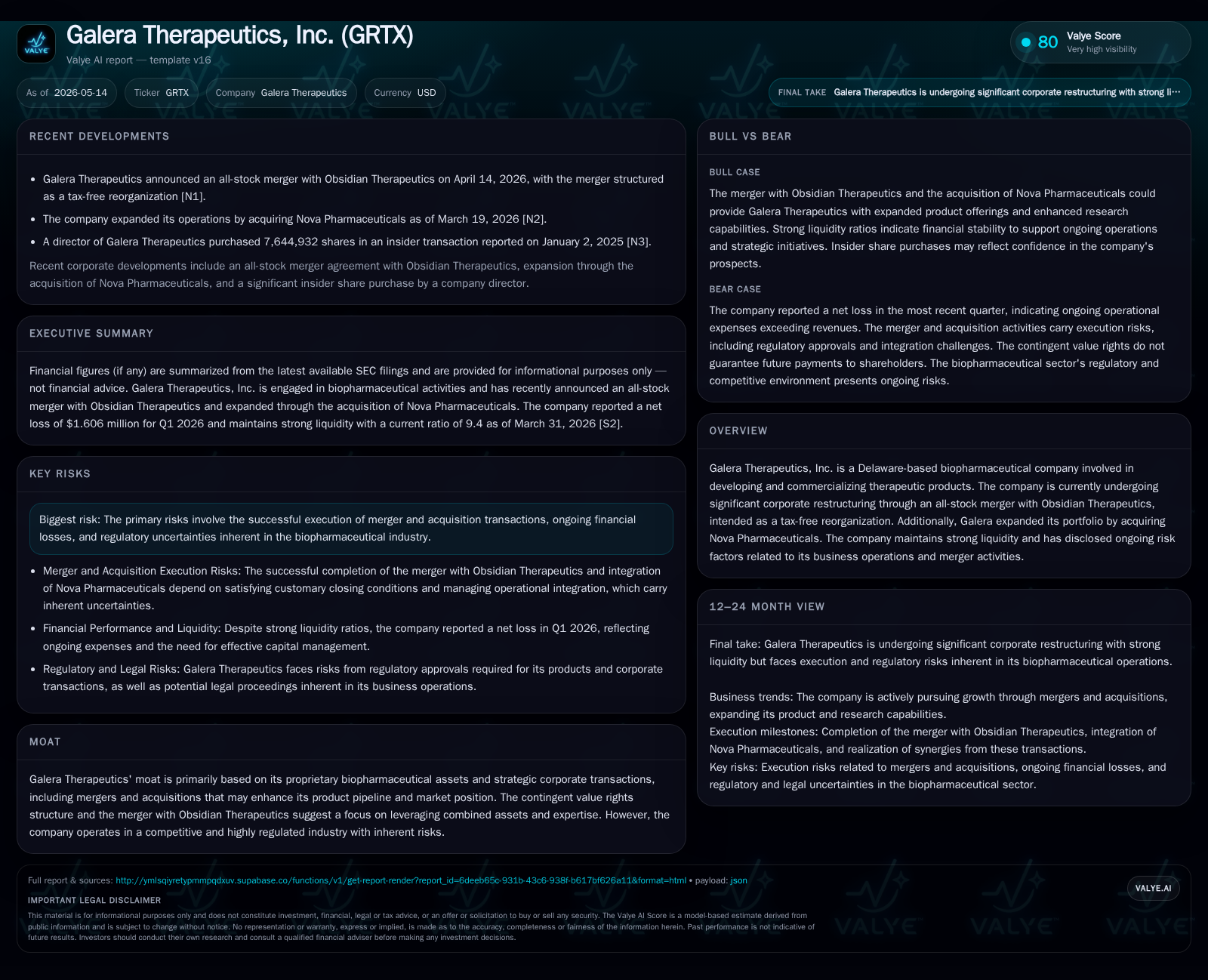
Galera Therapeutics is executing a pivotal strategic transformation anchored by an all-stock merger agreement with Obsidian Therapeutics and the acquisition of Nova Pharmaceuticals, signaling a new growth trajectory. The company has divested its primary clinical-stage antioxidant assets, avasopasem and rucosopasem, to Biossil Inc., suspending prior development programs. These moves position Galera to leverage combined biopharmaceutical platforms post-merger while maintaining operational liquidity. However, execution risks remain elevated amid ongoing integration challenges and regulatory uncertainties.
Recent Operating Update
The most recent quarterly report dated May 14, 2026, anchors Galera Therapeutics’ current strategic narrative around an all-stock merger with Obsidian Therapeutics intended as a tax-free reorganization [S2]. This transaction follows a decisive move in late 2025 where Galera divested its clinical-stage antioxidant assets—avasopasem (GC4419) and rucosopasem (GC4711)—to Biossil Inc., effectively suspending further development or commercialization efforts for these compounds [S26]. The company concurrently acquired Nova Pharmaceuticals, broadening its therapeutic portfolio beyond its previous focus.
Liquidity metrics remain solid amid these strategic shifts, with cash and equivalents reported at $5.5 million and a strong current ratio of approximately 9.4 as of March 31, 2026 [F1]. This liquidity profile supports funded operations during the merger process and subsequent integration phase.
An April 14, 2026, press release formalized the merger agreement alongside a securities purchase agreement bringing in approximately $350 million through concurrent PIPE financing aimed at bolstering the combined entity’s capital base [S20]. Subsequent filings detailed stockholder voting outcomes affirming charter amendments including increased authorized capital stock and provisions facilitating written consent rights—governance changes aligned with anticipated post-merger corporate structure shifts [S17].
Business Model
Historically centered on developing novel dismutase mimetics targeting oxidative stress pathways in oncology supportive care, Galera has transitioned its business model following the Biossil asset sale. It no longer directly generates revenue from product sales or licensing of avasopasem or rucosopasem but instead pivots to leveraging proprietary intellectual property along with acquired assets through the Nova Pharmaceuticals transaction.
Revenue mechanics are currently minimal given halted commercial readiness activities noted in recent disclosures [S26], shifting the company’s value proposition toward R&D pipeline advancement and corporate development events such as mergers that unlock shareholder value through expanded therapeutic scope.
Operational expenses predominantly reflect research investments in developing new candidates post-merger, administrative costs related to corporate governance adjustments, and integration planning. Margins remain negative as is typical for early-stage biopharmaceutical enterprises without marketed products.
Industry Structure and Competitive Position
Galera operates within the highly competitive biopharmaceutical sector characterized by intensive regulation, substantial capital requirements, significant scientific risk, and a complex path to market approval. Its therapeutic focus on oxidative stress modulation differentiates it within niche indications such as radiation-induced tissue injury but faces competition from broader enzymatic antioxidant candidates and emerging gene-/cell-based modalities.
The proposed merger with Obsidian Therapeutics unites complementary technology platforms potentially strengthening combined pipeline depth by integrating Obsidian’s synthetic biology expertise with Galera’s clinical-stage assets [N1], which could enhance competitive positioning through expanded intellectual property barriers.
However, industry barriers remain formidable including long timelines for clinical validation, regulatory hurdles (FDA approvals), reimbursement challenges post-launch, and the necessity of strategic partnerships or alliances to commercialize successfully.
Growth Drivers
Post-merger growth will be driven by advancing newly combined pipeline candidates through preclinical/clinical milestones. The acquisition of Nova Pharmaceuticals also adds diversification potential in therapeutic targets beyond traditional oxidative stress approaches. Successful integration promises cross-functional synergies—technology platforms merging discovery capabilities with clinical readiness.
Milestones to track include:
- Effectiveness declaration of SEC Form S-4 registration statement necessary for closing the merger [S22]
- Receipt of requisite stockholder consents for both Galera and Obsidian shareholders [S17]
- Progression of combined R&D projects through IND submissions or early-phase trials announced publicly
- Deployment of PIPE financing proceeds toward prioritized development programs enhancing valuation trajectories
Structural drivers also include broader trends favoring personalized medicine approaches where oxidative stress mitigation intersects with immuno-oncology strategies—domains attracting significant investor interest.
Risks and Watchpoints
Key risks revolve around successful execution of the merger:
- Timing risks associated with regulatory filings clearance (Form S-4), stockholder approvals, and closing conditions [S20]. Delays or failures in any step could jeopardize anticipated strategic benefits.
- Execution risk during post-close integration where cultural fit between organizations influences R&D productivity.
- Financial risk linked to ongoing cash burn given absence of product-generated revenues; dependency on external financing remains acute despite recent PIPE infusion plans.
- Regulatory uncertainties inherent in biopharmaceutical development risking pipeline devaluation if novel candidates fail clinical endpoints or face approval delays.
- Potential dilution for existing shareholders arising from large equity issuance tied to the merger financing structure.
The consolidated risk factor discussions in both the latest annual [S1] and quarterly filings reinforce industry-standard caution emphasizing developmental program failure potential along with transactional counterparty risks related to mergers.
What to Watch Next
Progression toward consummation of the described all-stock merger is paramount. Upcoming signals include:
- Declaration by SEC regarding effectiveness of Form S-4 filing facilitating issuance of Parent common stock as merger consideration [S22]
- Final quantitative updates on Pipeline candidates' advancement or new IND-enabling studies initiated under combined entity auspices.
- Detailed plans on utilization of capital raised via Concurrent PIPE Financing slated to support integrated operations.
- Investor communications clarifying pro forma financial profile post-closing including any guidance updates released alongside next quarterly results.
Monitoring corporate governance votes will also be essential given recent approvals around charter amendments affecting capital structure flexibility going forward [S27].
Financial Profile Contextualized
Latest financial snapshot
| Metric | Value | Period |
|---|---|---|
| Cash & equivalents | $6mm | |
| 2026-03-31 | ||
| Current assets | $6mm | |
| 2026-03-31 | ||
| Current liabilities | $645000 | |
| 2025-12-31 | ||
| Current ratio | 9.4x | |
| 2026-03-31 |
Source: SEC companyfacts cache [F1].
While Galera remains pre-revenue due to asset divestitures and suspended product commercialization efforts, liquidity stands sufficient for near-term operational continuity. As of March 31, 2026:[F1]
| Metric | Value | Period End |
|---|---|---|
| Cash & Equivalents | $5.5M | |
| 2026-03-31 | ||
| Current Assets | $6.06M | |
| 2026-03-31 | ||
| Current Liabilities | $0.645M | |
| 2025-12-31 | ||
| Current Ratio | 9.4 | Calculated |
Operating expenses continue to contribute negative operating income dynamics consistent with an R&D-driven entity without product sales revenue [F1]. The expected infusion from the concurrent PIPE financing is likely unreflected yet in these figures but will bolster cash resources substantially upon closing [S20].
This transition phase reflects typical biopharma early-stage structural characteristics: high cash consumption tied to sustained innovation efforts coupled with reliance on capital markets until commercial-scale revenues become viable.
Disclaimer: This analysis is based solely on publicly available information up to May 14, 2026. It does not constitute investment advice or recommendations but aims to provide an informed industry overview grounded in disclosed data points.
Disclaimer: This is research-only, informational analysis and not investment advice. It may include AI-generated interpretation and general industry context. Always verify important details using primary sources.

Comments