
Adaptin Bio Advances with Licensing and Research Partnerships Despite Cash Constraints
Adaptin Bio’s latest quarterly filing illustrates ongoing liquidity challenges balanced with strategic research collaborations and patent licensing arrangements.
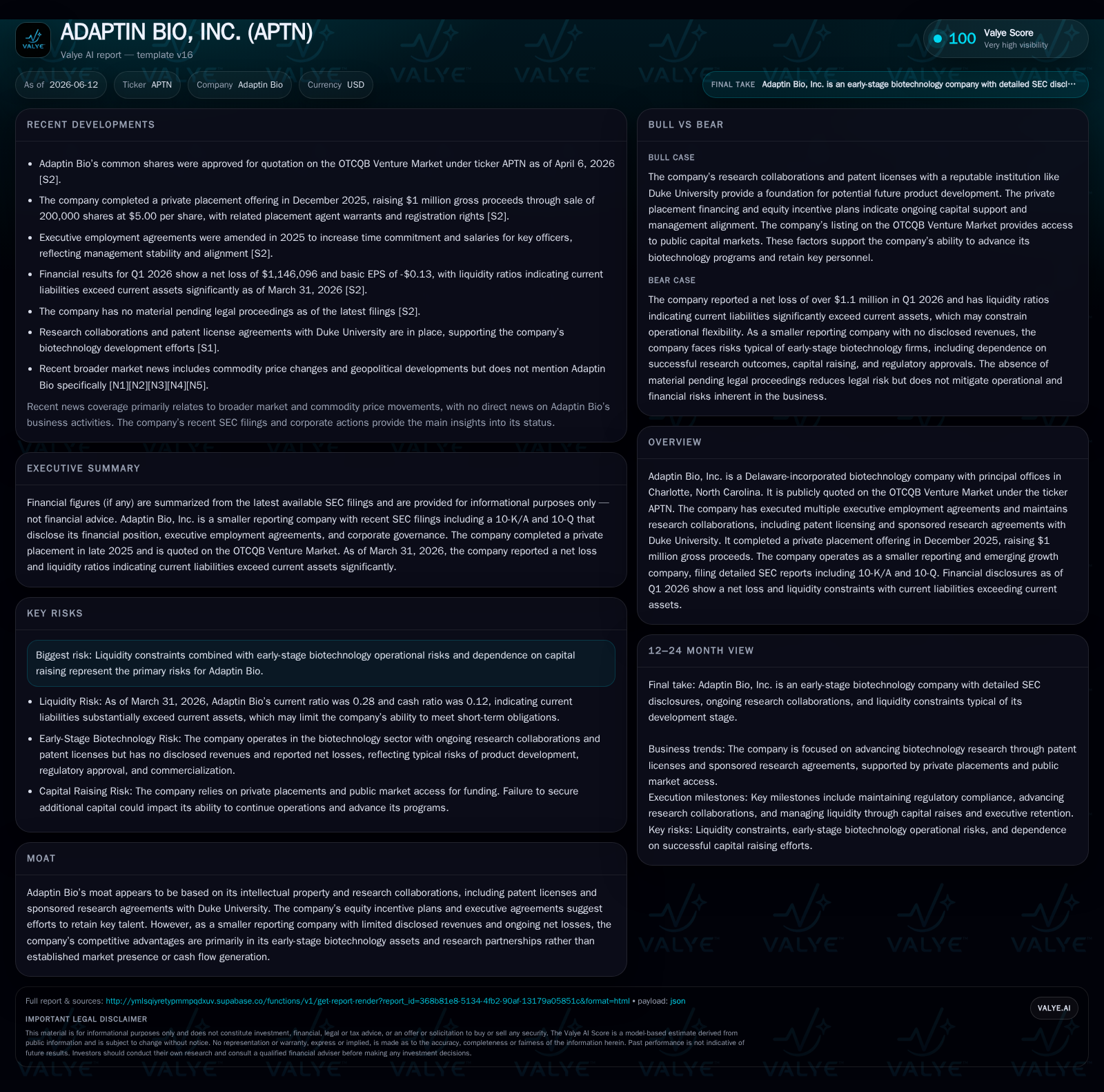
In its Q1 2026 10-Q filing, Adaptin Bio, Inc. reveals severe liquidity constraints marked by a current ratio of 0.28 and current liabilities outstripping current assets by a wide margin. Despite this, the company continues to leverage intellectual property partnerships with Duke University, including patent licensing and sponsored research agreements, which form the cornerstones of its early-stage biotech business model. The firm’s limited funding runway underscores the critical need for capital raises while operational efforts remain focused on advancing preclinical and discovery-stage programs. Executive employment agreements combined with equity incentive plans aim to mitigate talent retention risks amid these financial limitations.
Q1 2026 Operating Update Highlights Cash Strain Amid Early R&D Efforts
Combined with a continuing net loss position revealed in preceding reports with operating deficits near $5.4 million as recently as end-2025 [F1], the financial snapshot demands an intense focus on cash management. Despite these constraints, Adaptin Bio successfully secured OTCQB Venture Market quotation in April 2026 under ticker APTN, a milestone enhancing access to public investors but not immediately resolving liquidity deficiencies [S3][S9].
Business Model Centered on Research Collaborations and Licensing Revenue Streams
Adaptin Bio operates as an early-stage biotechnology entity specializing in novel biologics discovery and preclinical research endeavors. Its core revenue model pivots on leveraging intellectual property derived from academic collaborations—most notably with Duke University—via patent licensing agreements and sponsored research contracts [S1][S27]. These arrangements enable the company to monetize proprietary drug candidates at formative stages through milestone payments and research funding inflows rather than commercial sales.
Such structure typifies emerging growth companies reliant on external innovation sources where university tech transfer offices anchor IP through license fees while fostering joint scientific development. Adaptin’s December 2025 private placement raising $1 million gross demonstrates ongoing capital raising dependency integral for maintaining R&D activity under this licensing arrangement framework [S15]. The model also hinges critically on expenditure controls given net losses continue amid asset build-out before any regulatory submission or pivotal trials.
Equity incentive plans coupled with executive employment contracts amended during late 2025 reinforce management’s intent to retain specialized talent essential for steering complex biology programs forward despite financial tightropes [S19]. Increased commitment levels for executives such as CFO Maness and CDO Hewitt—who each received salary raises coinciding with enhanced company engagement thresholds—reflect calculated measures to mitigate attrition risk that could jeopardize the nascent pipeline
Intellectual Property Portfolio Anchored by Duke University Agreements
Adaptin's value proposition rests substantially on its intellectual property estate licensed from Duke University under formal patent license agreements dating back to early 2023 with amendments extending into mid-2024 [S1][S27]. These licenses grant rights to proprietary biologic compounds or platforms foundational to the company’s drug candidate pipeline still largely at early discovery or preclinical R&D phases.
Complementing these are sponsored research agreements facilitating joint laboratory investigation and technology validation efforts backed by university scientists—supporting both innovation depth and IP fortification beneficial for future sublicensing or partnership negotiations.
This dual-layer collaboration places Adaptin alongside other small-cap biotechs leaning on prestigious academic IP assets as initial commercial footholds prior to scaling clinical trial activities or out-licensing arrangements with larger pharmaceutical entities. Success in augmenting this portfolio via new patents or further amendments remains a critical KPI directly linked to licensing revenue potential and milestone accrual timing.
Competitive Context Among Emerging Growth OTCQB Biotechnology Players
In the broader industry context, Adaptin Bio occupies the early R&D segment of the biotechnology value chain where companies frequently struggle with protracted cash burn before visible clinical advances or product sales materialize. The OTCQB listing categorizes it among smaller venture-stage biotechs facing analogous liquidity pressures yet possessing scientific assets licensed from academic institutions—an archetype reminiscent of firms like Moderna or CRISPR Therapeutics during their infancy but far earlier in pipeline maturity.
Competition arises not only from peer biotech startups but also established pharma companies seeking innovative biologics through partnerships or acquisitions. Adaptin's relatively constrained cash reserves put upward pressure on executing timely capital raises essential for maintaining operational continuity while developing sufficient clinical data necessary to attract strategic partners or licensees.
Growth Catalysts From Research Progress and Future Capital Raises
Key growth drivers for Adaptin hinge upon achieving milestone payments embedded in its licensing agreements as pipeline candidates progress along discovery-successful research validations toward potential regulatory submission stages. Expansion of its patent portfolio strength through new filings or enhancements could unlock additional licensing opportunities facilitating non-dilutive revenue streams.
Capital raising efforts akin to the December 2025 private placement remain vital. The small size of that raise underscores both challenge and urgency in prolonging cash runway beyond immediate quarters given ongoing negative operating income trends [F1][S15]. Incremental R&D investment targeted at pipeline diversification may also enhance platform relevance but will inevitably escalate burn rate requiring prudent fund management.
Lastly, strategic partnerships with pharmaceutical companies could serve as inflection points enabling resource sharing or co-development pathways necessary for transitioning candidates into clinical trials—a sector milestone measurable via active study initiations or FDA engagement evidencing progression beyond preclinical phases.
Risks From Capital Scarcity, Clinical Progress Uncertainty, and Partner Dependency
Liquidity constraints stand out as the most pressing risk factor. With current liabilities vastly exceeding liquid assets and modest cash balances reported through Q1 2026, maintaining sufficient capital until reaching sustainable revenue inflows is tenuous [F1]. Prolonged reliance on equity financing may dilute shareholder value while market conditions affecting fundraising feasibility add uncertainty.
Clinical trial success remains unproven given the lack of disclosed active trials or regulatory submissions so far; failure or delays could stall milestone revenues destabilizing cash flow assumptions underlying continued operations. Moreover, heavy dependency on research collaborations with Duke University introduces counterparty risk should relationships falter or licensing terms require renegotiation.
Talent retention risks persist despite executive contract enhancements obligating increased officer dedication levels coupled with incentivization through equity awards [S19]. Loss of key personnel critical in navigating complex biological challenges could impede pipeline execution timelines substantially.
"What To Watch Next": Milestones, Funding Events, Pipeline Developments
Investors following Adaptin should monitor upcoming milestones related to licensing revenue triggers embedded in Duke University agreements potentially disclosed in future SEC filings or press releases. Any announcements marking progress from discovery toward preclinical validation stages would signify tangible pipeline momentum aligned with biotech KPIs.
Additional capital raising initiatives will be pivotal indicators of viability given constrained liquidity noted in Q1 results; success in securing sizable financing would extend operative runway reducing default risk scenarios.
Furthermore, adaptations in executive leadership structures or new equity incentive grants might signal internal focus shifts toward bolstering development capabilities amid competitive pressure.
Cash reserves totaling approximately $301K juxtaposed against nearly $2.5M in short-term obligations translate into a critical current ratio near 0.28 signaling distress under conventional working capital assessments [F1]. The latest known total debt figure dated September 2024 stood modestly at about $138K but does not offset immediate liquidity pressures notably given net losses exceeding $5 million annually reported at end-2025 [F1].
A recent private placement offering conducted in December 2025 produced gross proceeds of $1 million supporting interim funding needs; however, operational burn rates continue eroding available resources highlighting an urgent need for additional financing rounds [S15]. Expense management focused primarily on research and administrative costs remains vital alongside maximizing milestone-based inflows derived from intellectual property endeavors shared with Duke University [S1][S27].
The company’s designation as an emerging growth entity relieves some regulatory burdens but simultaneously demands cautious stewardship over scarce capital pools while demonstrating tangible progress toward commercialization benchmarks necessary for sustained investor confidence.
This analysis reflects information available through Adaptin Bio’s latest SEC filings as of June 12, 2026 and industry-standard benchmarks relevant to early-stage biotechnology enterprises. It is intended solely for informational purposes without any research view or endorsement.
Disclaimer: This is research-only, informational analysis and not investment advice. It may include AI-generated interpretation and general industry context. Always verify important details using primary sources.

Comments