
BIO-key International Faces Nasdaq Delisting Warning Amid Growing Security Demands
Recent Nasdaq notice on BKYI’s delayed filing spotlights regulatory risks amid its unique biometric IAM platform growth challenges.
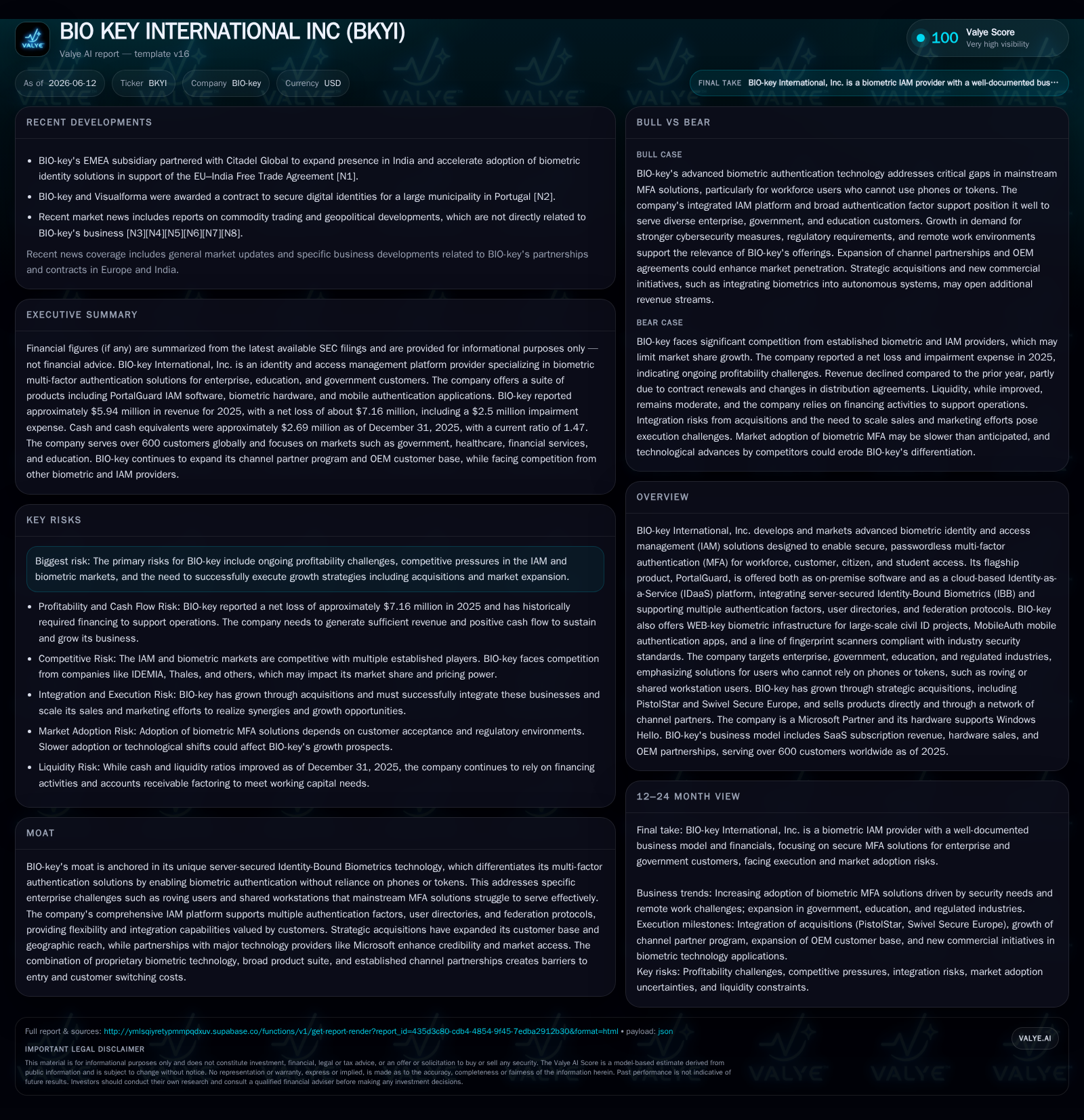
BIO-key International recently received a Nasdaq delisting notice due to its failure to file the Q1 2026 report timely, underscoring near-term governance and compliance concerns. The company’s core differentiation lies in its patented server-secured Identity-Bound Biometrics technology that positions it uniquely within the Identity and Access Management (IAM) market by enabling passwordless, phone- and token-free multi-factor authentication (MFA). Despite growing demand from enterprises, governments, and education sectors driven by remote work and enhanced cybersecurity mandates, BIO-key continues to face profitability headwinds characterized by high operating expenses and cash burn. Success depends on navigating competitive pressures, closing operational gaps, and executing on SaaS transition and partnership strategies.
Nasdaq Notice Highlights Regulatory Pressure and Reporting Gap
On June 5, 2026, BIO-key International received formal notification from the Nasdaq Listings Qualifications Department warning of potential delisting of its common stock due to failure to file its Quarterly Report on Form 10-Q for the period ended March 31, 2026 as mandated by Nasdaq Listing Rule 5250(c)(1) [S3]. This event signals acute governance challenges that risk undermining investor confidence during an already demanding competitive environment. Although the notification itself is procedural rather than punitive at this juncture, it places near-term pressure on BIO-key’s management team to restore compliance promptly. This regulatory spotlight reframes analysis of the company's operational execution discipline alongside its strategic positioning in the Identity and Access Management (IAM) market.
Product Suite Anchored by Identity-Bound Biometrics Sets BIO-key Apart
BIO-key’s distinctive competitive edge is rooted in its patented server-secured Identity-Bound Biometrics (IBB) technology which powers its multi-factor authentication (MFA) offerings without reliance on external devices like phones or tokens [S1]. Its flagship product PortalGuard offers a hybrid delivery model — both cloud-based Identity-as-a-Service (IDaaS) and on-premises software — enabling integration across multiple user directories (Azure AD, LDAP, IBM Domino) and federation protocols (OIDC, SAML) for scalable access management [S23]. Complementing this ecosystem are WEB-key biometric platforms serving large civil ID projects, MobileAuth apps for biometric mobile authentication, and fingerprint scanning hardware compliant with industry standards such as FIPS-201 [S13]. The server-secured biometric factor essentially binds authentication directly to the user’s biometric identity rather than a device or passcode, facilitating seamless passwordless access while enhancing security.
This approach addresses gaps left by mainstream MFA solutions like Okta or Duo Security that commonly rely on mobile devices or tokens — options unfit for certain workforce segments such as roving users or employees sharing kiosks. BIO-key’s product relevance is heightened in enterprise environments where users require flexible yet secure access without cumbersome hardware or workflows.
Market Context: Addressing IAM Limitations for Roving and Shared Users
Traditional MFA solutions tend to struggle with user classes that cannot carry phones or tokens consistently — a niche BIO-key specifically targets. These include workers in manufacturing floors, call centers with shared terminals, or government agencies with stringent physical device policies [S1]. By enabling biometrics via fingerprint scanners or mobile biometric apps not tied exclusively to phone possession, BIO-key lowers friction while mitigating security risks posed by credential sharing or lost devices.
This niche positioning taps into a broader security imperative magnified by rising cybersecurity incidents targeting remote workforces. The increasing requirement from infosec policies and cyber insurance underwriters for strong MFA adoption provides BIO-key opportunities to capture incremental enterprise demand underserved by dominant cloud IAM providers focusing primarily on traditional token-based MFA.
Growth Drivers Supported by Passwordless MFA Adoption Trends
BIO-key benefits from macro tailwinds including regulatory mandates (e.g., NIST guidelines), escalating cyber threats emphasizing phishing resilience, and accelerating cloud transition prompting enterprises to modernize identity controls [S1],[S27]. The pandemic-driven shift towards remote work has entrenched persistent demand for robust yet user-friendly authentication methods that reduce reliance on passwords — long considered vulnerable attack vectors.
These trends favor technologies like biometrics implementing passwordless MFA at scale. Moreover, BIO-key’s strategic partnerships with Microsoft Azure Active Directory extend its reach into well-established enterprise security ecosystems enhancing customer pipeline potential [S13]. Additionally, the company’s broader target markets encompass government identity projects (civil IDs, passports), higher education networks using PortalGuard MFA/SSO solutions for students/staff access control, and commercial verticals requiring compliance-grade hardware security modules.
Profitability Headwinds Amid Rising Operating Expenses and Cash Burn
Liquidity remains modest but adequate with about $2.7 million in cash balances supplemented by factoring arrangements to monetize receivables—a critical source given monthly operating cash burn estimated near $750K which ongoing business cash flow cannot fully offset yet [S4],[F1]. Capital raises via warrant exercises generated significant proceeds totaling over $6 million during 2025 assisting short-term funding needs but underline continued dependency on external financing amid protracted path to sustainable profitability.
Risks Around Listing Compliance, Competition, and Financing Needs
The Nasdaq delisting notification underscores governance risk that may impede investor sentiment or raise transaction costs in future capital raises. Separately, the intensely competitive IAM landscape presents persistent pressure from large IAM SaaS providers entrenched within enterprise accounts including Microsoft Azure Active Directory’s expansive cloud identity platform offering robust native MFA solutions [S27]. Competitors benefit from broader ecosystem integration and deeper pockets potentially limiting BIO-key’s ability to scale quickly.
Integration complexity is another challenge; enterprises require seamless compatibility with diverse directory services and legacy systems which can lengthen sales cycles impacting customer acquisition cost efficiency. Furthermore, reliance on key partners enhances market access but introduces dependency risk should any alliances weaken.
Finally, substantial ongoing operating losses alongside concentrated working capital requirements heighten financing risks if additional capital is not raised timely or inexpensively—potentially limiting investments in R&D or go-to-market expansions necessary for growth acceleration.
Outlook: Catalysts to Watch Including Filing Updates and Market Expansion
In the near term, BIO-key must prioritize remediating its Nasdaq periodic filing compliance situation as prompt resolution is vital for restoring market stability [S3]. Key performance indicators monitoring progress will include timely quarterly filings recovery alongside metrics evidencing increasing Annual Recurring Revenue (ARR) through SaaS subscription growth versus legacy license sales.
Operational execution milestones include expanding the Channel Alliance Program beyond existing ~85 resellers/system integrators+ partners such as Amazon Web Services and Atlassian to broaden distribution reach. Introduction of new biometric hardware variants compliant with evolving standards may also drive adoption within regulated industries seeking cutting-edge secure authentication options [S13]. Strategic acquisitions remain part of management’s playbook for entering adjacent verticals or geographic regions further diversifying revenue sources.
Continued emphasis on user experience innovation that facilitates passwordless transitions within complex IT environments will be crucial for sustaining retention rates while reducing customer churn—a pivotal aspect given competition intensity.
Financial Snapshot Summary
At year-end 2025, BIO-key reported negative net income exceeding $7 million alongside operating losses surpassing $6.8 million highlighting significant investment phase status [F1]. Revenue was primarily derived from license fees (58%), followed by services (20%) and hardware (~22%). Gross margins compressed slightly reflecting higher cost structure mainly attributable to hardware sales expansion [S12],[F1]. The company had approximately $2.7 million in cash equivalents bolstered by an accounts receivable factoring facility supporting liquidity needs amidst monthly cash consumption around $750K [S4],[F1]. Total debt was modest at roughly $136K mid-2025 indicating light leverage but upcoming note maturities necessitate monitoring refinancing risk closely [F1],[S8].
Disclaimer: This is research-only, informational analysis and not investment advice. It may include AI-generated interpretation and general industry context. Always verify important details using primary sources.

Comments