
Brown-Forman Advances Distribution Control While Managing Premium Spirits Demand Challenges
Latest quarterly filings reveal strategic shifts in distribution ownership amid stable but pressured global sales of aged whiskey and RTD products.
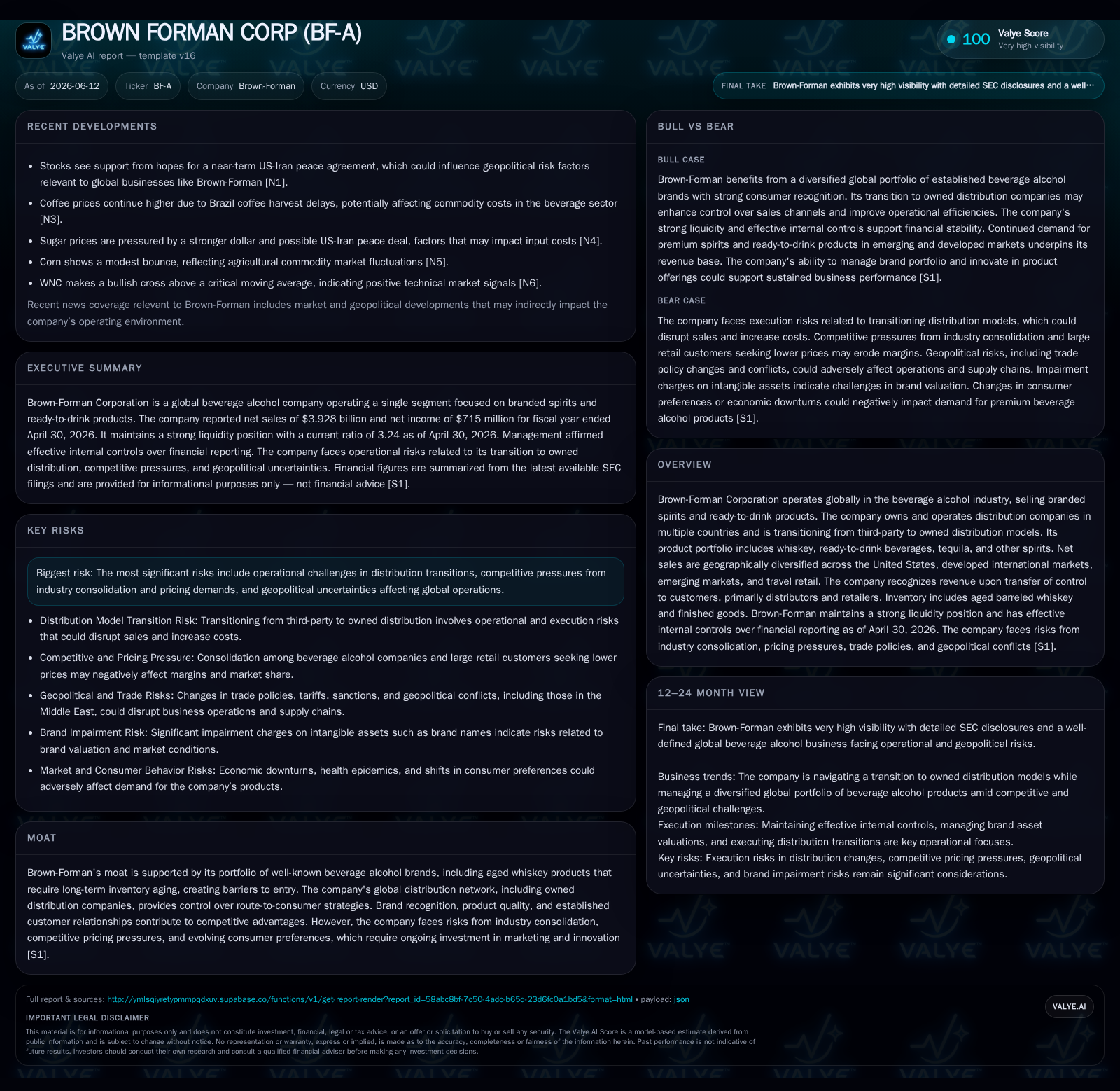
Brown-Forman's latest quarterly filing highlights continued progression toward owned distribution networks, enhancing route-to-market control and margin potential. Despite a modest decline in consolidated net sales to $3.93 billion for fiscal 2026 from $3.98 billion in 2025, the company maintains a premium brand portfolio led by Jack Daniel’s Tennessee Whiskey. The business model benefits from long aging cycles that create supply barriers and support premiumization, yet faces risks from foreign currency volatility, input cost pressures, and evolving consumer preferences. Growth catalysts include expansion in emerging markets, innovation in ready-to-drink formats, and travel retail penetration, balanced against regulatory and competitive headwinds.
Recent Operating Update: Q3 Fiscal 2026 Highlights
Operating income remained robust at approximately $1.0 billion for the latest fiscal year [F1], underpinned by a disciplined focus on premium product mix despite headwinds from foreign currency fluctuations and some volume softness in developed markets. Management notes that these factors together pressured net sales performance but expect ongoing investments in marketing and innovation to support recovery trajectories.
Business Model: Brand Ownership Coupled with Distribution Evolution
Brown-Forman operates predominantly as a vertically integrated producer of distilled spirits including aged whiskey varieties such as bourbon and Tennessee whiskey, alongside tequilas and ready-to-drink (RTD) beverages. The company’s revenue mechanics rest on wholesale transactions largely occurring upon transfer of control to distributors and retailers globally [S1]
A defining characteristic is the extended barrel aging process—typically three years or more—that creates tangible inventory capital requirements yet establishes sizeable barriers to entry by limiting supply elasticity. This aging cycle necessitates significant upfront capital deployment in barreled whiskey inventory while simultaneously entrenching brand exclusivity through maturation quality standards mandated by various jurisdictions.
Complementing product ownership is a global distribution network shifting progressively away from traditional third-party wholesalers toward owned subsidiaries. This shift empowers Brown-Forman with tighter route-to-consumer logistics control and better integration of trade marketing programs, thereby strengthening pricing power and sustaining gross margin expansion opportunities.
Consumers ultimately pay premiums for recognized brands like Jack Daniel’s Tennessee Whiskey (JDTW), which drives the backbone of overall financial performance [S1]. Pricing dynamics are influenced by volume growth in key categories balanced against average selling price (ASP) adjustments reflecting premiumization initiatives.
Industry Structure and Competitive Position
Operating within the beverage alcohol industry—a heavily regulated sector characterized by complex excise taxation, bottling regulations, labeling mandates, and marketing restrictions—Brown-Forman occupies a leadership position among global spirits producers alongside peers such as Diageo and Pernod Ricard (used here as industry reference points).
Its broad portfolio diversification across product types (aged whiskey, tequila, RTDs) coupled with geographic diversification across the U.S., Mexico, Europe (Germany, UK), Australia, emerging markets, and travel retail channels underpins resilience against regional economic volatility [S4]. The company’s vertically integrated approach including distillation, blending, barrel aging, bottling, and distribution confers competitive advantages through quality assurance and supply chain efficiencies.
Brand strength remains a critical moat element reinforced by sustained marketing spend targeted at maintaining relevance amidst shifting consumer preferences toward higher-end spirits and convenient RTD formats [S1]. Brown-Forman also actively manages regulatory compliance risks globally via robust governance frameworks across federal, state/local U.S., and international jurisdictions.
Growth Drivers
Key growth catalysts for Brown-Forman include:
- Premiumization: Growing consumer willingness to pay higher prices for quality aged spirits helps lift ASPs even amid flat volume trends.
- Distribution Ownership Expansion: Moving more markets under owned distributor control improves margin profile over time.
- Emerging Market Penetration: Rising disposable incomes spur demand for branded spirits beyond established western markets.
- Ready-to-Drink Innovation: Development of novel RTD flavors targets convenience-seeking demographics expanding category reach.
- Travel Retail/Duty-Free Channels: Continued growth in duty-free contributes incremental exposure to affluent international travelers.
- Brand Marketing Investments: Ongoing campaigns reinforce flagship brand equity to maintain loyalty amidst competitive pressure.
These drivers are measurable through KPIs such as volume growth in cases/liters sold internationally and domestically, improvements in gross margin linked directly to premium product mix shifts, expansion of distribution coverage metrics under owned models, and increased advertising ROI evidencing heightened brand resonance.
Risks and Watchpoints
Brown-Forman faces multiple industry-specific challenges warranting close monitoring:
- Foreign Currency Exposure: With revenues earned primarily in local currencies offset against some foreign cost bases but net exposure skewed due to revenue predominance abroad, currency volatility particularly USD strength may compress reported earnings despite hedging strategies [S6].
- Raw Material Input Volatility: Fluctuations in grain prices for distillation or agave supply used in tequila production can raise COGS unpredictably; similarly oak barrel supply constraints affect aging timelines [S1][N1].
- Regulatory Complexity: Evolving laws governing alcohol marketing restrictions including advertising bans or consumption location limits pose risks to market access or require costly adaptations [S5][S8].
- Litigation Risk: Potential class actions related to product liability or marketing practices present reputational and financial hazards despite historically low success rates against industry players [S9].
- Supply Chain Disruptions: Aging inventory requirements magnify sensitivity to production bottlenecks or logistical delays affecting timely product availability.
- Competitive Pricing Pressure & Consolidation: Industry consolidation increases bargaining power among distributors/retailers creating price negotiation challenges impacting ASPs.
Strategic responses revolve around continuous innovation efforts coupled with risk mitigation via diversified sourcing arrangements and rigorous regulatory engagement programs.
What to Watch Next
Key forthcoming milestones include:
- Progress reports on additional owned distribution conversions aiming to solidify improved margin capture.
- Volume recovery signals across major geographies post-currency adjustments.
- New product launches within RTD space that may broaden demographic penetration or enhance premium market share.
- Travel retail channel performance relating to macroeconomic travel trends.
- Regulatory developments particularly any shifts affecting U.S tax regimes or advertising freedoms abroad.
- Management commentary during upcoming earnings calls addressing inflationary input cost outlooks or raw material supply dynamics.
Financial Profile Summary
Disclaimer: This is research-only, informational analysis and not investment advice. It may include AI-generated interpretation and general industry context. Always verify important details using primary sources.

Comments