
Odyssey Health Extends Debt Maturity Amid Ongoing Medical Device Development and Cash Constraints
Latest quarterly filing reveals extended debt terms but continued operating losses as product commercialization remains pending.
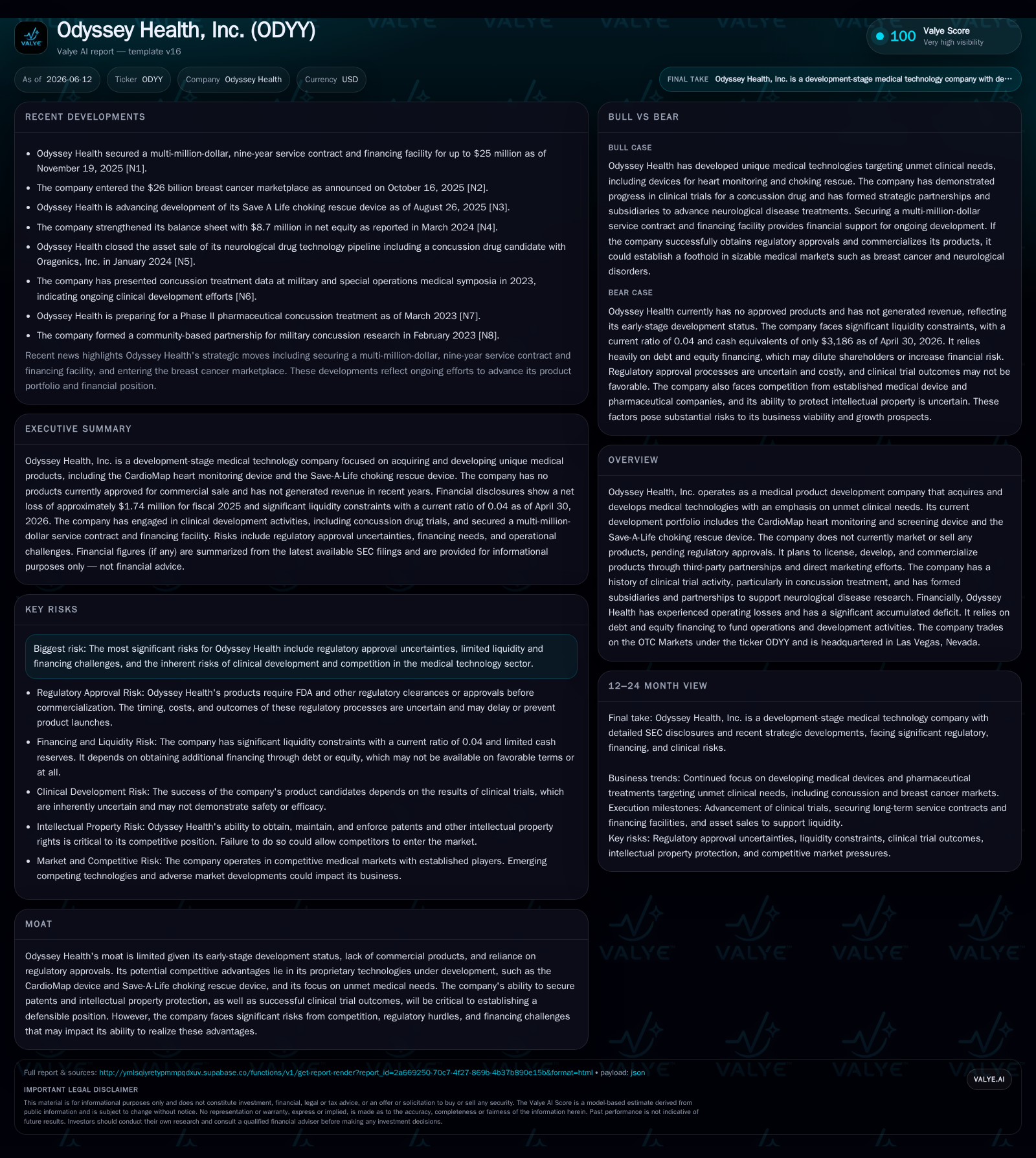
Odyssey Health, Inc. remains in an early-stage development phase with no commercial products currently generating revenue. The June 2026 quarter disclosed an extension of a key convertible promissory note’s maturity to September 2026, reflecting ongoing financing management amid constrained liquidity. The company continues advancing its product pipeline, emphasizing the CardioMap heart monitoring device and the Save-A-Life choking rescue device, both awaiting regulatory approvals. Odyssey Health's business model relies heavily on licensing partnerships and third-party commercialization efforts, but significant risks persist around regulatory clearances, capital availability, and clinical validation milestones.
Recent Quarterly Operating Update
Odyssey Health’s latest quarterly report filed June 12, 2026 ([S2]) primarily highlighted a financial restructuring move rather than operational progress: an extension of the maturity date on a key convertible promissory note held by LGH Investments LLC. Effective from April 30, 2026 (noted in the May 26, 2026 8-K [S3]), this amendment pushes the debt maturity to September 30, 2026. This signals that Odyssey must address near-term liquidity challenges within the next few months, underscoring the company's ongoing reliance on debt agreements to fund operations during limited cash reserves.
The company reported no material changes to risk factors during the quarter ([S2][S14]). There were no revenue-generating activities disclosed for this period or historically (latest revenue $0 as of July 31, 2020 per [F1]) confirming Odyssey’s pre-revenue status.
Business Model: Product Pipeline Focused on Licensing and Clinical Development
Odyssey Health operates under a classic early-stage medical device development archetype. The company acquires or develops medical technologies addressing unmet clinical needs—currently housing two flagship developmental devices: the CardioMap heart monitoring and screening system aimed at cardiovascular diagnostics, and the Save-A-Life device designed for choking emergencies ([S1]). These technologies remain in pre-commercial phases pending FDA clearance or equivalent regulatory approvals necessary for market entrance.
The company’s strategy hinges on progressing these devices through clinical trials and regulatory submissions before seeking commercialization pathways that could either be direct marketing initiatives or licensing agreements with established distributors or manufacturers ([S1]). Outsourcing technical development to specialized third-party R&D firms facilitates cost management while focusing internal resources on oversight and strategic partnerships.
This development-to-commercialization transition is resource intensive and involves managing intellectual property filings to create patent protections essential for competitive differentiation in a sector where innovation translates into defensible product moats. However, Odyssey has yet to report newly granted patents or finalized licensing deals explicitly in recent filings ([S2][S1]).
Industry Structure and Competitive Positioning
Odyssey occupies a typical early-entrant role within the medical device industry’s value chain—primarily committed to ideation/acquisition and product validation stages rather than commercial scale manufacturing or distribution. Its peer context includes companies like Masimo or iRhythm Technologies known for heart-monitoring solutions; however, unlike those peers that are generating revenues and undergoing scale commercialization, Odyssey lacks operational scale and market traction.
The company’s focus on unmet clinical needs aligns with industry best practices for creating differentiation through innovation. Yet without clear evidence of advanced clinical trial milestones or substantial patent portfolio strength disclosed publicly recently ([S2][S14]), it faces considerable competitive pressure from larger players with deeper R&D budgets who may accelerate similar products faster.
Growth Drivers
Long-term growth prospects rest heavily on achieving several visible checkpoints:
- Clinical Trial Progress: Successful validation of safety and efficacy is fundamental before any regulatory submissions can be approved.
- Regulatory Approval Milestones: Securing FDA clearance represents a major hurdle but also a crucial gatekeeper to market entry.
- Licensing/Partnership Agreements: Forming alliances with established medtech companies or distributors can provide revenue streams without requiring extensive direct sales infrastructure.
- Intellectual Property Protection: Building a robust patent portfolio mitigates competitive substitution risks.
- Expanding Product Portfolio: Acquisition or internal development of additional complementary devices broadens potential market coverage ([S1]).
Risks and Growth Constraints
While the business model is straightforward for an early-stage medical device developer, Odyssey faces substantial challenges:
- Regulatory Uncertainty: Delays or failures in obtaining FDA approvals can drastically derail timelines.
- Liquidity Pressures: Extremely low current ratio (~0.04) driven by high current liabilities exceeding $10 million versus current assets under $400k indicates tight operating capital conditions ([F1]).
- Dependence on Additional Financing: Continuous reliance on debt amendments signals vulnerability regarding capitalization sufficiency ([S3]).
- Clinical Trial Outcomes: Negative results could invalidate expensive R&D efforts.
- Competitive Risks: Larger incumbents could pre-empt market opportunities with similar or superior technology.
- Limited Operating History: Absence of commercial product sales complicates performance evaluation.
What to Watch Next
Investors should monitor several critical updates in forthcoming quarters:
- Outcomes from pivotal clinical studies related to CardioMap and Save-A-Life devices.
- Timing and content of regulatory filings submitted to FDA or equivalent agencies.
- New partnership or licensing announcements indicating progress toward commercialization.
- Refinancing activities addressing upcoming September 2026 note maturity cited in recent amendments ([S3]).
- Any signs of improved liquidity or capital raises supporting development expenditures.
Financial Profile Snapshot
As of April 30, 2026 (recent quarter-end), Odyssey held approximately $374k in current assets versus $10.12 million in current liabilities resulting in a highly negative working capital condition ([F1]). This reflects a straining operational cash position common among early development-stage medical device companies without product revenues. Recent debt amendments extending maturities suggest management actively managing liquidity risks but also highlight ongoing funding needs that will require resolution beyond short-term refinancing agreements ([S3]).
These factors underline continuous net losses including an operating loss exceeding $1 million as of last fiscal year-end July 31, 2025 ([F1]). The company has not generated any revenue historically per available data ([F1]).
This analysis provides an evidence-based view grounded strictly in recent SEC filings without speculative valuations or forward-looking projections not supported by explicit disclosures. It reflects Odyssey Health's position as an early-stage medtech developer balancing product innovation against challenging financial constraints amidst a demanding regulatory environment.
Disclaimer: This is research-only, informational analysis and not investment advice. It may include AI-generated interpretation and general industry context. Always verify important details using primary sources.

Comments