
AutoZone’s Store Expansion and Commercial Program Drive Sales Amid Margin Pressures
Latest quarterly results highlight AutoZone’s sales growth driven by network expansion and commercial momentum despite margin compression.
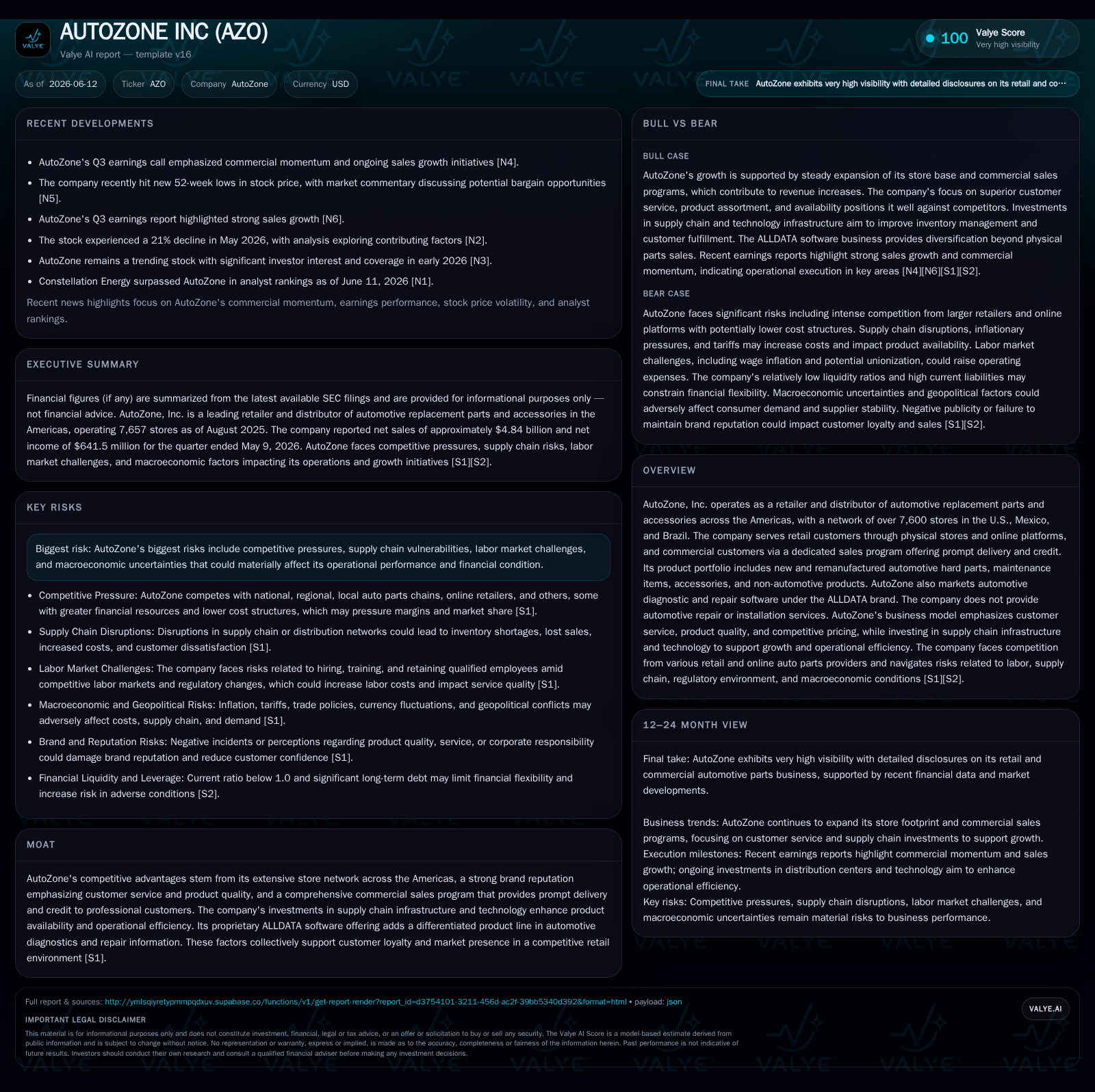
AutoZone reported sustained revenue growth anchored by its expanding store footprint and robust commercial sales program in the latest quarter ending May 2026. The company continues to leverage its broad physical store network alongside digital channels, strengthening customer loyalty and product availability. However, gross margin pressures from cost inflation and higher operating expenses cast caution on profitability trends. AutoZone’s capital strategy balances reinvestment in supply chain and store growth with ongoing share repurchases, supported by a manageable debt profile. Key watchpoints include execution on omnichannel initiatives, margin management amid competitive pricing, and supply chain resilience.
Recent Operating Update
AutoZone’s latest quarterly filing for the period ended May 9, 2026 [S2] reveals ongoing top-line momentum despite considerable external cost pressures. The company reported sequential gains in same-store sales primarily attributable to growth in both retail consumers and its commercial sales division—serving professional repair shops with credit terms and rapid delivery [N1]. While gross profit margins contracted due to inflationary pressures within supply chain logistics and rising warehouse and labor costs, these expenses align with AutoZone's strategic investments to scale capacity and better serve an expanding customer base.
On the balance sheet front, AutoZone exhibits solid financial discipline. Its reported total debt stands near $9 billion as of late fiscal 2025 [F1], supported by a revolving credit facility capacity of $2.25 billion that remains undrawn as of quarter-end [S8]. The company has maintained compliance with all covenants and expects to do so moving forward [S2], underpinning financial flexibility to fund growth initiatives alongside shareholder returns.
Business Model Articulation
AutoZone operates predominantly within the automotive parts retail and distribution sector, targeting both individual vehicle owners (DIY consumers) and professional repair service providers through a large physical store footprint complemented by an e-commerce platform [S1]. Revenue is generated chiefly from selling a broad assortment of aftermarket parts—including failure-related components that represent approximately 86% of sales mix—and automotive accessories [S9]. The commercial sales program plays a vital role in increasing average spend per transaction by offering credit terms and reliable delivery services to fleet operators and repair shops.
The company's product portfolio also includes proprietary diagnostic software (ALLDATA), adding differentiation beyond physical goods. This dual emphasis on product quality combined with superior customer service creates switching costs that help sustain customer loyalty in a low-margin environment [S1]. Supply chain infrastructure investments aim to improve product availability rates—a key metric affecting customer retention given the immediacy required for repairs
Industry Structure and Competitive Position
Within the automotive parts aftermarket retail industry, AutoZone ranks among leading specialty retailers such as O'Reilly Automotive and Advance Auto Parts. Compared to general retailers like Walmart or online marketplaces such as Amazon, AutoZone differentiates itself through a dense store network exceeding 7,600 locations across North America and Latin America, extensive inventory assortment tailored for local demand profiles, and integrated commercial sales programs that drive recurring business from professional customers [S1]
Despite this scale advantage, increasing competition from lower-cost online players exerts downward pressure on pricing dynamics. These competitors benefit from lower operating costs due to minimal physical infrastructure but typically lack the breadth of same-day availability available at AutoZone stores. This dynamic places emphasis on omnichannel retail capabilities—seamlessly blending online ordering with rapid in-store or next-day fulfillment—to maintain relevance among digitally savvy customers.
Growth Drivers
AutoZone's revenue expansion hinges on several structural drivers:
Store Footprint Expansion: The company’s steady addition of approximately three percent annual growth in store count over recent years underscores its commitment to deepening geographic market penetration in both existing U.S. regions and international markets like Mexico and Brazil [S1]. Site selection focuses on demand analysis for aftermarket parts coupled with supplier logistics feasibility.
Commercial Sales Program Growth: Increasing penetration into professional repair shop networks via credit establishments enhances volume throughput per location [N1]. This segment benefits from business-to-business stickiness provided by timely delivery lead times superior to many competitors
E-Commerce & Omnichannel Integration: Complementary online platforms accommodate growing consumer preference for digital research prior to purchase while driving convenient pick-up or delivery options. Enhanced IT systems aim to streamline inventory turnover ratios by coupling data analytics with demand forecasting.
Rising Vehicle Age & Miles Driven: Long-term trends of aging vehicles increase demand for replacement parts due to more frequent maintenance needs—a secular tailwind supporting aftermarket parts sales independent of new vehicle production cycles [S9]
Proprietary Diagnostic Software (ALLDATA): Investing in diagnostic software complements physical part sales by offering bundled information services used by commercial clients for vehicle repairs, adding revenue diversification.
Risks / Watchpoints / Constraints
Maintaining operational efficiency amid evolving challenges is critical:
Margin Pressure From Supply Chain Costs: Inflationary cost increases for logistics, labor wages, and sourcing impact gross margin durability—higher inventories may be required to stave off stockouts but raise working capital demands.
Competitive Pricing Pressure: Online marketplaces aggressively pursue price leadership; matched against large retailers’ scale economies, AutoZone must balance competitive pricing without eroding brand value or service levels.
Labor Market Tightness: Recruiting qualified staff for stores and distribution centers remains difficult amid tight labor markets potentially raising operational expense ratios.
Macroeconomic Sensitivity: Consumer discretionary spending on non-essential vehicle maintenance varies with economic cycles; recessionary environments could reduce frequency of visits or average ticket size.
Technological Adaptation Risk: Failure or delay in implementing effective digital tools may diminish ability to compete with nimble omnichannel players who leverage AI-enhanced personalization or rapid fulfillment technologies.
Credit Risk Exposure: Extended credit terms to commercial clients introduce default risk especially under volatile economic conditions requiring prudent underwriting controls.
What To Watch Next
Investors should monitor:
- Quarterly metrics including same-store sales growth segmentation between retail vs commercial channels indicating program momentum.
- Gross margin trends relative to inflation pass-through capability plus cost control efficacy.
- Progress on new store openings along with geographic mix impact especially international expansions.
- E-commerce contribution growth signaling success of omnichannel integration efforts.
- Operational cash flow generation sustaining share repurchase activity or funding capex increments.
- Updates on supply chain innovation outcomes improving product availability rates reducing lost sales opportunities.
- Management commentary around labor market conditions influencing operating expense guidance.
- Any prospective changes in borrowing costs or covenant compliance impacting capital structure flexibility [S2]
Financial Profile Summary
As of May 2026, AutoZone held approximately $254 million in cash equivalents juxtaposed against about $8.85 billion in total debt outstanding reported at August 2025 year-end [F1]. Net debt is therefore near $8.6 billion indicating moderate leverage typical for a large specialty retailer investing aggressively in expansion while returning substantial cash via share repurchases [S2]. Operating cash flows remain robust; for fiscal year 2025 net income was approximately $2.5 billion [F1], translated into strong free cash flow supporting liquidity needs. The company made notable progress refinancing maturing senior notes earlier this year reducing near-term obligations [S17], preserving access to capital markets under investment-grade rating covenants [S5]. Capital expenditures remain focused on supply chain infrastructure upgrades alongside calculated new store openings balancing growth aspirations with margin preservation goals.
This analysis is grounded solely on publicly filed SEC disclosures and reputable news sources without speculative assumptions or investment research views.
Disclaimer: This is research-only, informational analysis and not investment advice. It may include AI-generated interpretation and general industry context. Always verify important details using primary sources.

Comments