
Coffee Holding’s Strategic Maneuvers Amid Coffee Market Volatility
The latest quarter reveals operational resilience through strategic acquisitions, disciplined freshness standards, and a diversified product mix.
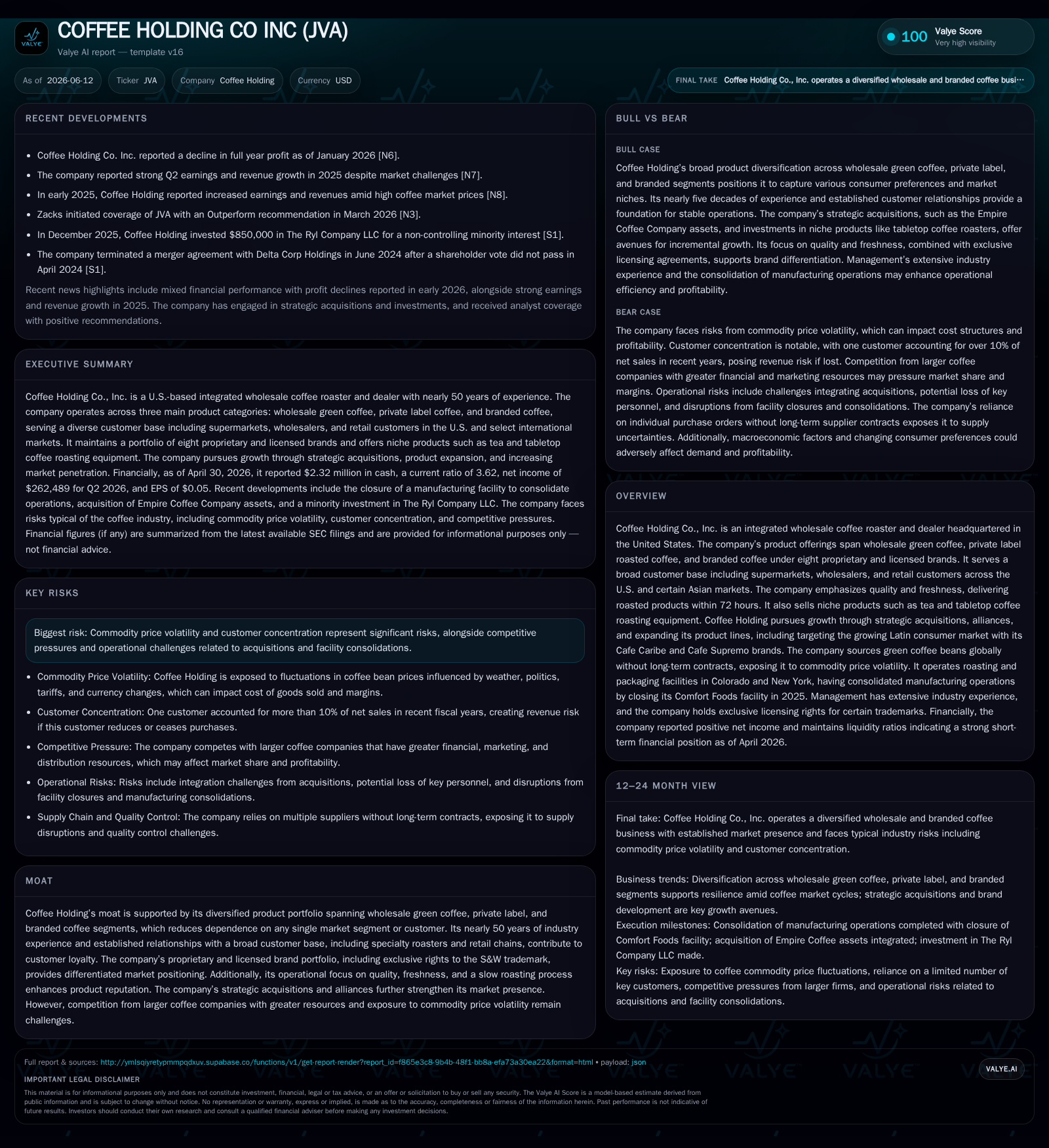
Coffee Holding Co., Inc.'s June 2026 quarterly update underscores steady operating performance amid ongoing commodity price volatility and customer concentration risks. The company leverages its integrated model spanning wholesale green coffee, private label roasting, and proprietary branded products—delivered within a strict 72-hour freshness window—to maintain market presence. Recent operational moves include consolidation of production facilities and integration of the Empire Coffee acquisition to improve efficiency. Opportunities lie in expanding geographic reach, growing specialty coffee demand, and product innovation; however, exposure to supply cost swings and customer dependency remain key challenges.
Latest Quarterly Update: Performance Highlights and Operational Insights
In its June 2026 quarterly filing [S2], Coffee Holding Co., Inc. reported continued steady operational results without material changes in its established risk profile [S15]. The company reaffirmed its exposure to industry cyclicality such as commodity price fluctuations; however, integration efforts surrounding the November 2024 Empire Coffee acquisition [S5] are progressing as planned. Complementing this is the October 2025 consolidation initiative that closed the Comfort Foods facility [S8,S22], shifting production to the Port Chester site operated by Second Empire LLC—an internal subsidiary created for managing acquired operations efficiently.
Management communicated consistent application of freshness standards by delivering roasted products within 72 hours to customers—a critical quality metric that supports brand loyalty during competitive pressures. These operational dynamics capture Coffee Holding's resilience navigating market headwinds.
Business Model Deep Dive: Revenue Streams and Product Mix Dynamics
Coffee Holding operates as an integrated wholesale coffee roaster and dealer with three primary revenue streams: wholesale green coffee beans sold unroasted primarily to specialty roasters; private label roasted coffee manufactured under retailers’ brand names; and proprietary branded coffees marketed under eight main labels including Cafe Caribe and Cafe Supremo designed for distinct market niches [S1,S11,S22]. The company’s product offerings also extend into related niche areas such as tabletop coffee roasting equipment sold through its Sonofresco unit acquired in 2016.
The business model emphasizes sourcing over 90 varieties of high-quality green coffee globally without long-term contracts, exposing it to unpredictable commodity price volatility mitigated only partially through short-term futures contracts [S1]. Through a carefully managed slow roasting process honed over nearly five decades, Coffee Holding ensures deep flavor profiles aligned with premium categories. Critical to sustaining this quality edge is the company’s operational discipline guaranteeing shipment within three days post-roasting—freshness standards that many competitors or larger roasters may find operationally challenging at scale.
This blended portfolio allows revenue diversification across different volume- and margin-driven channels: wholesale green coffee offers volume gains but is sensitive to commodity swings; private label contracts ensure steady volume from large supermarket partners seeking cost-effective branding alternatives; proprietary branded products capture premium pricing potential albeit at lower volumes relative to commercial labels.
Competitive Environment: Scale vs Niche Positioning in Packaged Coffee
In an industry marked by well-capitalized multinationals such as Keurig Dr Pepper or J.M. Smucker commanding substantial scale advantages, Coffee Holding occupies a smaller niche characterized by flexibility across several value chain points. Its ability to serve diverse customer types—ranging from supermarkets to independent retail chains and gourmet coffee shops—alongside private label branding differentiates it from pure-play specialty roasters focused exclusively on premium freshness or from mass-market companies reliant solely on branded products.
The company's distribution channels span U.S. domestic markets complemented by selective Asian market exposure, enabling penetration into both developed grocery networks and growing specialty segments [S1]. However, such breadth can bring about customer concentration risks: a single major customer represented over 10% of net sales in both fiscal years ending 2025 and 2024 [S16], indicative of dependence that could cause revenue disruption if lost.
Furthermore, while its slow roasting process assures product distinctiveness aligned with consumer preferences for freshness and flavor nuance seen among premium roasters like Stumptown or Blue Bottle, scale-related cost efficiencies seen among global competitors remain out of reach. Thus, competitiveness relies heavily on balancing quality differentiation against cost pressures.
Growth Engines: Acquisitions, Geographic Expansion, and Product Innovation
Strategic acquisitions have been pivotal for growth expansion recently. The November 2024 Empire Coffee asset purchase aimed to strengthen east coast roasting capacity and consolidate production facilities while expanding client lists through merging operations under Second Empire LLC [S5]. The subsequent closure of the Comfort Foods manufacturing plant in Massachusetts completed October 2025 also aligns with this efficiency drive by concentrating roasting into fewer locations [S8,S22].
Product innovation efforts focus on broadening appeal within fast-growing specialty coffee niches—including espresso blends tailored for Latin consumers via Cafe Caribe (premium) and Cafe Supremo (value-oriented) brands—reflecting demographic trend awareness [S11]. Additionally, selling complementary tabletop equipment through Sonofresco reinforces cross-selling opportunities within loyal customer segments who appreciate controlled roasting experiences.
Geographic expansion strategies concentrate on enhancing U.S. national footprint through supermarket partnerships while gradually developing international markets in Asia where gourmet coffee consumption is rising. Future growth will likely hinge on increasing distribution channel penetration combined with product diversification rather than aggressively pursuing price-based volume increases.
Risks to Monitor: Commodity Price Fluctuations and Customer Concentration
A principal risk thread throughout Coffee Holding's disclosures remains exposure to substantial commodity price volatility inherent in the green coffee bean market [S1,S25]. Although the company employs short-term futures contracts—typically covering three to four months—to hedge partial price exposure [S1], this strategy does not fully insulate gross margins from sudden raw material cost spikes.
Customer concentration further compounds revenue volatility risk. One major client accounted for over 10% of net sales consistently during prior years without long-term binding contracts [S16], leaving potential for abrupt order reductions or substitutions.
Operational risks include complexities related to integrating acquisitions like Empire Coffee successfully without losing key employees or customers while managing overhead increases due to expansion logistics [S27]. The recent facility consolidation into a single East Coast production hub may mitigate some costs but imposes execution risks linked to capacity utilization.
Finally, competitive pressures from both large roasters leveraging scale advantages and highly specialized premium roasters focusing intensely on freshness standards create an ongoing challenge requiring continuous investment in quality differentiation.
What Comes Next: Upcoming Milestones and Market Signals to Watch
Stakeholders should monitor forthcoming quarterly reports for updates on key performance indicators such as incremental revenue contribution from newly integrated Empire Coffee operations, progress in geographic expansion particularly in Asian markets, shifts in private label versus branded sales mix reflecting evolving consumer trends, and margin improvement attributable to facility consolidations [S3]
Operational signals like enhanced inventory turnover rates aligned with maintaining the tight 72-hour freshness delivery window will also be telling regarding efficiency improvements. Management commentary on hedging effectiveness amid global coffee price dynamics will provide insight into future margin stability prospects.
Moreover, any announcements concerning further strategic acquisitions or licensing arrangements expanding product portfolios could signify acceleration steps toward capturing specialty coffee demand growth niches.
Financial Overview: Balance Sheet Strength and Profitability Trends
As of April 30, 2026 (latest available data), Coffee Holding displays a robust liquidity position highlighted by cash & equivalents approximating $2.3 million against minimal total debt around $4,200—effectively net cash positive—aided by current assets near $32 million against current liabilities under $9 million yielding a strong current ratio of approximately 3.6 [F1]
Operating income margins remain positive though modest relative to larger peers but consistent with an efficient mid-sized roaster-dealer balancing quality commitments with cost structures. These financial metrics underscore prudent fiscal management compatible with sustaining working capital needs alongside strategic investments into acquisitions and operational consolidations.
Disclaimer: This analysis is based exclusively on publicly available information including SEC filings up to June 12, 2026. No forward-looking statements or investment advice is provided herein.
Disclaimer: This is research-only, informational analysis and not investment advice. It may include AI-generated interpretation and general industry context. Always verify important details using primary sources.

Comments