
Hooker Furnishings Reshapes Portfolio to Bolster Profitability Amid Trade Headwinds
Q1 2027 results highlight brand divestiture completion and rising tariff costs shaping strategic and operational priorities.
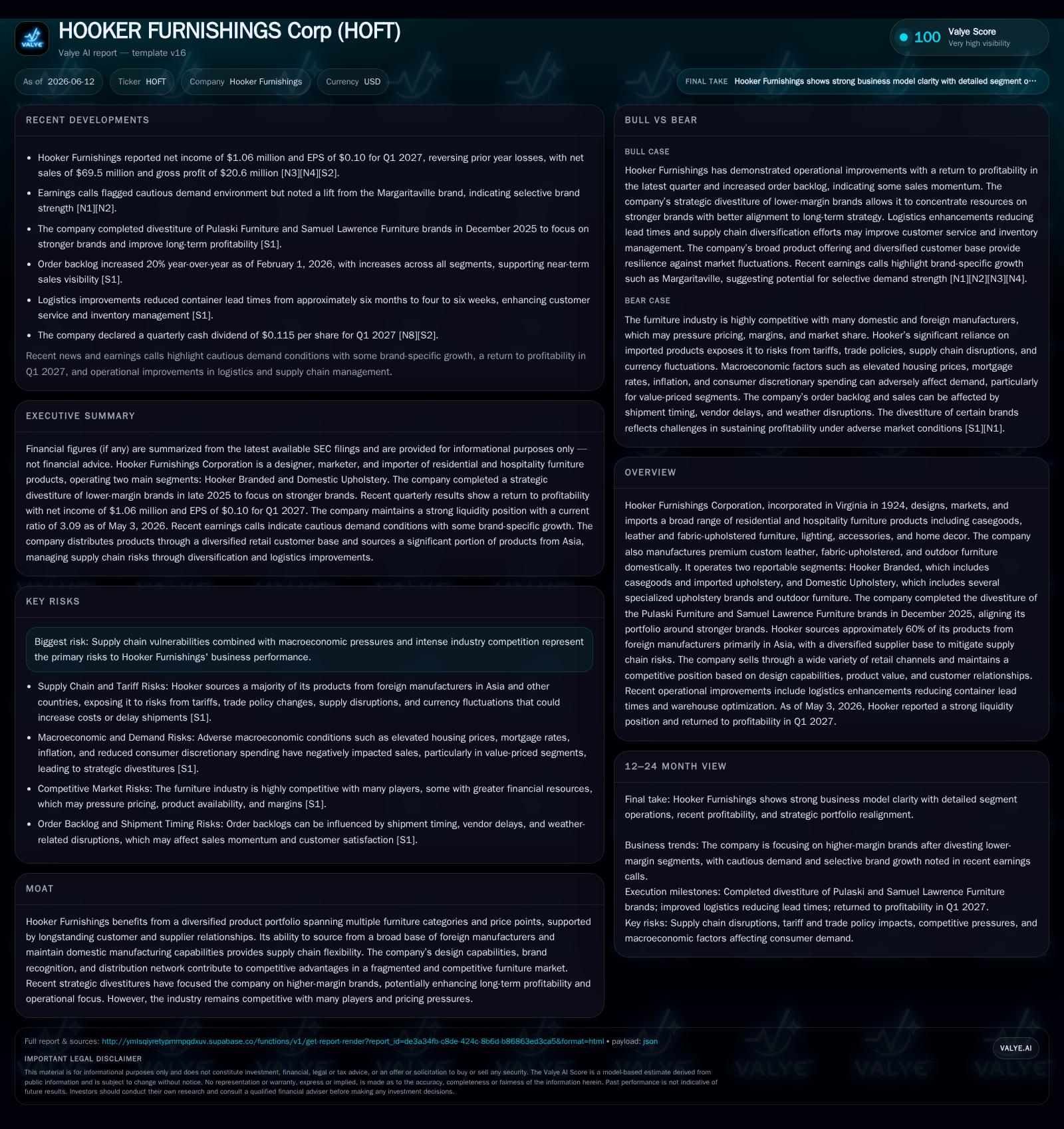
Hooker Furnishings completed divestitures of its Pulaski Furniture and Samuel Lawrence casegoods brands in late 2025, signaling a pivot away from low-margin, volume-driven segments toward higher-profit brands. The company’s latest 10-Q warns of escalating costs linked to tariffs on imported raw materials and upholstery components, primarily sourced from Asia, which heighten margin pressure. Hooker operates through two core segments—Hooker Branded focusing on imported casegoods and upholstery, and Domestic Upholstery producing premium custom furniture—balancing import sourcing with domestic manufacturing to navigate supply chain complexities. Despite macroeconomic softness in housing dampening demand, the company aims to leverage product innovation, brand repositioning, and wholesale distribution channels to drive growth.
Q1 Operating Update: Portfolio Refocus Under Rising Tariff Costs
Hooker Furnishings’ June 12, 2026 10-Q filing underscores a material pivot marked by the completion of strategic divestitures in December 2025—specifically the sale of Pulaski Furniture and Samuel Lawrence casegoods brands [S2][S1]. These legacy value-priced brands had suffered profitability erosion due to weakened housing market conditions, inflationary pressures, elevated mortgage rates, and an increasingly punitive tariff environment. The divestiture eliminates the Home Meridian segment as it was previously structured and reflects management’s commitment to realigning toward higher-margin brands that generate more consistent earnings.
Simultaneously, the filing highlights growing tariff risks tied to imported inputs critical for the Domestic Upholstery segment. Hooker sources about 60% of products from Asia-based manufacturers with diversified suppliers aimed at mitigating concentrated risk [S1]. However, ongoing U.S. Section 301 tariffs, antidumping duties on timber and lumber—key raw materials—and potential reciprocal measures create upward cost pressures. This constellation of tariffs threatens to inflate Hooker's input costs significantly unless offset by price increases or operational efficiencies [S2]. Such cost headwinds complicate gross margin dynamics across both imported casegoods/upholstery lines and domestically produced furniture.
Firm Business Model Anchored by Dual Segments and Product Diversity
Hooker's revenue model operates through two principal reportable segments delineated by sourcing and product type [S1][S25]. The "Hooker Branded" segment encompasses casegoods—wooden furniture lines—and imported upholstery. This segment leans heavily on foreign sourcing, predominantly from Asia.
Conversely, the "Domestic Upholstery" segment includes several specialized upholstery brands producing premium custom leather and fabric-covered furniture as well as outdoor lines manufactured domestically. This bi-continental sourcing strategy attempts to balance cost advantages from imports with quality assurance and differentiated product offerings featuring customizability that command higher price points.
Distribution channels primarily employ wholesale relationships servicing residential retailers, hospitality clients, and contract customers. The product portfolio spans "good/better/best" segmentation reflecting price tiers aligned with consumer preferences and competitive positioning. Design distinctiveness underpins customer loyalty amidst sectorwide price sensitivity. Despite pricing challenges exacerbated by tariffs inflating raw material costs such as timber/lumber for imported goods [S2], Hooker's continued emphasis on custom furniture supports resilience in more premium niches.
Competitive Environment: Fragmentation, Supply Chain Complexity, and Brand Strength
The home furnishings industry where Hooker competes is notably fragmented with numerous domestic manufacturers and importers vying without any single dominant player across segmented price points [S1][S23]. Peers like La-Z-Boy exemplify balancing global sourcing with domestic fabrication akin to Hooker's dual-segment approach.
Key success factors hinge on brand reputation bolstered by robust design capabilities—an area where Hooker’s longstanding relationships with suppliers enhance supply chain agility amid trade uncertainties [S1]. The company leverages its broad brand portfolio specifically tailored for residential versus hospitality contexts while managing distribution scale to ensure service availability.
Tariff exposure further complicates these dynamics given that significant portions of upholstery components are subject to Section 301 tariffs or antidumping duties [S2]. Efficient management of this exposure via supplier diversification or negotiation power remains critical for sustaining operating margins within a highly competitive pricing environment.
Strategic Growth Drivers amid Macroeconomic Headwinds and Product Innovation
Growth catalysts for Hooker rest partially upon anticipated stabilization or modest improvement in housing starts and remodeling expenditure which historically underpin residential furniture demand [S1]. The hospitality segment offers expansion avenues tied to contract furniture needs addressing specialized commercial furnishing requirements—a sector that benefits from longer-term order backlogs.
Post-portfolio realignment following Pulaski/Samuel Lawrence divestitures enables greater resource focus on high-margin product lines enhancing average selling prices (ASP) and potentially improving overall gross margins. Moreover, ongoing product innovation aimed at differentiating design refreshes can support sustained consumer interest even amid discretionary spend volatility.
While direct e-commerce or direct-to-consumer channel initiatives were not prominently detailed in filings, wholesale distribution efficiency remains a pillar of their commercial approach [S1]. Continued monitoring of inventory turnover ratios will reflect efficacy in aligning production with shifting demand patterns influenced by macroeconomic cycles.
Risks: Tariffs, Supply Disruptions, Pricing Pressures, And Market Sensitivity To Housing Trends
Hooker's filings explicitly flag major risks stemming from tariff impositions including Section 301 duties enforced against imports from key Asian suppliers alongside antidumping/countervailing measures affecting timber/lumber raw materials [S2]. These tariffs add cost layers that may not be fully transferable through pricing without dampening demand or ceding share amid competition.
Supply chain disruptions represent another salient threat given reliance on a geographically diversified but tariff-exposed vendor base. Any geopolitical developments or worsening trade relations could exacerbate lead times or increase component expenses further impacting gross profit margins.
The company's past experience with depressed sales volumes in its divested value-priced Home Meridian brands reflects vulnerability to macroeconomic headwinds such as depressed housing affordability reducing discretionary consumer spending [S1]. Competitive intensity across all product categories subjects Hooker to persistent pricing pressures that could compress operating income if cost inflation is not matched by sales price adjustments or operational improvements.
Employee-related costs also warrant attention as the company mentioned rising healthcare inflation impacting self-insured workers compensation plans that could elevate operating expenses unpredictably [S2]. Inventory obsolescence risk remains intertwined with demand forecasting accuracy in a cyclical industry.
What To Watch For: Demand Indicators, Supply Chain Developments, Brand Expansion Milestones
Near-term monitoring should focus on housing market indicators—new residential construction data alongside remodeling spend—which directly correlate with orders backlog trends reported quarterly. Improvements here might signal better demand traction for both casegoods and upholstery products post-divestiture.
Tariff policy developments including any alleviation or intensification of Section 301 levies or antidumping rulings can materially affect input cost structure; timely updates may influence pricing strategies.
Operational KPIs such as inventory turnover rates and customer order fill rates will provide early readouts on supply chain responsiveness amid ongoing trade uncertainties [S2]. Additionally, tracking incremental contribution from retained hospitality-focused branded businesses like Samuel Lawrence Hospitality may reveal progress in leveraging specialized market niches following portfolio rationalization.
Brief Financial Snapshot: Liquidity, Debt Positioning, And Short-Term Outlook
As of May 3, 2026, Hooker Furnishings held $10.6 million in cash and equivalents against current liabilities totaling approximately $29.8 million yielding a current ratio of roughly 3.09—a sign of solid near-term liquidity coverage [F1][S2]
The company maintains access to a revolving credit facility capped at $70 million with an option to increase by up to $30 million upon lender consent providing ample flexibility for working capital needs amidst episodic earnings volatility [S4]. Outstanding debt approximates $22.9 million as per recent disclosures though no term loans were outstanding at quarter-end beyond letters of credit commitments totaling $3.2 million [F1][S4].
Interest costs remain manageable relative to operating income levels supporting stable financial footing even as earnings experience pressure from tariff-related cost escalation [S14]. This liquidity posture should afford time for execution of strategic initiatives focused on portfolio optimization without immediate refinancing stress or capital constraint risks.
This analysis synthesizes insights grounded strictly in recent SEC filings complemented by relevant industry context. It does not constitute investment advice but aims to illuminate operational shifts signaling Hooker Furnishings’ strategic repositioning amid evolving market conditions impacting home furnishings manufacturing.
Disclaimer: This is research-only, informational analysis and not investment advice. It may include AI-generated interpretation and general industry context. Always verify important details using primary sources.

Comments