
Karyopharm Therapeutics Faces Liquidity Pressure While Advancing Selinexor’s Clinical Pipeline
Despite steady commercialization of XPOVIO, Karyopharm’s liquidity challenges and regulatory setbacks spotlight operational hurdles ahead.
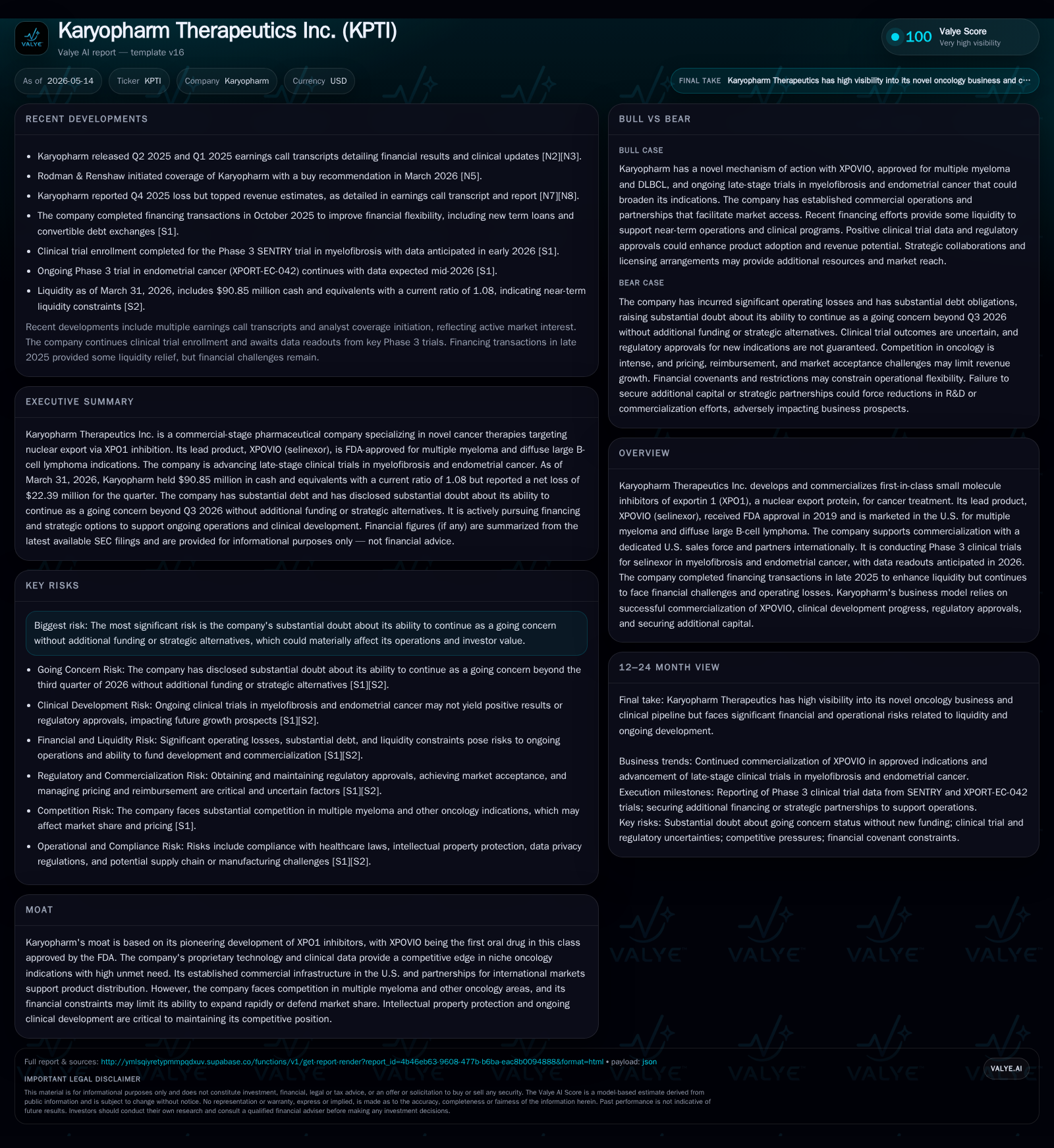
Karyopharm Therapeutics’ latest quarterly filing reveals that while sales of its flagship drug XPOVIO continue, the company faces substantial doubt about its ability to continue as a going concern without additional funding. The voluntary withdrawal of the accelerated approval for the diffuse large B-cell lymphoma (DLBCL) indication marks a strategic retrenchment, though clinical development in myelofibrosis and endometrial cancer remains active with key data expected in 2026. Karyopharm’s business model centers on leveraging its first-in-class exportin 1 inhibitor platform, but competition and regulatory complexity weigh heavily. The company’s capital structure is strained by significant debt and covenant restrictions, requiring close monitoring of upcoming clinical milestones and financing developments.
Recent Operating Update
Karyopharm Therapeutics' latest quarterly filing dated May 14, 2026 [S2] provides a sobering update on its near-term operating outlook. As of March 31, 2026, the company had approximately $90.9 million in cash and cash equivalents [F1]. This liquidity level indicates marginal short-term coverage given current assets of $126.3 million versus current liabilities of $117.3 million, yielding a current ratio of approximately 1.08 [F1]. This situation places substantial pressure on management to secure additional financing or alternative strategic arrangements imminently to maintain ongoing research, development programs, and commercialization efforts.
A material regulatory development outlined in a concurrent Form 8-K [S3] is the voluntary withdrawal of the accelerated FDA approval for XPOVIO’s indication in diffuse large B-cell lymphoma (DLBCL). This decision follows FDA feedback that the confirmatory trial could not be completed given shifting treatment paradigms. While this withdrawal does not affect other approved indications for XPOVIO nor implicate safety concerns, it represents a notable setback for one of the product's earlier expanded uses. Importantly, sales derived from the DLBCL indication were immaterial.
Meanwhile, pivotal clinical milestones loom large. The company expects topline Phase 3 data from ongoing SENTRY trials targeting myelofibrosis in H2 2026 [S22]. Additionally, results from the Phase 3 XPORT-EC-042 trial evaluating selinexor in advanced endometrial cancer are anticipated mid-2026. These outcomes will be critical signals for potential label expansion and market opportunity growth.
Business Model
Karyopharm operates principally as a biopharmaceutical developer specializing in small molecule inhibitors of exportin 1 (XPO1), a nuclear export protein implicated in tumorigenesis. Its lead commercial product is XPOVIO (selinexor), an orally administered selective inhibitor of nuclear export approved by the FDA since 2019 primarily for multiple myeloma and certain subtypes of lymphoma [S1]. The commercial model hinges on proprietary technology licensing paired with an internally managed U.S. sales force complemented by international partnership arrangements.
Revenue streams arise mostly from net product revenues generated through direct sales handled by Karyopharm's dedicated sales team and partner royalties or milestone payments outside the U.S. Pricing dynamics reflect negotiated reimbursement agreements with payers amid increasing scrutiny over oncology drug costs—especially oral therapies with broad usage potential.
Margins are pressured by continued investment needs in marketing infrastructure to build adoption within hematology-oncology settings alongside R&D expenditures aimed at label expansion via supplemental indications.
Industry Structure and Competitive Position
Karyopharm sits within a competitive oncology pharmaceutical niche focusing on novel mechanistic approaches targeting nuclear export processes. Being first mover with the only FDA-approved oral selective inhibitor of XPO1 confers some differentiation; however, competition from more established therapies across multiple myeloma (proteasome inhibitors, immunomodulators), lymphoma (CAR-T therapies, chemotherapy regimens), and emerging biologics constrains market share expansion.
Internationally, distribution relies heavily on partners which can limit margin capture but extend geographic reach without direct operational need. Intellectual property protections around selinexor underpin its competitive moat but require vigilant defense amid rapidly evolving oncology therapeutics landscapes.
Pricing pressures remain an industry-wide challenge driven by government programs such as Medicaid rebate mandates [S10], emerging transparency legislation at state levels [S17], and payer resistance to premium-priced specialty drugs even when clinically differentiated.
Growth Drivers
Primary growth levers center on:
- Clinical Development Success: Progression to full regulatory approval for new indications such as myelofibrosis and endometrial cancer could open sizeable patient populations that currently lack effective oral therapies.
- Geographic Expansion: Enhancing international penetration through licensing partners can bolster non-U.S sales contributions.
- Label Expansion: Beyond current approvals, identifying additional opportunities within oncology indications or other disease areas leveraging XPO1 inhibition mechanism.
- Commercial Execution: Building prescriber awareness and integration into treatment guidelines are vital given competitive options; robust U.S. sales infrastructure supports this need.
- Regulatory & Reimbursement Strategies: Navigating complex pricing frameworks and payer negotiations successfully will safeguard margins while broadening patient access.
These drivers manifest through measurable KPIs such as: increasing prescription volumes of XPOVIO across indications, enrollment success rates in clinical studies (indicative of timely trial completion), milestone achievements tied to FDA approvals or guideline inclusions, international deal signings or revenue recognition from licensed territories.
Risks / Watchpoints / Growth Constraints
The foremost existential risk remains Karyopharm's financial position that casts doubt on its capability to sustain operations beyond the near term without fresh financing [S2]. This condition constrains spending flexibility across R&D programming intensity or commercial activities.
Regulatory setbacks such as the DLBCL approval withdrawal underscore how evolving therapeutic landscapes can render confirmatory trials impractical—a risk inherent in accelerated pathways reliant on surrogate endpoints [S22]. Adverse clinical trial results or tolerability issues could stall pipeline progression further impeding growth potential.
Debt service obligations totaling over $190 million aggregated across term loans and convertible notes combined with restrictive covenants curtail strategic maneuvering [S7][S12].
Ongoing compliance demands spanning healthcare fraud/abuse statutes [S14][S15], Medicaid drug rebate intricacies [S10][S21], pricing transparency laws [S17], data privacy regulations including HIPAA/GDPR [S25], and international anti-corruption frameworks [S24] contribute legal/regulatory complexity increasing operational costs/risk exposure.
Competition intensifies continually from both established oncology franchises as well as innovative biotech entrants developing alternative targeted therapeutics or cellular immunotherapies threatening market share expanses.
What to Watch Next
Key near-term markers include:
- Topline Data Releases: Cues from Phase 3 SENTRY trial for myelofibrosis expected late H2 2026; Phase 3 XPORT-EC-042 data for endometrial cancer slated mid-2026 provide critical readouts testing clinical promises behind labeling expansions [S22].
- Regulatory Submissions/Approvals: Timing and outcome of supplemental new drug applications based on these datasets will validate commercial runway extensions.
- Liquidity Updates/Earnings Announcements: Monitoring subsequent quarterly filings for updated cash burn pace and capital raise announcements will track going concern status progressions.
- Strategic Partnership Deals or Asset Sales: Any moves toward collaborations or licensing aimed at monetizing non-core assets or preserving funding runway bear significance amid financial constraints.
- Market Access Developments: Tracking changes in coverage decisions from pivotal payers post-label changes influences uptake trajectories.
Financial Profile Summary
Latest financial snapshot
| Metric | Value | Period |
|---|---|---|
| Cash & equivalents | $91mm | |
| 2026-03-31 | ||
| Current assets | $126mm | |
| 2026-03-31 | ||
| Current liabilities | $117mm | |
| 2026-03-31 | ||
| Current ratio | 1.08x | |
| 2026-03-31 |
Source: SEC companyfacts cache [F1].
As of March 31, 2026:
- Cash & Equivalents: $90.9 million [F1]
- Current Assets: $126.3 million vs Current Liabilities: $117.3 million yields a current ratio of approximately 1.08 indicating marginal short-term liquidity comfort [F1]
- Total Debt (latest available): $193.2 million reported at end-2021 - assumed similar scale currently with additional obligations from convertible notes 828 Notes/$929 Notes totaling an aggregate principal exceeding $100 million each post-financing amendments [S7][S12].
- Net working capital position implies tight operational cash coverage necessitating imminent capital raises or restructuring [F1]
Operating losses continue substantially negative consistent with prior periods reflecting ongoing investments into commercialization expansion alongside R&D burn related to active clinical pipelines [-90.7M operating income annually - most recent full year] [F1].
This analysis synthesizes SEC filings through May 14, 2026 alongside relevant corporate disclosures capturing an evolving liquidity-challenged yet innovation-driven biopharma endeavor focused on enhancing treatment paradigms via nuclear export inhibition pharmacology. Investors should monitor forthcoming clinical updates closely along with financing execution to gauge viability prospects amid intensifying competition and regulatory oversight complexities.
Disclaimer: This report is for informational purposes only; it does not constitute investment advice.
Disclaimer: This is research-only, informational analysis and not investment advice. It may include AI-generated interpretation and general industry context. Always verify important details using primary sources.

Comments