
Stark Focus Group's Early Transition Into Consumer Drones Meets Capital and Commercial Challenges
SKFG’s pivot from apparel wholesale to unmanned aerial vehicles faces hurdles with no revenue and working capital deficits.
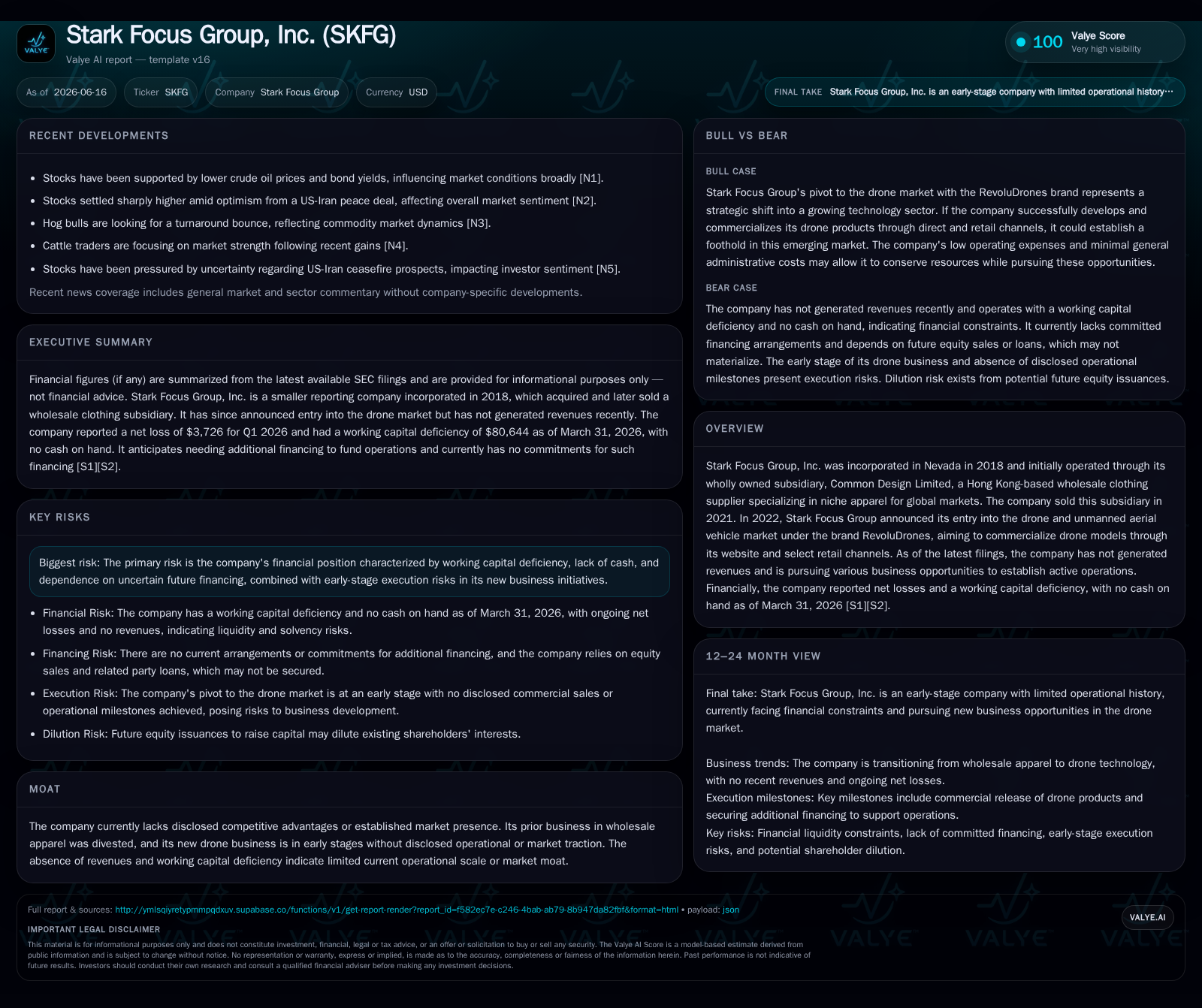
Stark Focus Group, Inc. has shifted its business focus from a divested wholesale apparel subsidiary to launching a new drone brand, RevoluDrones, targeting the consumer electronics and UAV market. However, as of the latest quarter ended March 31, 2026, the company reports no revenue and sustained net losses amid a working capital deficiency exceeding $80,000, highlighting significant early-stage execution and financial risks. The firm aims to commercialize drone models through e-commerce and selected retail channels but currently lacks production scale, R&D spend, or secured financing. Its growth hinges on securing capital, accelerating product development, and navigating an intensely competitive drone manufacturing landscape.
Recent Operating Update
Management indicates operational funding needs of about $60,000 for the coming year—allocated mostly among marketing ($15k), general administrative expenses ($25k), and professional fees ($20k). However, there are no current financing arrangements or commitments in place [S2][S8]. This liquidity gap accentuates Stark Focus Group’s dependency on future equity raises or related-party financing to continue operations.
Business Model Overview
Originally incorporated in Nevada in 2018 with operations rooted in apparel wholesale via its fully owned Hong Kong subsidiary Common Design Limited [S1], SKFG divested this core business in late 2021. By mid-2022, it repositioned itself within the consumer electronics domain by entering the unmanned aerial vehicle (UAV) market under the RevoluDrones brand [S1][S2]. The strategic plan involves designing consumer drones targeted primarily at retail consumers through a dual channel approach: direct-to-consumer e-commerce via www.Revoludrones.com and selective retail distribution partners.
This business archetype typically generates revenues by selling differentiated drone models leveraging innovation in flight capabilities and consumer-friendly features. Revenue drivers depend heavily on unit sales volume aligned with effective marketing efforts to build brand awareness [S2]. Post-sale services such as firmware updates or accessories can also add recurring income streams. From the recent filings however, SKFG demonstrates neither realized sales nor investment in research & development or marketing to date
Industry Structure and Competitive Context
The global consumer drone market is dominated by well-capitalized incumbents including DJI (market leader), Skydio (autonomy-focused U.S. maker), Parrot SA (Europe-based), GoPro (electronics diversification), and Yuneec. These firms benefit from significant technological expertise embedded within fast-paced R&D cycles that compress product development times and time-to-market requirements.
Competition exerts downward pressures on average selling prices (ASPs) due to commoditization risks fueled by component standardization. Meanwhile regulatory compliance for UAVs remains complex across key markets affecting product launch timelines. New entrants like SKFG face steep barriers not only in technological innovation but also brand-building amid an ecosystem where switching costs favor established suppliers.
From a value chain perspective, players focus heavily on product design innovation coupled with outsourced component fabrication to reduce capital expenditure intensity. Success factors include speed of commercialization coupled with scaled distribution reach either through e-commerce platforms or major retail networks.
Growth Drivers
Demand growth stems from expanding applications for drones encompassing photography/videography hobbyists, recreational users seeking more accessible devices, commercial sectors deploying UAVs for agriculture monitoring or delivery trials, and technological advances integrating AI capabilities enhancing autonomous flight functions.
Structural industry tailwinds include rising disposable incomes enabling consumer upgrades in emerging markets alongside loosening regulations facilitating broader UAV usage.
Secondarily, prolonged absence of advertising or research spending signals potential delays in achieving viable product commercialization milestones critical to transitioning beyond conceptual phase [S2]. This issue is exacerbated by reliance solely on equity financings yet lacking any firm commitments leading to dilution risks for existing shareholders.
Operational risks include supply chain disruptions common among electronics startups reliant on scarce specialized components; regulatory obstacles unique to UAV deployment; rapid technological obsolescence requiring ongoing reinvestment; and brand establishment challenges amid crowded market conditions dominated by legacy leaders with entrenched customer bases.
What To Watch Next
Key upcoming markers will be announcements evidencing actual commercial release of drone models under RevoluDrones brand—such as new product launches accessible on their website or impact agreements securing retail shelf space.
Monitoring future filings for operating expense increases signaling ramped-up R&D or marketing support could indicate movement toward active sales generation. Likewise assessing changes in working capital trends together with disclosure surrounding any successful capital raise will provide insight into sustainability prospects.
Absence of explicit guidance constrains forward visibility; thus quarters delivering initial revenues or documented unit sales volumes would represent meaningful inflections validating operational progress.
Financial Profile Summary
Capital resource discussions consistently highlight operational funding requirements near $60,000 annually with unknown sources undermining confidence around meeting cash burn demands without dilutive financings forthcoming imminently.
This analysis is based solely on disclosed quarterly filings and publicly available information without extrapolation beyond reported operating facts. It reflects an early-stage enterprise navigating transition risks inherent in shifting sector focus toward consumer electronics-based drones amid challenging financial headwinds typical for nascent UAV entrants.
Disclaimer: This is research-only, informational analysis and not investment advice. It may include AI-generated interpretation and general industry context. Always verify important details using primary sources.

Comments