
GATX Expands Fleet and Enhances Shareholder Returns Amid Rail Leasing Demand
GATX’s latest quarter shows continued fleet growth, robust maintenance capabilities, and strategic share repurchases supporting its durable railcar leasing business.
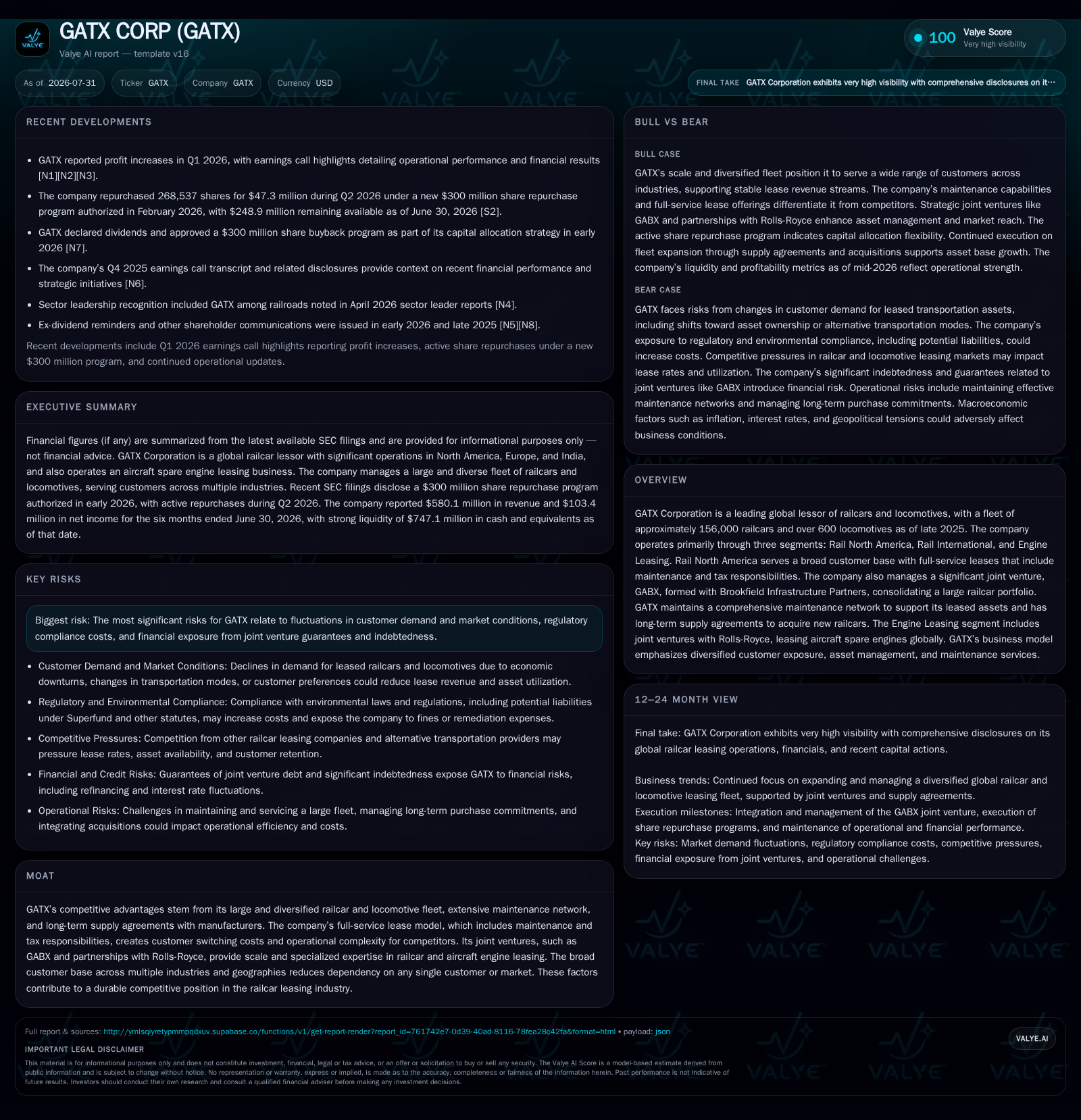
In its second quarter of 2026, GATX Corp advanced its position as a global leader in railcar and locomotive leasing by continuing to expand and diversify its fleet while actively returning capital through a significant share repurchase program. The company’s full-service lease model, coupled with joint ventures like GABX and partnerships in aircraft engine leasing, underpin a broad, diversified customer base and operational resilience. While capital intensity and market cyclicality remain industry challenges, GATX’s established maintenance network and long-term supply agreements support asset utilization and competitive differentiation.
Recent Operating Update
The recent disclosures provide no explicit updates on fleet size changes during Q2 but maintain confirmation that as of late 2025 the company operated approximately 156,000 railcars and over 600 locomotives worldwide through three core segments: Rail North America, Rail International, and Engine Leasing [S1]. Notably, the firm completed a sizable fleet acquisition in Q4 2025 with the purchase of nearly 5,900 railcars from DB Cargo AG. This transaction augmented the GRE-managed portfolio within Rail North America with well-positioned asset types favorable for current freight demand trends [S1].
Business Model Overview
GATX primarily generates revenue through long-term leasing of railcars and locomotives across multiple industries such as chemicals, automotive parts, petroleum products, and agricultural commodities. The leasing contracts are predominantly full-service agreements where GATX assumes maintenance responsibilities and tax obligations related to the equipment. This full-service lease structure creates substantial switching costs for customers because it transfers asset management complexity away from lessees onto GATX's integrated maintenance network. By bundling maintenance with lease rentals, GATX can negotiate longer contract terms—typically several years—and improve fleet utilization rates versus simpler net leases where customers bear upkeep risks.
The company’s asset management extends through dedicated facilities that conduct repairs and routine inspections ensuring fleet availability aligns with customer logistical requirements. These services underpin high lease renewal rates critical to sustaining steady lease rental revenues during freight demand cycles [S1]. Additionally, GATX maintains long-term supply agreements with leading railcar manufacturers which smooth capital expenditure planning for new equipment acquisitions needed to replace aging assets or expand into new demand pools.
Beyond traditional railcar leasing, the Engine Leasing segment represents growth diversification by leveraging joint ventures with aerospace firms like Rolls-Royce to lease aircraft spare engines globally. This segment gains exposure to different equipment lifecycles and customer bases outside rail freight transportation while benefiting from GATX’s expertise in equipment leasing operations [S1].
Industry Structure and Competitive Position
GATX operates at scale in an industry characterized by high capital intensity due to the expensive nature of specialized rolling stock and regulatory compliance costs. The company sits between rolling stock manufacturers—who produce equipment—and end customers—including freight shippers and passenger operators—who require flexible access to transportation assets without ownership burdens.
Within this value chain placement, GATX's large diversified fleet offers competitive benefits: it supports geographic diversification across North America, Europe (through GRE), India (Rail India), and other international markets [S1], reducing exposure to regional economic cyclicality. Its partnerships such as the joint venture GABX consolidate scale advantages realized via shared investment and risk pooling with partners like Brookfield Infrastructure Partners [S1]. Such alliances strengthen purchasing power for new equipment procurement while enhancing portfolio management efficiencies.
Competitors in this space tend to be specialized railcar lessors such as Trinity Industries Leasing or CIT Rail Holdings; however, GATX’s multi-asset class offering including locomotives and aircraft engine leasing distinguishes its revenue streams. The integrated maintenance network elevates service quality relative to peers that may rely on third-party servicing or simpler lease models. Furthermore, its ability to execute large fleet acquisitions—like the DB Cargo transaction—supports proactive portfolio optimization that peers may find challenging due to capital constraints or lack of diversified partnerships.
Growth Drivers
Demand for railway freight transport remains structurally supported by macroeconomic trends favoring sustainable logistics modes over trucking for bulk commodities—a tailwind for expanding leased fleet utilization. Infrastructure investments in rail capacity upgrades enable higher volumes transported per train cycle which increases demand for efficient rolling stock typically sourced via leasing rather than outright purchase due to capital flexibility needs.
Fleet modernization mandates driven by regulatory safety requirements create replacement cycles incentivizing lessors like GATX who have ready-maintained fleets meeting current standards. Expanding into emerging markets such as India leverages strategically managed assets under net leases allowing geographic diversification beyond mature western economies [S1]
Long-term lease renewals coupled with extensions contribute recurring revenue visibility across economic cycles given typical contract durations ranging from five to fifteen years depending on region and asset class [S1]. Joint ventures provide access to complementary markets such as aerospace spare engines which diversify sector risk while broadening overall installed equipment base leveraged for high fixed-cost amortization.
Risks and Watchpoints
Despite stable fundamentals, fluctuations in customer freight volumes linked to cyclical economic environments pose ongoing utilization risks impacting lease rental revenues. Regulatory compliance demands around emission standards or safety protocols impose increasing maintenance cost pressures potentially compressing margins if not fully recoverable through contractual rent escalations.
Residual value risk arises from the long useful lives of railcars (15-30 years) requiring prudent asset retirement timing lest outdated equipment erode balance sheet valuations. Credit risk associated with lessees also requires active underwriting given variability in end-market exposures across industries served.
Capital intensity dictates reliance on continued access to debt or equity financing at attractive rates to fund new acquisitions or opportunistic investments; interest rate volatility could elevate funding costs diminishing profitability.
Joint venture arrangements introduce complexity regarding financial guarantees or operational coordination requiring careful management oversight to avoid dilution of returns or unexpected liabilities.
What To Watch Next
Key milestones will include quarterly reporting on lease portfolio growth metrics such as fleet utilization rates, average remaining lease terms especially after major acquisitions or renewals, and incremental margin trends from maintenance operations. Monitoring capital deployment pace in acquiring newer railcars aligned with freight growth areas signals proactive positioning versus reactive fleet adjustments.
Progress on share repurchase execution offers insight into management’s confidence level about cash flow sustainability amid external uncertainties. Updates on international expansions particularly in emerging geographies are relevant for gauging diversification benefits.
Additionally, announcements regarding enhancements or expansions of joint ventures—railcar or engine leasing—may indicate strengthening moats through scale economies or product breadth enhancement.
Financial Profile Discussion
As of December 31, 2023, GATX reported total debt of approximately $7.39 billion and net debt of about $6.64 billion, with cash and equivalents of $747 million as of June 30, 2026 [F1]. These figures reflect the company’s capital-intensive business model reliant on significant debt financing to support its large leased asset base. Maintaining disciplined free cash flow generation to fund fleet reinvestment and shareholder returns remains critical for sustaining financial flexibility.
Capital expenditures continue to focus on acquiring new railcars tailored to evolving customer demand while managing asset retirements to mitigate residual value risks. The company’s open-ended share repurchase authorization totaling $300 million, with nearly $47.3 million executed in Q2 2026, demonstrates ongoing commitment to shareholder returns balanced against operational funding needs [S2]
This report is prepared solely for informational purposes reflecting publicly available data up to July 31, 2026; it does not constitute investment advice or endorsement of any securities discussed herein.
Disclaimer: This is research-only, informational analysis and not investment advice. It may include AI-generated interpretation and general industry context. Always verify important details using primary sources.

Comments