
Stagwell Leverages AI-Driven Marketing Cloud to Expand Competitive Edge in Digital Marketing Services
Stagwell's latest quarterly results underscore growth fueled by its integrated AI-powered marketing services and proprietary technology offerings amid a fragmented marketing landscape.
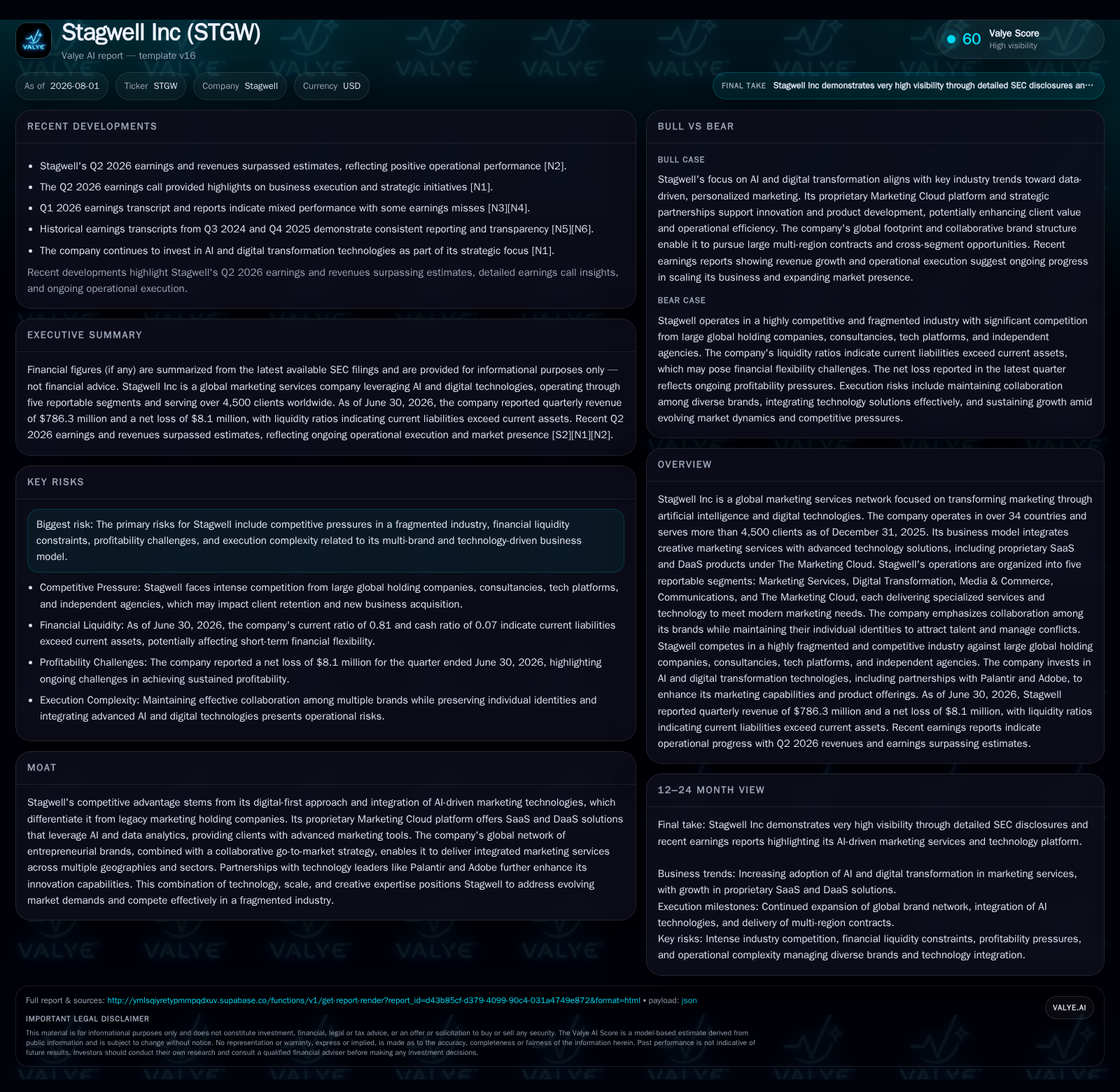
In its Q2 2026 filing, Stagwell Inc highlights solid momentum driven by accelerating client demand across its creative agencies and SaaS/DaaS technology platforms. The company’s hybrid business model combines traditional marketing services with a proprietary Marketing Cloud suite that leverages AI for enhanced client outcomes. Stagwell's diversified global network and strategic technology partnerships aim to differentiate it from legacy holding companies amid macroeconomic pressures. However, challenges remain around economic sensitivity, operating complexity, and margin sustainability. Monitoring client retention, SaaS subscription growth, and new business wins will be key to assessing execution on its growth strategy.
Recent Operating Update
Stagwell Inc’s second quarter 2026 disclosures provide an updated view of the company’s operational progress amid a dynamic marketing services environment. In its July quarterly filing, the company reported ongoing acceleration in net new business wins and expanded penetration of its AI-enhanced software offerings housed within The Marketing Cloud platform [S2][S3]. This underscores the traction of Stagwell's strategy to meld traditional creative agency services with next-generation SaaS and DaaS technology products leveraging artificial intelligence.
The July 30th earnings release highlighted revenue growth drivers spanning multiple service lines including digital transformation initiatives and media commerce solutions aimed at helping clients optimize their omnichannel marketing [N1][N2]. Such diversification across five distinct segments—Marketing Services, Digital Transformation, Media & Commerce, Communications, and The Marketing Cloud—is central to how Stagwell manages risk while aiming for profitable expansion [S1].
Business Model Nuances
Stagwell operates a hybrid business model blending fee-for-service revenue from its global network of creative agencies with recurring revenue streams generated by proprietary software subscriptions. Its clientele comprises predominantly enterprise-level marketers who require integrated campaign management augmented by real-time data analytics and automation tools.
Revenue from the core agency services depends on factors like billings volume (e.g., media buying budgets), utilization rates of creative staff, and client retention—a dynamic sensitive to macroeconomic shifts affecting marketing spend levels. Meanwhile, The Marketing Cloud delivers SaaS and DaaS products that command subscription or usage fees, adding a relatively higher-margin, recurring revenue layer that enhances overall financial resilience when client uptake expands [S1].[F1]
Strategically, this bifurcated revenue approach aligns with broader industry trends where legacy holding companies are investing heavily in digital transformation but often lack native technology platforms. Stagwell’s ability to sell both high-touch creative work alongside scalable AI-powered tools targets the evolving needs of modern marketers who seek performance insights alongside creative storytelling.
Industry Structure and Competitive Position
The global marketing services landscape remains highly fragmented with numerous agencies and independent units vying for share alongside established multinational holding companies such as WPP plc, Publicis Groupe, and Omnicom Group. The rise of digital channels and e-commerce has shifted competitive dynamics favoring entities that can integrate data-driven insights with creativity.
Stagwell distinguishes itself through its digital-first ethos manifested in The Marketing Cloud suite which includes applications spanning research & insights, communications automation, media planning analytics, and content generation using AI algorithms [S1]. Its partnerships with technology innovators like Palantir for advanced data analytics capabilities and Adobe for creative software enhance innovation velocity relative to many competitors reliant solely on external vendors.
Furthermore, its presence in over 34 countries servicing more than 4,500 clients allows access to large multi-region contracts potentially surpassing $10 million annually—scale credentials crucial when competing against legacy holding companies for marquee accounts [S1]. However, integration complexity across multiple specialist brands requires effective coordination to maximize cross-selling opportunities without diluting brand identities or internal collaboration.
Growth Drivers
Several secular trends underpin Stagwell’s growth prospects:
- Rising global digital marketing spend: As advertisers increasingly allocate budgets towards digital channels over traditional media formats.
- Accelerating adoption of artificial intelligence: Marketers demand sophisticated data analytics combined with automation to drive measurable ROI.
- Shift toward performance-based marketing: Clients favor accountability which favors technologies enabling precise measurement.
- Expansion in emerging markets: Offering revenue diversification beyond mature US/European markets.
- E-Commerce growth: Driving demand for integrated media commerce capabilities facilitating direct-to-consumer brand engagement.
- Client demand for self-service marketing automation: Enabled by scalable SaaS platforms which reduce dependency on agency labor hours.
Quantitatively important KPIs aligned with these drivers include net revenue retention rates in The Marketing Cloud segment reflecting subscription base stability or expansion; new business win rates signaling market acceptance; average contract values indicating upsell success; and utilization improvements within agency staff demonstrating operational leverage potential.
Risks and Watchpoints
While Stagwell benefits from favorable macro trends supporting digital-first marketing solutions, several headwinds warrant caution:
- Economic sensitivity: Client marketing budgets remain vulnerable to inflationary pressures, elevated interest rates, geopolitical uncertainties impacting discretionary spend resulting in revenue volatility [S1].
- Highly fragmented competition: Leading to pricing pressure especially on commoditized services like media buying.
- Execution complexity: Managing multiple brands along with continuous investment demands in R&D for its AI-powered platform increases operational risk.
- Margin compression risk: From rising labor costs globally combined with investments needed in technology infrastructure.
- Liquidity constraints: Current ratio below 1 (0.81) flags near-term working capital tightness balancing $109 million cash against $1.45 billion debt as of June 30 [F1][S2].
- Client concentration risks: Large multi-region contracts can account for substantial revenue portions creating exposure if renewals falter.
- Talent Retention: Both creative talent at agencies and technical talent developing SaaS products are critical yet competitive labor markets challenge this sustainability.
What to Watch Next
Key milestones to monitor include:
- Quarterly updates on net new business wins globally across all segments indicating sales execution amid competitive pressures. - Growth trajectory of recurring revenues from The Marketing Cloud detailing the pace of SaaS/DaaS subscription adoption contributing stable margin streams. - Expansion into underpenetrated geographies or verticals reflecting capability scaling. - Client retention rate sustainability as a barometer of service excellence marrying creativity with technology innovation. - Margin trends demonstrating operating leverage despite inflationary headwinds impacting salary cost structures. - Strategic partnership developments or incremental product launches expanding AI capabilities enhancing differentiation versus peers. - Any developments around refinancing or debt management addressing current liquidity tightness observed mid-year [N1][N2]
Financial Profile Discussion
As of June 30, 2026, Stagwell reported a cash balance just over $109 million against total debt approximating $1.45 billion resulting in net debt exceeding $1.3 billion [F1]. The current ratio stands at approximately 0.81 indicating near-term liquidity constraints given current liabilities slightly exceed current assets [F1]. This ratio below the conventional benchmark of 1 signals tight working capital conditions requiring close treasury management or reliance on upcoming cash flows from operations or refinancing activities.[S2]
Close scrutiny over free cash flow conversion will determine Stagwell's capacity to deleverage or internally fund continued tech innovation without excessive dilution or cost-cutting measures detrimental to growth. Given the financial profile juxtaposed with operating opportunities in high-growth digital service lines combined with proprietary SaaS technology initiatives creates a complex capital allocation balancing act for management going forward.
Disclaimer: This analysis is based solely on publicly available information as of August 2026 and is intended for informational purposes only without providing investment advice.
Disclaimer: This is research-only, informational analysis and not investment advice. It may include AI-generated interpretation and general industry context. Always verify important details using primary sources.

Comments