
Apple’s Q3 2026 Update Highlights Supply Chain Cost Pressures and Ecosystem Growth
Apple reported strong hardware revenue but faces margin headwinds from rising component costs, while services expansion advances its ecosystem strategy.
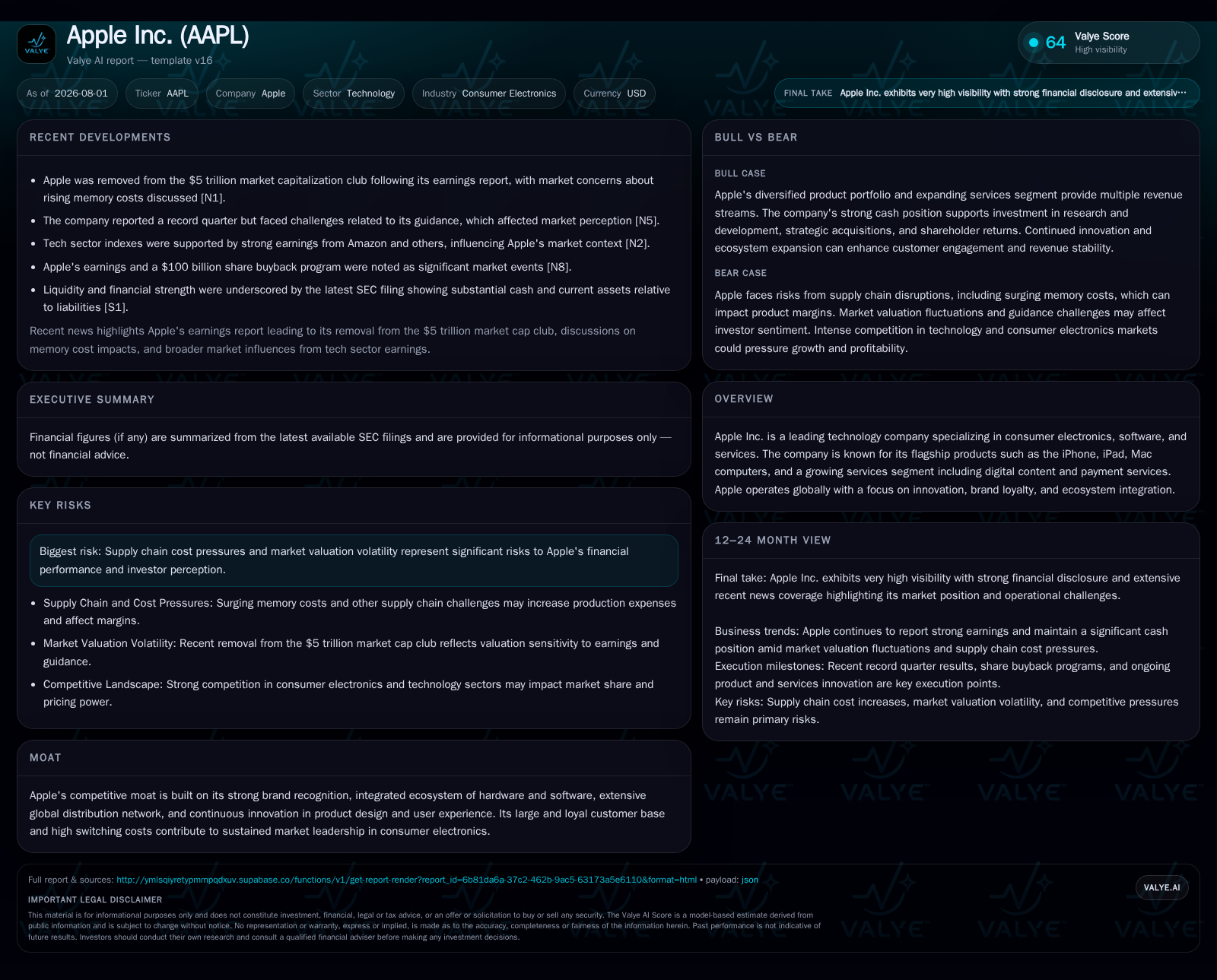
In its latest Q3 2026 filing, Apple Inc. disclosed solid sales across its device portfolio, including iPhone and wearables, but flagged increasing supply chain cost pressures impacting gross margins. The company’s growing services segment continues to diversify revenue beyond hardware, reinforcing ecosystem lock-in. Leadership transition announced with John Ternus succeeding Tim Cook as CEO in September 2026. Market valuation reacted negatively to margin concerns despite record revenue levels.
Recent Operating Update: Q3 Fiscal 2026 Review
Apple’s Q3 fiscal 2026 results, filed July 31, underscore a complex operating environment combining strong demand for flagship devices with rising input costs [S2]. The company reported continued high-volume sales across its smartphone (iPhone), tablet (iPad), personal computing (Mac), and wearables categories. However, gross margins contracted due to increased prices for critical components such as memory chips—a challenge corroborated by contemporaneous market reports on surging semiconductor costs [N1]. This gross margin pressure offset some gains from the higher-margin Services segment that includes digital content distribution, app store fees, and payment offerings.
The overall picture shows Apple maintaining unit sales momentum even as pricing power is tested by supply chain cost inflation. Channel sell-through rates remain healthy, indicating resilient end-customer uptake despite macroeconomic uncertainties. This dynamic points to enduring brand loyalty and effective ecosystem-driven customer retention that enables Apple to sustain a premium pricing model despite competitive pressures.
Leadership communication also announced a pivotal governance change: John Ternus, currently Senior Vice President of Hardware Engineering with nearly 25 years at Apple, will succeed Tim Cook as CEO effective September 1, 2026 [S16]. This transition emphasizes Apple’s focus on product innovation leadership continuity amid industry competition.
Business Model Specifics
Apple’s revenue derives primarily from the design, manufacture (largely outsourced via contract manufacturers like Foxconn), and sale of consumer electronics including smartphones, tablets, PCs, and wearables. Hardware sales contribute the bulk of top-line revenues facilitated through a blend of direct retail (Apple Stores), online channels, and third-party resellers worldwide. Pricing strategy benefits from brand strength and a differentiated user experience enabled by proprietary hardware-software integration.
Supplementing device sales is a fast-growing services division generating recurring revenues through App Store commissions, streaming subscriptions (Apple Music, TV+), cloud storage (iCloud), payment processing (Apple Pay), and device care programs. This services portfolio benefits from significant installed base size measured in hundreds of millions of active devices globally—an asset driving ecosystem lock-in that boosts customer lifetime value.
Revenue mechanics track unit sales volume modulated by average selling price (ASP) shifts influenced by product mix changes. Battery of new product launches cyclically impacts quarterly revenues but also drives usage intensity of digital services over time. Gross margins are notably sensitive to component cost fluctuations and product lifecycle phase; newer models typically enjoy better pricing power but require higher R&D outlays.
Industry Structure and Competitive Position
Operating at the nexus of consumer electronics hardware manufacturing and digital services ecosystems sets Apple apart from pure hardware peers such as Samsung or Sony and software-centric rivals like Google or Amazon. Its vertically integrated business model—melding proprietary chip design with optimized iOS software—fortifies competitive barriers against commoditized Android-based substitution.
Brand loyalty quantifiably supports unusually high customer retention rates relative to industry peers. This translates into stable channel sell-through levels even under cyclical consumer spending downturns. Moreover, Apple’s extensive global distribution coupled with direct-to-consumer channel control sustains favorable channel mix dynamics reducing reliance on wholesale partners who often apply discounting pressure.
Supply chain management remains critical given dependency on external suppliers for semiconductors and key materials subject to geopolitical risks. Apple’s scalability allows negotiating leverage compared to niche competitors but does not fully immunize it against sudden commodity cost escalations or logistic disruptions noted recently.
Growth Drivers
- Product Innovation and Launch Cadence: Continuing advancements in device hardware design—especially enhanced camera systems, silicon performance improvements via custom chips—and periodic refreshes fuel replacement cycles critical for sustaining unit volumes.
- Expansion of Services Revenue: Accelerating monetization of digital content distribution, financial payment systems integration, subscription scaling provides higher-margin onboarding beyond initial device sale.
- Ecosystem Integration: Cross-product interoperability in wearables (Apple Watch), smart home capabilities (HomeKit), and health monitoring deepen user engagement enhancing switching costs.
- Emerging Market Penetration: Incremental adoption of smartphones and internet services among newer consumers underpins long-term installed base growth opportunities.
- Health & Wearable Device Adoption: Rising demand for health-related functionalities embedded in wearables offers new avenues for usage-based revenue expansion.
Risks and Watchpoints
The major risk highlighted is supply chain cost inflation materially compressing gross margin potential; memory prices exemplify this trend currently [S2][N1]. Such margin shrinkage could extend if global geopolitical tensions disrupt component sourcing or increase logistics expenses.
Dependency on highly anticipated product launches introduces volatility; any shift away from traditional launch schedules or weaker-than-expected demand can affect revenue visibility significantly. Regulatory pressures on data privacy or antitrust issues may constrain aspects of service platform monetization over time.
Inventory obsolescence risk remains relevant amid fast-evolving technology standards requiring precise channel mix management to avoid markdown-related earnings dilution.
Currency fluctuations also pose erosion risk given multinational exposure.
What To Watch Next
- Apple's upcoming product release cycle timings will be closely monitored for any acceleration or delay affecting quarterly revenue projections.
- Services subscription growth rates will serve as a proxy for ecosystem health beyond hardware sales.
- Gross margin trajectory alongside any early signs of mitigating component inflation via supplier renegotiations or design optimizations.
- Impact of CEO transition execution on innovation pipeline confidence among stakeholders.
- Inventory turnover trends indicating supply chain agility versus potential build-up risks.
Financial Profile Discussion
As of June 27, 2026 quarter-end, Apple maintains a strong liquidity position with cash and equivalents totaling approximately $39.5 billion alongside current assets nearing $149.8 billion versus current liabilities around $149.3 billion—implying a current ratio near parity at about 1 [F1]. This indicates sufficient short-term asset coverage for liabilities but underscores substantial working capital deployment consistent with inventory investment supporting global channel demands.
Total debt recorded was approximately $91.3 billion as of late FY2025 with net debt estimated near $51.7 billion after accounting for cash holdings [F1], signifying manageable leverage given Apple's robust operating cash flow generation capacity historically observed around $100+ billion annually per prior periods.
Capital allocation balances ongoing R&D investments necessary for innovation leadership against shareholder returns including dividends and buybacks typically maintained within disciplined financial policies.[S3]
In conclusion, Apple's latest quarter affirms resilience in driving device demand alongside an expanding services ecosystem crucial for long-term sustainable revenue diversification amid cost headwinds notably from supply chain factors. Monitoring component pricing trends along with new product cycle timing will be essential for assessing near-term margin recovery prospects.
Disclaimer: This is research-only, informational analysis and not investment advice. It may include AI-generated interpretation and general industry context. Always verify important details using primary sources.

Comments