
EPR Properties' Q2 Leap Highlights Tenant Quality and Capital Strategy
Strong Q2 operating metrics and disciplined capital management underscore EPR’s resilience in experiential real estate amid macroeconomic pressures.
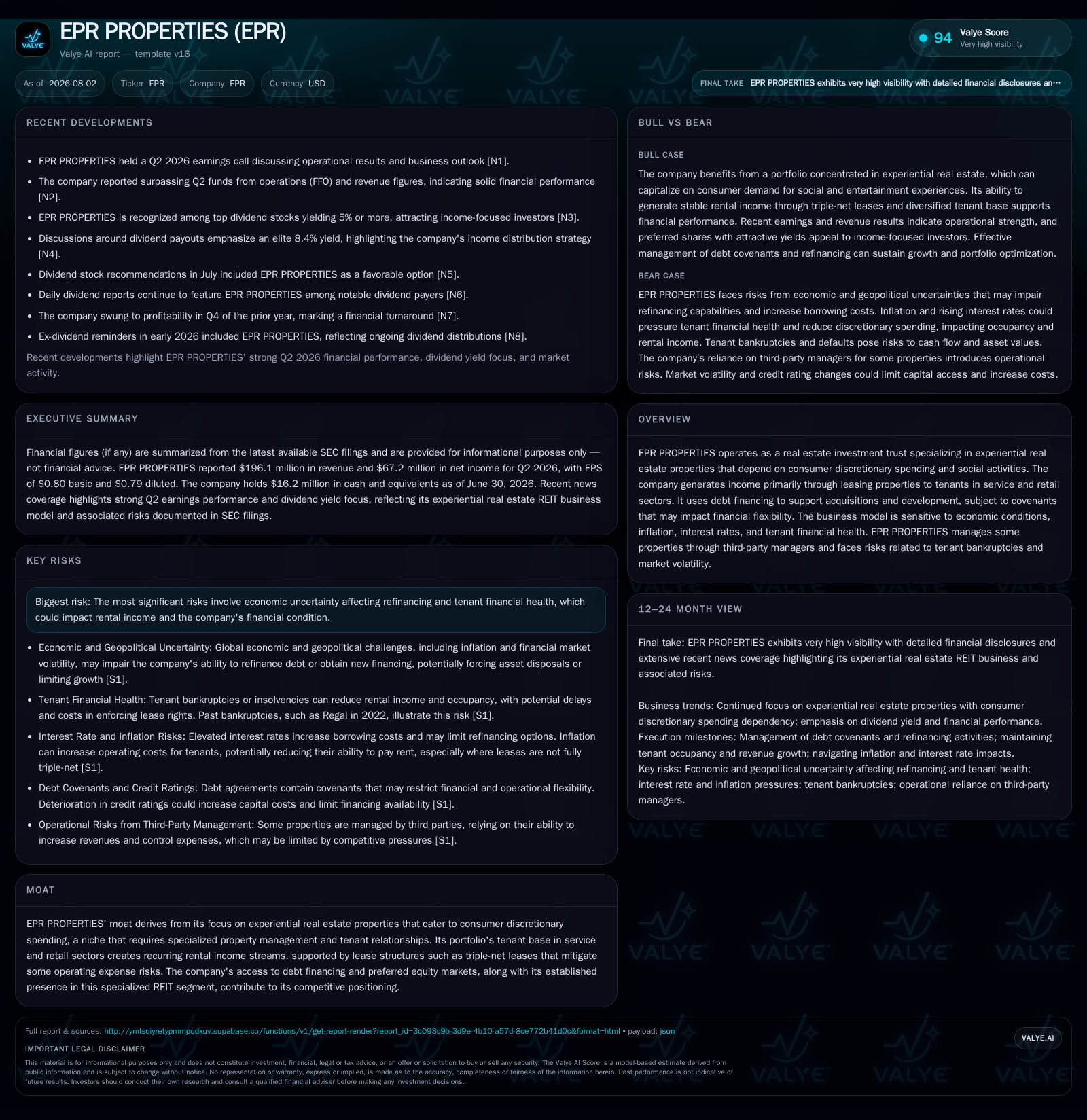
EPR Properties reported a solid second quarter marked by stable occupancy rates and robust same-store net operating income, reaffirming tenant quality in its experiential-focused portfolio. The company’s triple-net lease structure and tenant diversification provide a buffer against inflation and economic cyclicality. Meanwhile, active management of its capital structure—including new credit facilities and preferred equity issuances—supports near-term liquidity and acquisition capacity despite higher interest rate headwinds. Growth remains tied to consumer discretionary spending trends, while refinancing risks and tenant credit environment warrant close monitoring.
Q2 Operational Momentum Reaffirms Tenant Stability and Rent Collectibility
EPR Properties entered the second half of 2026 maintaining solid operational footing as reflected in their Q2 Form 10-Q filing. Occupancy across the experiential real estate portfolio remained stable, supporting ongoing collection of rental income—a critical metric given EPR’s specialization in properties tied closely to consumer discretionary spending [S2]. Same-store Net Operating Income (NOI) showed positive growth, highlighting resilient tenant performance even as inflationary pressures persist in the broader economy [S2][N1][N2]. This underscores continuing strength in EPR’s tenant credit quality within entertainment, recreation, and other social activity venues that define their asset base.
The persistence of stable leasing metrics amid higher interest rates signals durable demand fundamentals. Robust rent collectibility affirms the efficacy of EPR's lease agreements which transfer most property expenses to tenants through triple-net structures, reducing operating expense volatility for the REIT itself.
Experiential Leasing: Core Strategy Offering Resilient Recurring Income
EPR operates within a specialized REIT segment focused on experiential real estate assets — such as entertainment venues and leisure properties — that depend heavily on consumers’ discretionary income and social engagement trends. Their revenue predominantly arises from leasing properties under long-term triple-net leases where tenants bear expenses including property taxes, insurance, and maintenance [S1][S2]. This structure systematically shifts many inflation-related cost risks away from EPR while providing predictable rental streams augmented by contractual rent escalators.
These leases often contain percentage rent provisions tied to tenant sales volumes alongside fixed escalations capped contractually; hence while there is some natural inflation hedge, high inflation episodes could outpace escalation limits reducing margin protection [S1]. Tenant diversification across service and retail subsectors lowers default concentration risks but leaves some sensitivity to economic cycles impacting discretionary spending patterns
The specialized nature of these assets requires ongoing relationship management with operators whose business success directly influences EPR’s cash flow stability.
Capital Structure and Financing Flexibility Support Growth Pathways
EPR’s recent refinancing activity highlights a disciplined approach to managing leverage amid rising interest costs. The company executed an amended credit agreement comprising a $1.0 billion revolving credit facility plus a new $600 million term loan facility maturing in July 2030 and January 2032 respectively, both extendable subject to conditions [S3][S29]. The agreement includes an accordion feature allowing for up to $1.0 billion additional borrowing capacity upon lender approval, underscoring flexibility for future acquisitions or capital needs.
As of June 30, 2026, total debt approximated $3.3 billion against modest cash reserves near $16 million yielding net debt around $3.28 billion [F1], aligning with historical leverage ratios while remaining compliant with financial covenants requiring debt-to-asset limits below 60% and minimum fixed charge coverage over 1.5x [S4][S5][S9]. Recent senior unsecured note issuances at approximately 4.75% coupon facilitated repayment of prior revolver borrowings lowering short-term refinancing risk though overall cost of capital reflects elevated market rates compared to preceding years [S5][S13].
This capital structure supports EPR's growth ambitions through acquisitions or developments while maintaining adequate liquidity buffers during volatile market conditions.
Competitive Outlook: Positioning Versus Retail-Focused Peers
Within the broader REIT ecosystem, EPR distinguishes itself as a niche player concentrating on experiential real estate — an area encompassing leisure venues rather than traditional retail stores or commercial office spaces common among peers such as Realty Income or Federal Realty Investment Trust [S1]. This positioning offers differentiated exposure aligned with evolving consumer preferences toward experience-based spending but amplifies cyclical sensitivity.
Their triple-net lease model aligns operational risks more closely with tenants than general retail landlords who often assume certain operating expenses themselves. While this can enhance margin stability for EPR relative to peers vulnerable to property cost inflation, it does hinge on tenant financial resilience in discretionary sectors susceptible to economic fluctuations.
Moreover, specialization may limit geographical or sector diversification benefits enjoyed by more broad-based REITs yet allows focus on emerging demand growth in experiential venues tied to social trends.
Growth Catalysts: Leveraging Consumer Demand for Experiences
Emerging from pandemic-related disruptions, there has been a notable uptick in consumer willingness to spend on entertainment and leisure activities—core drivers underpinning demand for EPR’s portfolio assets [N1][N7]. Correspondingly, occupancy improvements might accelerate repeat leasing velocity supported by favorable demographic trends favoring experiential consumption.
EPR also pursues selective property acquisitions bolstered by its access to capital markets through debt financing facilities complemented by preferred equity offerings providing incremental funding capacity without excessive dilution [S6][S28]. Lease agreements commonly incorporate rent escalators or percentage rents that capture upside potential linked to improved tenant sales performance.
Continued economic recovery should enhance ability for tenants to meet lease obligations while providing headroom for negotiating renewals at improved terms where location desirability persists.
Watchpoints: Macroeconomic Sensitivities and Tenant Financial Health
Despite structurally attractive lease terms mitigating some inflation risk via escalations, contractual caps limit protection against sustained high inflation episodes impacting operating expenses borne by tenants [S1][S26]. Additionally, the timing concentration of upcoming debt maturities approaching mid-to-late decade mandates vigilant refinancing plans amid uncertain credit market conditions.
Tenant bankruptcies remain a salient risk particularly given the discretionary nature of many underlying businesses; though currently stable occupancy reflects healthy tenant credit profiles there remains cyclical vulnerability if consumer spending contracts materially post-Q2 [S1][S2]. Monitoring lease expiration profiles will be crucial as renewal success directly affects recurring revenue visibility.
Macroeconomic volatility including interest rate fluctuations also impact cost of capital dynamics influencing investment returns and distribution sustainability.
Forward Indicators: Lease Expirations, Occupancy Trends, and Capital Markets Access
Key upcoming milestones include assessing Q3 occupancy rate trajectories post-Q2 results publication which will signal momentum in leasing activity among experiential tenants navigating evolving economic conditions [S2][N1]. Additionally, tracking lease renewal spreads versus expiring rent levels provides insight into pricing power retention under inflationary environments.
Capital markets access remains pivotal; timely execution of any planned preferred or common equity raises along with prudent utilization of revolving credit facilities will demonstrate continued financial flexibility supporting dividend distributions consistent with adjusted funds from operations (AFFO).
Investor focus will also center on any revisions to dividend policy reflecting operational cash flow generation vis-à-vis leverage constraints.
Financial Profile Discussion: Leverage Metrics Aligning With Strategic Objectives
At quarter end June 30, 2026, EPR reported approximately $3.29 billion gross debt offset by roughly $16 million cash balances resulting in net debt near $3.28 billion—levels consistent with prior quarters indicating stable leverage utilization aligned with strategic targets [F1][S2]. The company continues compliance with all material covenants under notes payable instruments restricting total consolidated debt ratios (<60%) and secured debt ceilings (<40%), paired with fixed charge coverage requirements (>1.5x) supporting prudent risk management amidst challenging macroeconomic backdrops [S4][S9].
Key liquidity sources include the newly extended revolving credit facility totaling $1.0 billion available commitment plus remaining undrawn portions of recent term loan allotments enhancing short-to-medium term financial flexibility beyond immediate debt maturities clustered over 2026–2028 horizons [S29]
Interest costs have risen moderately reflecting prevailing higher rate environments; however issuance of senior notes at locked coupons around mid-4% range fixes portions of liabilities reducing exposure volatility compared to fully floating rate borrowings prevalent previously [S5][S13]. Operating cash flows backed by consistently strong rental income contribute sustainably towards servicing debt obligations while maintaining dividend payouts informed by AFFO calculations within REIT tax compliance parameters [S28].
In sum, the financial profile reveals a well-calibrated balance sheet poised for measured growth investments while cushioning refinancing risks through staggered maturities and diversified funding sources.
This analysis synthesizes recent quarterly disclosures and annual filing contents alongside sector knowledge pertinent to REITs specializing in experiential real estate without offering investment advice or price forecasts.
Disclaimer: This is research-only, informational analysis and not investment advice. It may include AI-generated interpretation and general industry context. Always verify important details using primary sources.

Comments