
BWX Technologies Strengthens Nuclear Contract Backlog and Innovation Trajectory with Robust Q2 Execution
BWXT’s Q2 2026 update highlights improved backlog, solid liquidity, and sustained R&D spending underpinning its leadership in nuclear and defense technologies.
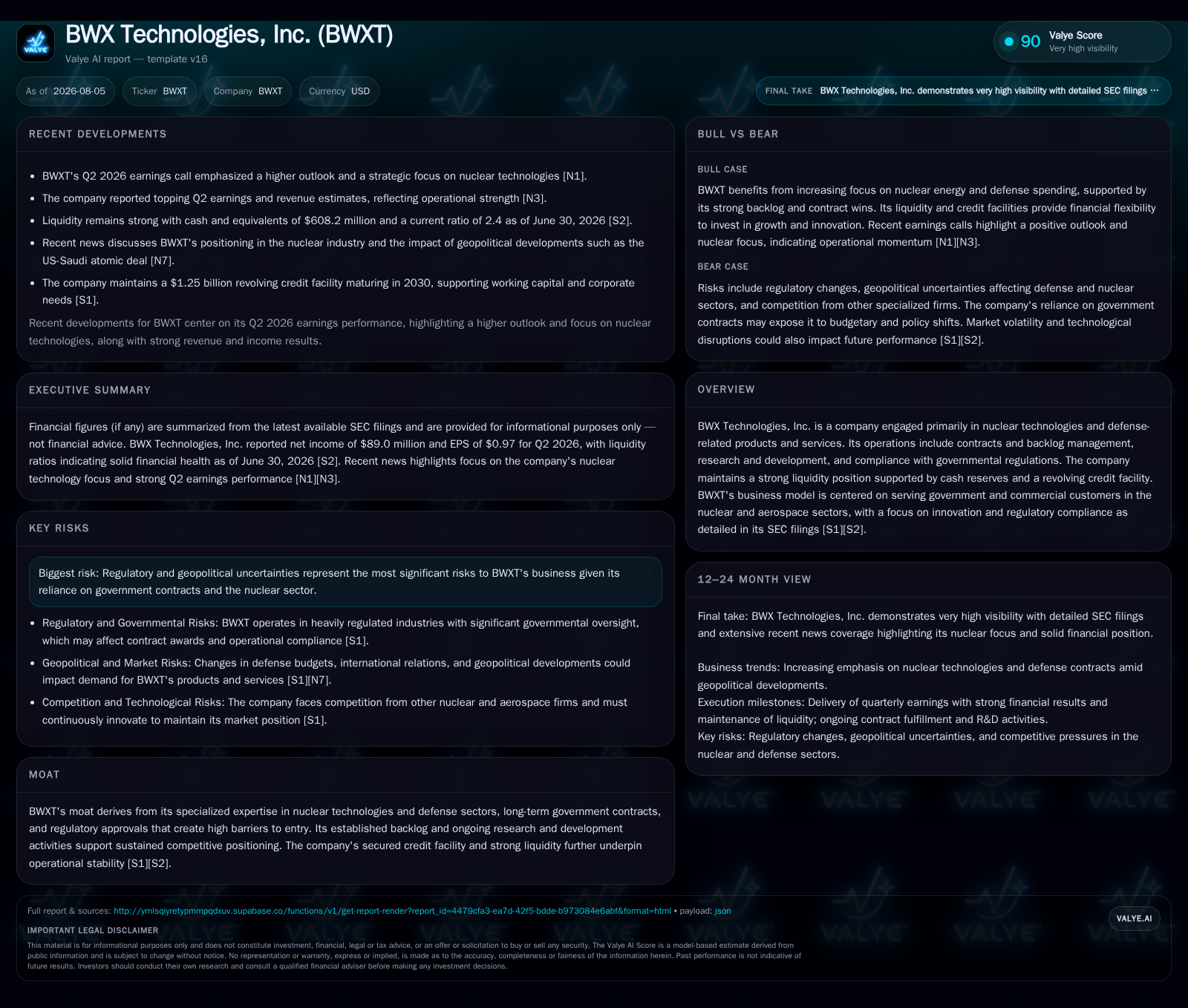
BWX Technologies reported a strengthened contract backlog during Q2 2026, enhancing near-term revenue visibility despite the aerospace and defense sector's characteristically long sales cycles. The company leverages its specialized nuclear technology offerings and stringent regulatory compliance to maintain a durable competitive moat amid evolving geopolitical risks. Government contract funding dynamics continue to shape revenue streams and risk exposure, while rising R&D investments signal commitments to innovation that sustain BWXT’s leadership. Furthermore, robust liquidity supported by substantial cash reserves and an ample revolving credit facility provides operational flexibility for executing long-term multi-year projects. Key growth catalysts include increased government defense spending and expansion of commercial nuclear programs, although regulatory and geopolitical uncertainties remain important watchpoints.
Slower Sales Cycle but Strengthened Contract Backlog Underpins Near-term Visibility
BWX Technologies’ August 2026 quarterly filing reveals a meaningful improvement in its contract backlog, a crucial metric given the aerospace, defense, and nuclear sector's characteristically extended sales cycles. While typical procurement processes involve multi-year timelines from contract award through execution, BWXT’s rising backlog signals enhanced near-term revenue visibility despite these structural lags [S2]. Management commentary during the Q2 earnings call emphasized this backlog growth as foundational for operating leverage gains in upcoming periods [N1]. Given that backlog conversion cadence is a strong forward indicator in government contracting industries, this development suggests a stable demand environment for BWXT’s specialized nuclear technologies and defense-related products.
Specialized Nuclear Technology Offerings Sustain Regulatory Moat Despite Sectoral Headwinds
BWXT operates within a niche emphasizing highly specialized nuclear components and life cycle support services, servicing U.S. government agencies alongside commercial nuclear energy customers [S1]. This product-service mix demands strict regulatory compliance with multiple agencies overseeing safety, environmental impact, and technology standards. These regulatory requirements create exceptionally high barriers to entry since new competitors face protracted certification processes before market access. Consequently, BWXT's extensive experience navigating this complex landscape underpins its sustainable competitive advantage.
Additionally, the company's dual role in defense systems manufacturing complements its commercial nuclear business; this diversification mitigates risk concentration yet requires ongoing innovation to maintain technological leadership [S1]. Such positioning aligns with the industry's broader trend where firms must balance R&D investment against rigorous compliance obligations to protect their market foothold.
Government Contract Funding Dynamics Shape Revenue Streams and Risk Profile
Government funding cycles heavily influence BWXT’s contract awards and delivery schedules. The company's predominance of U.S. federal contracts creates dependencies on appropriations processes susceptible to political shifts, budget delays, or continuing resolutions [S2][S3]. These factors can introduce unpredictability in order intake timing and payment flows.
Recent filings highlight ongoing vigilance regarding budget uncertainty risks including potential government shutdowns that could delay program starts or cause temporary suspensions in operations [S27]. These issues underscore why maintaining a strong backlog is vital; it cushions near-term financial performance from volatile procurement calendars. Moreover, BWXT's ability to manage long sales cycles effectively positions it resiliently relative to peers facing similar fiscal policy headwinds.
Increasing R&D Investments Signal Focus on Future Nuclear Innovation Pipeline
Maintaining technological leadership within tightly regulated nuclear technology sectors necessitates continuous investment in research and development (R&D). BWXT’s Q2 disclosures confirm sustained R&D expenditure levels consistent with prior years, reflecting strategic emphasis on advancing product innovation pipelines critical for future contract competitiveness [S1][S2]
This investment strategy is pivotal not only for developing next-generation nuclear systems but also for securing the array of regulatory approvals needed before commercial deployment or military application. Given typical multi-year lags between R&D outlays and resultant product introductions in this sector, consistent spending signals management’s commitment to fortifying their market position over the medium term.
Anchored Liquidity Position Supports Execution of Long-term Multi-year Projects Amid Uncertainty
Liquidity metrics reported at June 30, 2026 demonstrate BWXT’s well-capitalized position essential for buffering against procurement timing irregularities inherent to government contracting sectors [F1]
This strong liquidity profile reduces refinancing risk amid persistent budget uncertainty while enabling ongoing R&D investments without pressuring operational cash flow.
Geopolitical and Regulatory Risks: Key Watchpoints for Order Intake and Production Schedules
The company identifies several material risks that could adversely affect future demand or margin stability including geopolitical tensions impacting defense priorities or global nuclear collaboration frameworks [S27]. Trade restrictions or shifting alliances may influence contract renewals or new awards internationally.
Regulatory cost inflation stemming from enhanced safety standards or environmental compliance presents incremental operational expenses [S27], potentially constraining margin expansion if offsetting pricing adjustments are delayed due to contract structures. Supply chain disruptions for critical materials used in manufacturing nuclear components also constitute a watchpoint given their potential effect on on-time delivery rates critical in fulfilling government contracts reliably.
Monitoring these risk factors through KPIs such as order intake patterns, production schedules adherence, and renewal success rates will be informative indicators of whether adverse scenarios materialize or are successfully mitigated.
Growth Catalysts from Rising Defense Budgets and Commercial Nuclear Expansion
Macro tailwinds supporting BWXT's growth include increased U.S. defense spending aligned with geopolitical instability trends driving demand for advanced nuclear technologies in military applications [N9][S1]. Simultaneously, expanding commercial nuclear energy programs domestically and internationally are catalyzing opportunities for lifecycle service contracts and component manufacturing.
Emerging international nuclear cooperation agreements further unlock new market avenues requiring trusted suppliers capable of meeting rigorous regulatory criteria—an area where BWXT’s expertise holds particular advantage. This intersection of defense modernization priorities with a renaissance in clean energy policies supporting nuclear power forms a multi-dimensional growth platform underpinning order book expansion prospects.
What Investors Should Monitor: Backlog Developments, Contract Renewals, and Cash Flow Trends
Post-Q2 reporting periods will be critical times to gauge how effectively BWXT converts backlog into booked revenues amid complex sales cycles sensitive to appropriations timing [N2][N3]. Key metrics such as order intake rates provide forward-looking signals of demand trends while renewal announcements will clarify stability in established program revenues.
Transparency around production output volumes and any emerging supply chain pressures would further help assess execution quality in transitioning from contracting phase through delivery.
Integrating Peer Context: How BWXT Stacks Versus Other Aerospace Defense Contractors
Compared with broadly diversified prime contractors like Lockheed Martin or Northrop Grumman focused across general aerospace-defense portfolios, BWXT occupies a more specialized niche centered on nuclear technologies leveraging its regulatory expertise as a moat. Similarly, GE's commercial nuclear segment shares overlaps but typically emphasizes reactor manufacturing rather than integrated lifecycle services prevalent at BWXT.
This specialization affords BWXT distinct advantages managing tailored government contracts requiring deep certifications seldom replicable by larger primes lacking focused know-how. However, scale limitations vis-à-vis bigger competitors constrain absolute capacity expansion but preserve agility underscoring quality over quantity strategies fundamental in high-barrier industries reliant on innovation pipelines supported by strong R&D commitments.
Disclaimer: This is research-only, informational analysis and not investment advice. It may include AI-generated interpretation and general industry context. Always verify important details using primary sources.

Comments