
Bimini Capital Manages Acquisition Integration and Market Sensitivities Amid Regulatory Demands
Bimini Capital Management, an SEC-registered adviser focused on Agency mortgage-backed securities, faces operational challenges tied to market volatility and a recent acquisition integration.
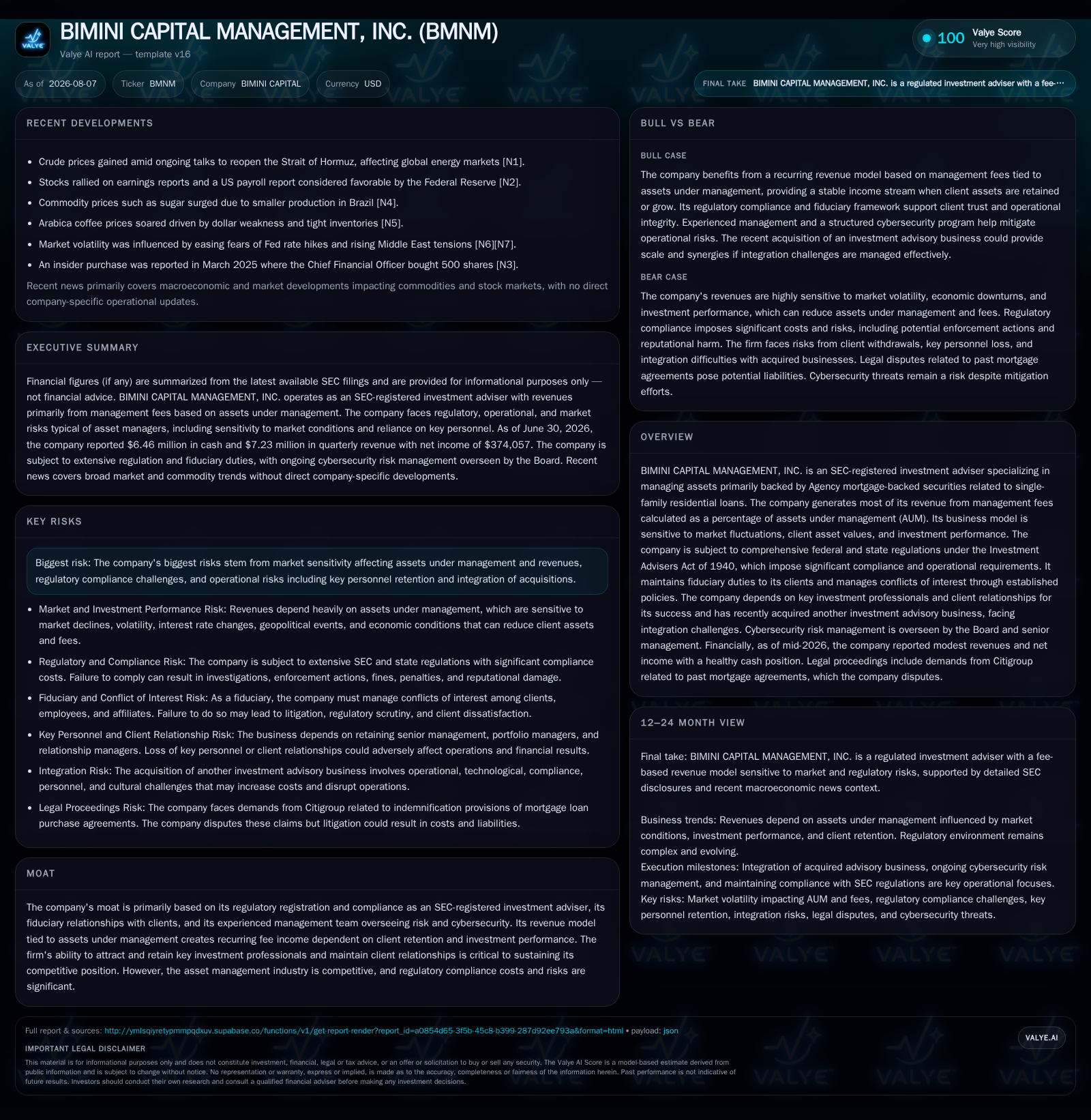
Bimini Capital Management’s latest quarterly filing highlights ongoing risks tied to the company’s asset-dependent fee model, regulatory compliance demands, and the integration of a recently acquired advisory business. The firm’s revenue is closely linked to assets under management (AUM), which are vulnerable to market fluctuations, redemptions, and investment performance shifts. Bimini’s competitive strength lies in regulatory registration, fiduciary duties, and experienced management but faces pressure from industry-wide headwinds including cybersecurity risks and operational integration hurdles. Financially, the company maintains a moderate cash balance with legacy debt indicating capital structure considerations during this period of transition.
Recent Operating Update: Market Sensitivities and Acquisition Challenges
Bimini Capital Management's most recent quarterly filing dated August 7, 2026, underscores the company's heavy reliance on assets under management (AUM) as the principal driver of its revenues through management fees calculated as a percentage of AUM [S2]. This exposes Bimini to inherent market risks — including fluctuations in asset valuations driven by interest rate changes, geopolitical uncertainties, inflationary pressures, economic cycles, and investment performance volatility — all of which can significantly alter fee income. Moreover, client behaviors such as redemptions or reallocations directly reduce AUM and consequently impact revenue flows.
In addition to these market-driven factors, Bimini has recently acquired another investment advisory business (TJIM), creating integration complexities across operational systems, compliance protocols, personnel alignment, and corporate culture [S28]. The filing warns about potentially higher-than-expected integration costs and possible disruptions that could jeopardize client retention or employee stability during this transitional period. Such integration challenges are known pain points in asset management consolidations where technology platforms and fiduciary standards must be harmonized seamlessly.
Business Model: Fee Revenue Linked to Agency MBS Assets
Bimini operates as an SEC-registered investment adviser specializing predominantly in portfolios backed by Agency mortgage-backed securities (MBS) relating to single-family residential loans [S1]. Its core monetization lever is recurring management fees tied directly to total assets under management (AUM), calculated at agreed-upon rates typically expressed in basis points. While some asset managers supplement fees with performance-based incentives, Bimini stresses management fees as its primary revenue source.
This model inherently creates revenue sensitivity to asset valuation fluctuations because AUM can decline with adverse market conditions even absent net client outflows. Additionally, active portfolio management focused on fixed income instruments like Agency MBS exposes the firm to duration risk and interest rate sensitivities — factors distinct from equity-oriented managers. Clients for Bimini are largely institutional or high-net-worth segments requiring rigorous fiduciary standards.
The company also owes fiduciary duties mandated under the Investment Advisers Act of 1940. Managing conflicts of interest between proprietary funds, client accounts, employees, and affiliates is central to retaining trust and avoiding litigation or regulatory actions [S2]. This positions Bimini not just as a portfolio allocator but also a compliance-driven service provider.
Industry Structure and Competitive Positioning
Within the broad asset management industry focused on fixed income securities, Bimini aligns with specialized managers like PIMCO who focus on mortgage-backed securities but operates at a smaller scale without diversified retail mutual fund lines typical of firms like Franklin Templeton or Invesco. The industry requires robust regulatory compliance frameworks due to extensive SEC oversight under federal securities statutes.
The company's moat stems from its SEC registration status — enabling it to offer regulated advisory services with fiduciary accountability — combined with an experienced leadership team that oversees both investment risk and operational cybersecurity measures [S1]. Oversight of cybersecurity risks is managed at the board level through the Audit Committee with ongoing reporting from dedicated executives possessing longstanding sector experience.
However, competition pressures fees downward industry-wide while increasing compliance costs necessitate operational efficiency. Client retention critically depends on delivering consistent performance within Agency MBS strategies alongside managing redemptions triggered by broader market shifts or competitor offerings.
Growth Drivers
Though exposed to cyclical market factors impacting AUM, Bimini can grow top-line through several levers:
- Asset inflows: Attracting new client mandates capitalizes on investor demand for specialized Agency MBS strategies amid periods favoring fixed income diversification.
- Investment performance: Outperformance relative to benchmarks can boost net inflows while mitigating redemption risks.
- Acquisition strategy: The recent TJIM acquisition aims to expand advisory footprint and asset base but hinges on successful integration execution.
- Regulatory trends: Increasing complexity encourages some institutional clients to outsource asset management functions rather than build internal capabilities.
- Technology adoption: Process improvements via cybersecurity enhancements or operational platforms can support scalability while controlling cost ratios.
Monitoring KPIs such as net inflows/outflows of client assets post-acquisition, client retention rates during integration phases, operating expense ratios reflecting synergy capture efforts, and investment returns relative to comparable fixed income benchmarks will be essential demand markers going forward.
Risks and Watchpoints
Key risks highlighted include:
- Market volatility: Sudden shifts in interest rates or credit spreads affecting MBS valuations can erode fee-bearing assets quickly [S2].
- Client redemptions: Not only reducing AUM but also potentially triggering reputational effects amidst volatile conditions.
- Regulatory compliance: Expanding requirements around cybersecurity protocols, marketing disclosures, custody regulations, ESG reporting mandates impose growing operational burdens [S2].
- Conflict management failures: Fiduciary breaches pose material litigation exposure and trust erosion [S2].
- Key personnel turnover: Losing senior portfolio managers or relationship directors could impair client relationships critical for retention and future mandates.
- Integration challenges: Operational missteps during TJIM consolidation could inflate costs or cause lost business if disruption diminishes service quality or compliance adherence [S28].
- Cybersecurity incidents: Despite robust governance overseen by board committees, any breach impacting sensitive asset information could carry direct financial loss plus long-term reputational harm [S1].
What To Watch Next
Stakeholders should prioritize monitoring the following milestones and indicators:
- Progress reports on TJIM acquisition integration covering operational systems unification, personnel retention statistics, and early client feedback reflecting service continuity or disruption.
- Quarterly updates on AUM levels post-integration illustrating whether net inflows offset outflows due to redemption activity.
- Regulatory examination outcomes or material fines/fines indicating compliance effectiveness.
- Investment performance metrics compared with peer indices in the Agency MBS space signaling competitiveness.
- Updates on cybersecurity incident reports or enhancements reflecting adaptive risk mitigation in response to evolving threats.
- Changes in fee structures negotiated with clients revealing pricing power dynamics amid competitive pressures.
Absent explicit guidance disclosures for 2026 beyond these filings, future public reports will offer clarity on how well Bimini navigates these composite challenges while leveraging growth opportunities inherent in specialized fixed income advisory services.
Financial Profile Discussion
As of June 30, 2026, Bimini held approximately $6.46 million in cash and equivalents providing liquidity for operations including acquisition-related expenses [F1]. The latest available total debt figure dates back to September 30, 2022, at approximately $27.4 million, with net debt around $21 million after accounting for cash [F1]. Operating margins remain sensitive to fixed overhead allocations particularly tied to compliance staffing, technology investments, and risk management which become more significant proportionally in smaller scale firms such as Bimini versus larger diversified peers like BlackRock or Franklin Templeton. Bimini’s ability to maintain positive free cash flow will depend heavily on stabilizing AUM trends, efficiently executing acquisitions, and controlling incremental operating expenses related especially to regulatory adherence—including cybersecurity provisions overseen carefully by its Audit Committee per disclosure [S1,S2].
This analysis synthesizes publicly filed disclosures without offering investment advice. It emphasizes structural business drivers alongside near-term operating challenges characteristic of niche investment advisers navigating complex regulatory landscapes while growing assets primarily concentrated in Agency mortgage-backed securities portfolios.
Disclaimer: This is research-only, informational analysis and not investment advice. It may include AI-generated interpretation and general industry context. Always verify important details using primary sources.

Comments