
Silence Therapeutics' Progress in RNAi Pipeline Validates Growth Path Amid Market Transition
Recent Phase 2 trial results for divesiran reinforce clinical advancement and milestone potential, underpinned by solid liquidity and evolving U.S. market engagement.
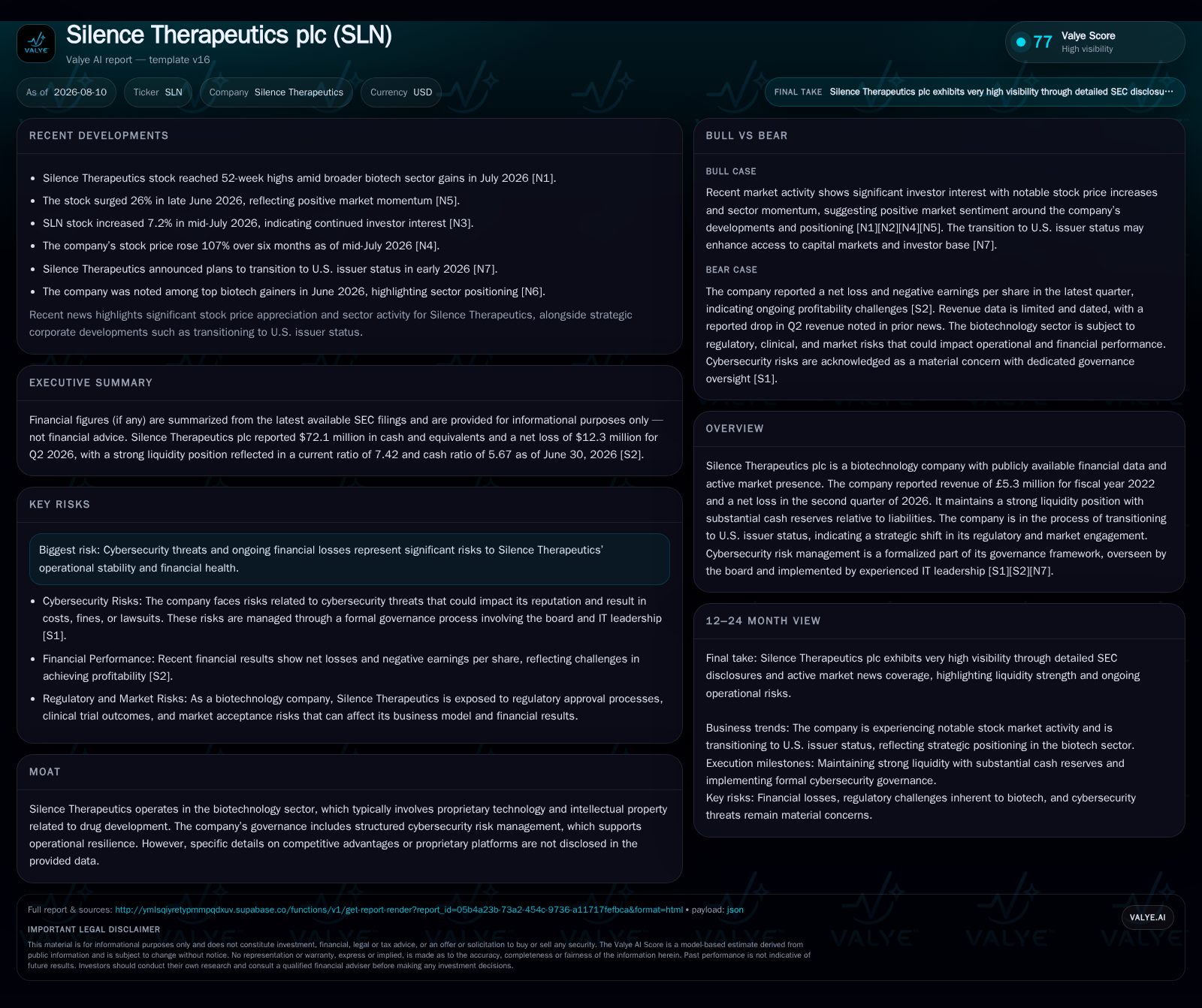
Silence Therapeutics reported positive topline results from its Phase 2 SANRECO trial for divesiran in polycythemia vera, meeting primary and secondary endpoints with strong efficacy and safety signals [S2][S8]. The company maintains a robust cash position of approximately $72 million as of June 2026, supporting ongoing R&D investments amid continued net losses [F1][S2]. Positioned within the RNA interference (RNAi) therapeutics field, Silence is progressing toward Phase 3 trials with regulatory milestones expected, reflecting a typical biotech development cycle. Governance over cybersecurity risks complements operational stability during its strategic transition to U.S. issuer status [S1][S2].
Phase 2 SANRECO Trial Results Elevate Clinical Milestones
Silence Therapeutics’ August 2026 disclosures revealed positive topline data from the Phase 2 SANRECO study evaluating divesiran—a novel siRNA therapeutic targeting TMPRSS6—for treatment of polycythemia vera (PV) [S8]. The trial met its primary endpoint with a significantly higher proportion of clinical responders in divesiran-treated cohorts versus placebo (88% vs. 19%, p<0.0001), defined by absence of phlebotomy necessity and hematocrit levels below 45% during weeks 18–36. Dose stratification showed strong efficacy with response rates of 93.8% for dosing every six weeks versus 81.3% every twelve weeks.
Secondary endpoints corroborated these findings; notably, divesiran recipients experienced a dramatic reduction in required phlebotomies (0.2 vs. 2.1 per patient for placebo) alongside improvements in iron biomarkers and patient-reported symptom scores (MPN-SAF TSS). Safety profiles aligned with prior trials—no new adverse events surfaced, indicating tolerability consistent with expectations for RNAi biologics [S15].
This data supports clinical advancement by demonstrating both meaningful efficacy and manageable safety, important factors that typically trigger milestone payments in biotech licensing agreements. It reduces scientific risk for the pipeline asset while setting the stage for a pivotal Phase 3 trial planned for H1 2027 assessing Q12W dosing versus placebo [S8]. Such progression through clinical trial phases is a critical KPI reflecting pipeline de-risking vital for valuation.
Sustained Cash Reserves Reinforce Operational Runway
Financial disclosures as of Q2 2026 show Silence Therapeutics holding $72 million in cash and equivalents with current assets totaling approximately $94 million against liabilities near $13 million, yielding a very strong current ratio of roughly 7.4 [F1][S2]. This liquidity cushion indicates considerable runway to fund ongoing research and development spend without near-term capital raises.
However, operating losses continue given the pre-commercial stage profile; prior annual reports note net losses approaching $89 million primarily driven by R&D expenses during advancing clinical trials [F1][S1]. The sustained cash reserves thus critically support investment into clinical program progression rather than commercial operations at this stage.
With R&D intensity a hallmark metric in biotechnology—often exceeding revenues due to long development cycles—the company’s ability to maintain financial flexibility during this period is essential to avoid disruptive dilution or slowed progress consistent with industry peers striving to reach commercial inflection points.
RNAi Innovation Underpins Competitive Position in Biotech Landscape
Operating within the complex biotechnology value chain focused on RNA interference therapeutics situates Silence Therapeutics among specialized drug developers seeking to harness gene silencing mechanisms for rare or genetic diseases. Companies like Moderna and Alnylam represent benchmarks in RNA-based therapy maturation—with Alnylam commercializing multiple RNAi drugs—and highlight the potential trajectory Silence aspires toward.
While currently focused on trials and pipeline development rather than commercialization, Silence’s strategic shift marked by U.S. issuer status reflects intent to engage deeper with capital markets supportive of biotech innovation hubs [S1][S3]. Proprietary intellectual property related to its siRNA platform is foundational though specific patent breadth remains undisclosed publicly, anchoring potential competitive moats typical of advanced nucleic acid therapies.
Success within this landscape depends heavily on navigating clinical trial complexities, securing regulatory approvals, managing partnerships for late-stage scaling or commercialization, and protecting innovation through patents—all key components shaping competitive positioning in an increasingly crowded space.
R&D Intensity Reflects Pipeline Investment Strategy
The company’s business model predominantly revolves around extensive research and development expenditures directed at progressing drug candidates through preclinical studies and phased clinical trials. This inherently leads to recurring operating losses while the pipeline advances since product commercialization—and associated sustainable revenue streams—remain future milestones.
Recent filings indicate substantial investment aligned with achieving pivotal development milestones such as those exemplified by the SANRECO trial outcomes that may unlock licensing revenue or partnership opportunities [F1][S2]. This pattern reflects typical biotech sector dynamics where R&D expense as a percentage of revenue—albeit revenues are currently modest—is a key measure of commitment to innovation versus near-term profit generation.
Tracking milestone achievements correlated with phase transitions remains essential to evaluate efficiency and progress given the substantial capital outlays required over often extended timeframes before potential regulatory approval can enable commercialization.
Growth Enablers in Clinical Advancement and Licensing Potential
Clinical progression toward later-stage trials—such as the imminent Phase 3 study initiation—directly supports growth prospects by propelling divesiran closer to commercialization viability. Regulatory incentives like orphan drug designation can further enhance market exclusivity potential while expanding indications responsive to unmet medical needs broadens addressable populations.
Revenue generation hinges largely on milestone payments related to developmental phases completed or licensing deals struck with larger pharmaceutical partners capable of commercialization scale [S1]. Advances demonstrated through SANRECO results amplify attractiveness for partnerships or collaborative agreements that can augment funding sources and distribution capabilities.
Simultaneously, ongoing expansion of pipeline breadth through additional targets or indications typical among RNA therapeutics companies can diversify risk and underpin future revenue streams beyond singular assets.
Risks from Regulatory Hurdles, Cybersecurity, and Funding Dependency
Despite encouraging progress, significant risks remain inherent in RNAi therapeutic development including regulatory delays or rejections—a frequent biotech sector challenge impacting timelines and valuations [S29]. Clinical trial failures represent considerable operational risks given high attrition rates typical across phases.
Additionally, Silence Therapeutics explicitly identifies cybersecurity as a material operational risk due to reliance on extensive proprietary data and sensitive patient information; this risk is governed actively by senior IT leadership with board audit committee oversight ensuring mitigation strategies align with best practices [S1]. As scientific data forms core intellectual property, any breaches could impair competitive positioning or lead to costly remediation.
Funding dependency persists throughout pre-commercial biotech phases; while current cash levels appear sufficient near term, continuous access to capital markets remains crucial given burn rates related to high R&D spend before sustainable product revenues emerge.
Upcoming Catalysts: Data Readouts and Market Engagement Signals
Near-term milestones include Phase 3 trial commencement targeted for early 2027 following FDA approvals—a pivotal catalytic event validating its development trajectory materially impacting pipeline valuation [S8][S3]. Additional data readouts especially around patient enrollment rates or extended safety/efficacy metrics will provide operative signal clarity reinforcing investor confidence or highlighting challenges.
The transition toward U.S. issuer status facilitates broader capital market engagement improving share liquidity which could indirectly influence funding capacity enhancing operational flexibility during this critical growth juncture.
Monitoring these execution points—trial initiation timing accuracy, pacing of patient recruitment, regulatory communication—will be essential markers against which operational success can be gauged going forward.
Financial Profile Discussion: Cash Strength Amid Continued Losses
Silence Therapeutics’ most recent quarterly balance sheet reports cash and equivalents at $72 million alongside current assets exceeding liabilities substantially (current ratio ~7.4), indicating favorable short-term liquidity supporting near-term clinical-development programs without immediate financing pressure [F1][S2]
Nevertheless, operating income remains negative reflecting ongoing investment characteristic of clinical-stage biotechnology enterprises reliant on external funding cycles until commercialization capabilities develop fully. Sustained net losses necessitate vigilant cash management strategies balancing aggressive pipeline advancement against dilution risks.
This profile harmonizes with sector norms observed among comparable RNAi-focused biotechs transitioning from research-centric models toward late-stage development readiness emphasizing consistent milestone achievement and collaboration formation as precursors to commercial-scale activities.
Disclaimer: This is research-only, informational analysis and not investment advice. It may include AI-generated interpretation and general industry context. Always verify important details using primary sources.

Comments