
Hancock Whitney Expands Regional Footprint and Fee Income through Strategic Organic Growth
Latest quarterly results reveal Hancock Whitney’s progress in broadening its regional banking footprint and diversifying revenue streams amid rising costs.
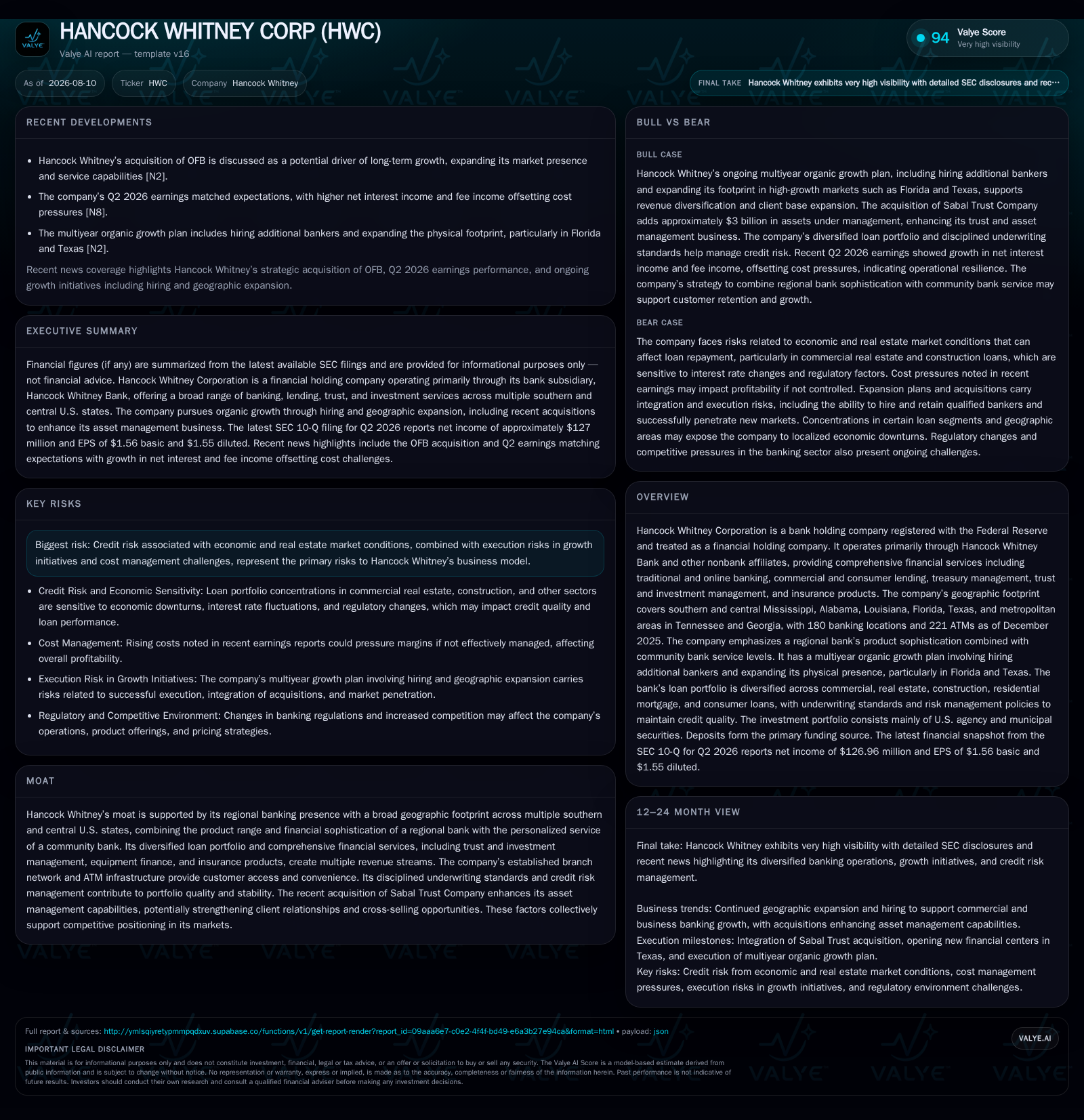
In its Q2 2026 10-Q filing, Hancock Whitney Corporation details the operational impact of recent mergers and organic growth strategies, notably expanding its presence in Florida and Texas while enhancing fee-based revenue through trust and treasury services. The integration of OFB Bancshares marks a significant milestone in extending its geographic reach. Despite increased operating expenses, the bank maintains credit discipline and steady asset quality within a competitive southern U.S. regional banking landscape. Going forward, key metrics such as loan and deposit growth, efficiency ratio trends, and acquisition integration will be critical performance indicators.
Q2 Operating Developments Signal Strategic Growth Execution Amid Rising Costs
Hancock Whitney’s August 7, 2026 10-Q [S2] highlights material progress in that quarter's operational landscape driven by strategic merger activity and ongoing organic initiatives. The consummation of the merger with OFB Bancshares, Inc., effective August 1, 2026 [S3], represents a pivotal geographic expansion principally in Florida, augmenting the bank's footprint beyond its traditional southern U.S. core into higher-growth markets. This transaction complements the multiyear organic growth plan initiated in late 2024 that includes active hiring of bankers and branch expansions specifically targeting Florida and Texas regions [S1]. This measured approach supports top-line growth avenues through loan originations tied to local market demands.
However, these expansion efforts come with near-term cost pressures. The filings disclose elevated operating expenses linked to increased staffing levels and branch network investments necessary to underpin future revenue gains [S2]. While expense inflation weighs on the efficiency ratio—a critical profitability metric for regional banks—the company emphasizes disciplined expense control measures alongside revenue diversification strategies to mitigate margin erosion risks [S1].
HWC's Revenue Channels: Loans, Deposits, and Service Fee Expansion in Regional Markets
Hancock Whitney continues deriving substantial net interest income from an expanding loan portfolio paired with a growing deposit base anchored by its branch network [S1]. As a regional bank serving commercial, small business, and retail customers across several southern states plus Tennessee and Georgia metropolitan areas, the company offers a product suite inclusive of secured/unsecured loans, treasury management solutions, trust services, investment advisory access, equipment financing, and insurance products—all contributing varied fee streams [S1].
The increase in bankers hired under the organic growth plan correlates with positive loan origination trends supported by robust deposit inflows. Deposits—pivotal funding sources for interest-earning assets—are primarily attracted via physical branches enhanced by digital accessibility [S1][S2]. Notably, noninterest income channels like treasury management fees and trust/investment services now form an increasingly material fraction of total revenue; this diversification aligns HWC more closely with peers such as Hilltop Holdings and Popular that have broadened their fee-income bases through similar service expansions [S1][N12]. These multiple revenue streams provide resilience against net interest margin compression.
Regional Banking Dynamics: Branch Network Growth Enhances Market Penetration and Client Access
Despite digital banking trends industry-wide, Hancock Whitney’s footprint strategy underscores the enduring importance of physical presence for customer acquisition and retention in regional markets. With 180 banking locations and 221 ATMs at year-end 2025 [S1], the branch network serves as a critical channel not only for deposit gathering but also relationship-based cross-selling opportunities intrinsic to community bank-level service.
The focused expansion into Florida’s panhandle regions and targeted Texas markets reflects an intentional pursuit of demographic growth corridors offering heightened commercial activity potential [S1][S2]. By augmenting density in these areas alongside legacy states such as Mississippi, Alabama, Louisiana, Tennessee, and Georgia metropolitan centers, Hancock Whitney reinforces its value proposition: delivering regional bank sophistication complemented by personalized local client service.
Diversification Impact: Acquisitions Elevate Asset Management and Cross-Selling Potential
The company’s acquisition of Sabal Trust Company stands out as a strategic move to deepen asset management capabilities within its financial services ecosystem [S1][S3][N12]. This addition significantly enhances trust administration competencies—an area generating recurring fee income—and enables cross-selling synergies whereby banking clients gain access to broader wealth management solutions under one institutional roof. Such integration aids in increasing customer wallet share while fortifying noninterest income streams.
This approach mirrors peer trends seen at diversified regional players like Hilltop Holdings that leverage targeted acquisitions to solidify fee-based revenue sources beyond traditional lending activities. The success of this strategy ultimately depends on effective operational integration and client adoption rates post-merger.
Credit Discipline Maintains Portfolio Quality Within Competitive Southern U.S. Environment
Credit risk management remains central to Hancock Whitney’s operational philosophy with tight underwriting standards articulated across commercial real estate (owner occupied & income producing), commercial industrial loans, consumer lending segments, and equipment finance operations [S1][S2]. Despite exposure to cyclical real estate sectors typical in southern U.S. markets plus economic variability within its multi-state footprint, delinquency rates remain stable without material upticks noted through the latest quarter [S2].
The allowance for credit losses is prudently maintained considering local market conditions while monitoring concentration risks particularly in construction & land development loans given their inherent volatility [S1][S15]. This conservative stance supports sustainable earnings even if localized economic downturn scenarios were to emerge.
Profitability Pressures: Managing Efficiency Ratio Against Expense Growth and Revenue Mix Shifts
Operating expenses rose during Q2 driven by incremental staff hiring aligned with growth initiatives plus investments in technology infrastructure improvements aimed at enhancing client service delivery [S2]
While increased noninterest income partially offsets margin compression risks associated with higher expenses compared to prior periods [S2], sustained cost discipline is necessary for profitability improvement. Balancing market share gains against expense control remains challenging given competitive talent markets for bankers as well as regulatory compliance costs inherent in banking operations across multiple jurisdictions [S1][S18].
Growth Opportunities and Headwinds: Market Penetration Balanced Against Execution Risks
Future acceleration hinges on successfully integrating acquisitions like OFB Bancshares while maintaining credit quality amidst economic uncertainties affecting southern U.S. real estate markets [S1][S3]. Further organic loan portfolio expansion depends on new banker productivity gains supported by expanded branch coverage especially in Florida/Texas locales where demographic tailwinds are favorable.
Critical execution risks include potential delays or inefficiencies in mergers/acquisitions integrations that could defer realizing anticipated cost synergies or revenue gains; additionally, sustaining competitive pricing while safeguarding asset quality amid intensifying competition from larger national banks and fintech disruptors poses ongoing challenges [S1][S18]
"What to Watch": Upcoming Milestones for Loan & Deposit Growth, Integration Progress, Cost Controls
Upcoming quarterly reports will be instrumental for assessing loan/deposit growth trajectories post-OFB acquisition impact along with monitoring efficiency ratio trends indicative of successful expense management post-expansion phase [S2]. Enhanced transparency on Sabal Trust integration progress will clarify prospects for noninterest fee income expansion.
Key performance indicators including net interest margin levels amidst evolving Federal Reserve policy landscapes combined with credit quality metrics (delinquencies/charge-offs) will also be proxies signaling durable profitability improvements or emerging stress points requiring reassessment.
Financial Profile Discussion Supporting Operating Narrative
Capital adequacy metrics meet or exceed regulatory minimums ensuring stability amid ongoing expansion activities governed by Federal Reserve guidelines applicable to bank holding companies treated as financial holding companies under the Bank Holding Company Act [S1][S22]. Net income was reported at approximately $486 million for calendar year 2025 reflecting underlying profitable operations supporting continued reinvestment into organic growth projects.
In summary, Hancock Whitney enters late-2026 positioned with solid franchise foundations combining geographic expansion into burgeoning markets plus enhanced fee-income streams via notable acquisitions such as OFB Bancshares and Sabal Trust. While heightened operating costs weigh on short-term margins requiring vigilant expense controls, credit discipline coupled with diversified product offerings underpin resilience within competitive southern U.S. regional banking sectors.
This analysis is based solely on publicly filed regulatory documents including SEC Form 10-K (02/27/2026), Form 10-Q (08/07/2026), related filings (8-K series), supported by verified numeric data per company facts repository as of reported periods. It does not constitute investment advice but serves as an independent industry analyst review highlighting operational developments relevant to Hancock Whitney Corporation's evolving business model within the regional banking sector.
Disclaimer: This is research-only, informational analysis and not investment advice. It may include AI-generated interpretation and general industry context. Always verify important details using primary sources.

Comments