
Deep Isolation Advances Deep Borehole Disposal Amid Regulatory and Commercial Challenges
Deep Isolation Nuclear, Inc. develops innovative deep borehole technology to permanently isolate nuclear waste, positioning itself uniquely in a complex regulatory environment.
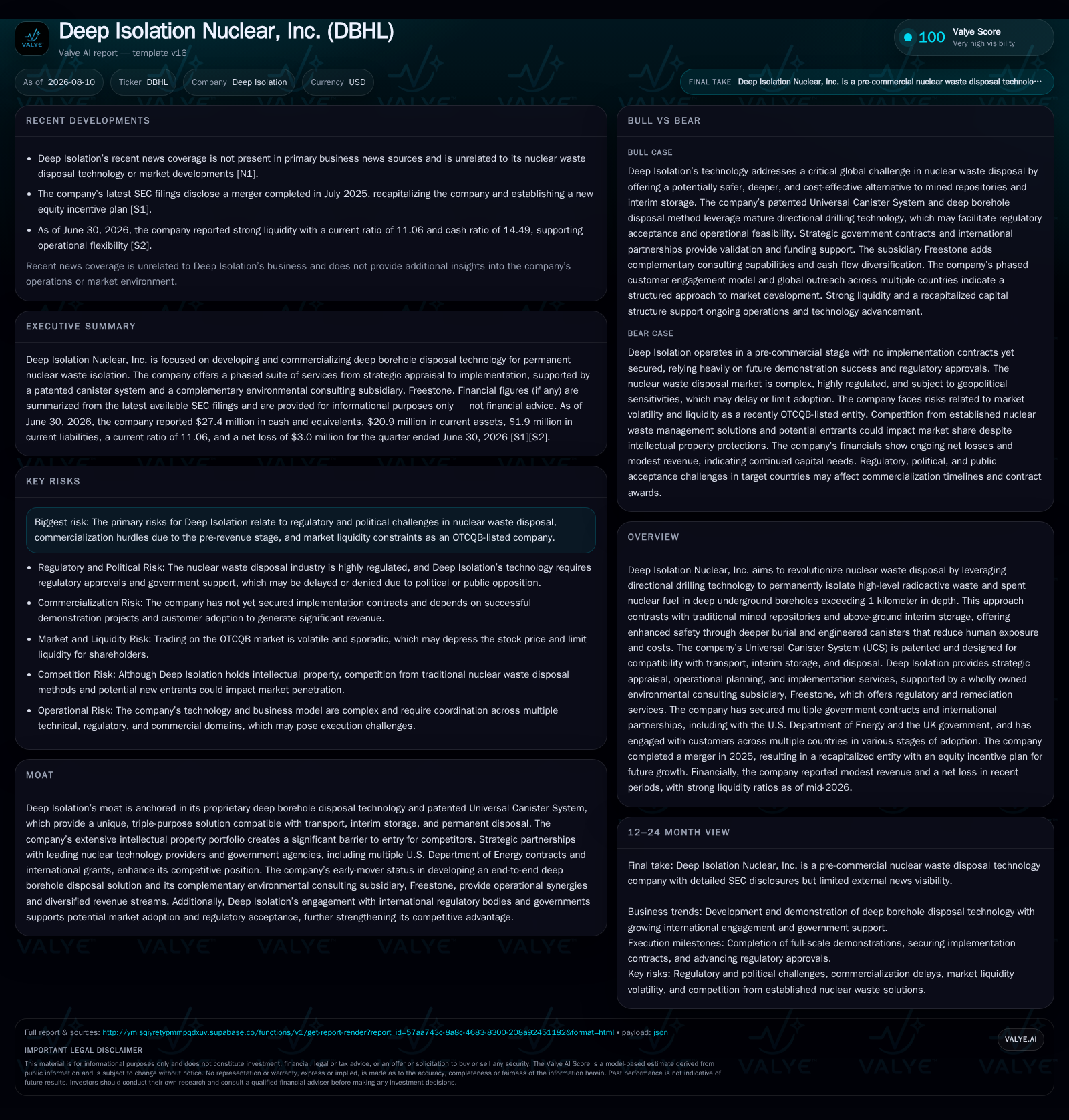
Deep Isolation Nuclear, Inc. leverages patented directional drilling and canister technologies to address the persistent global challenge of high-level radioactive waste disposal through deep borehole repositories. The company has transitioned towards OTCQB trading, improving liquidity but also exposing shares to volatile market dynamics. Its multi-phase business model focuses on strategic appraisal, operational planning, and eventual implementation, with revenues currently derived primarily from US government contracts and grants. While regulatory hurdles and the absence of licensed mined repositories confine near-term expansion, Deep Isolation’s patented technology, government partnerships, and subsidiary consulting services underpin its competitive moat and future growth potential.
Recent Operating Update: Progress Toward Demonstration and Market Introduction
Deep Isolation Nuclear, Inc.'s latest quarterly report filed August 7, 2026 highlights continued operational focus on demonstrating its deep borehole disposal (DBD) technology with an emphasis on completing a full-scale non-radioactive emplacement test at depth that management views as critical before securing long-term implementation contracts [S2]. According to the August 6 press release furnished in conjunction with this filing, second-quarter financial results reflect ongoing investment in product development and expansion of consulting services through its Freestone subsidiary [S3]. The company's common stock began trading on the OTCQB market in July 2026 — a meaningful step to foster liquidity but also bringing notable price volatility risks inherent in over-the-counter venues [S2].
This near-term activity underscores a phased strategy whereby revenue generation now accrues primarily from strategic appraisal and operational planning engagements valued at hundreds of thousands to a few million dollars per contract on a cost-plus-margin basis [S4]. Implementation contracts promising significantly larger order sizes—management estimates nearing $1 billion each over decades—remain contingent upon successful demonstration milestones and evolving regulatory approvals allowing commercial deployment
Business Model: Multi-Phase Revenue Focus Anchored in Proprietary Technology
Deep Isolation's business model integrates several complementary service tiers bound by its core DBD technological platform. The company generates recurring revenues primarily via three streams: strategic appraisal services assessing the benefits of DBD solutions relative to alternatives; detailed operational planning involving feasibility studies, safety cases aligning with International Atomic Energy Agency standards, licensing roadmaps and economic models; plus eventual long-term implementation services covering disposal system deployment, construction supervision, commissioning phases, operations management through repository closure and post-closure monitoring aligned with strict nuclear regulatory requirements [S1][S27].
Integral to this offering is Deep Isolation’s Universal Canister System (UCS), a patented technology co-developed with NAC International which enables seamless compatibility across storage phases—transportation, interim dry cask storage above ground without repackaging, followed by permanent underground disposal within boreholes exceeding 1 kilometer depth. This triple-function canister system reduces human exposure risks during handling and aims to lower overall system costs versus traditional mined repositories by eliminating intermediate repackaging steps [S1][S7].
Additionally, Deep Isolation wholly owns Freestone, an environmental consulting firm offering regulatory guidance, site characterization support, environmental data analysis, remediation services, and innovative sensor technologies for monitoring hazardous substances related to nuclear projects. Freestone complements core offerings by aiding clients’ navigation of evolving environmental standards essential to project permitting in multiple jurisdictions [S16][S27], enhancing customer retention while broadening consulting revenue beyond direct disposal engagement.
Industry Structure and Competitive Position
Nuclear waste management faces systemic challenges: no operational mined geologic repository for permanent HLW or spent nuclear fuel exists worldwide; political controversies constrain site progress; costs are high; public acceptance remains fragile. Within this context Deep Isolation stakes its position as an early mover offering an innovative alternative leveraging mature directional drilling techniques common in oil/gas sectors but novel for nuclear waste isolation.
By targeting depths nearly double those typical for mined repositories (~1 km+ vs. ~500 m), the company's approach promises enhanced isolation within ancient rock formations largely disconnected from biosphere impacts—strengthening long-term safety cases essential for licensing under stringent NRC and EPA standards framed by the US Nuclear Waste Policy Act (NWPA) [S1][S20]. Compared to prominent peers such as NAC International which focuses on broader nuclear fuel cycle technology consulting or government-led mined repository efforts (e.g., Waste Isolation Pilot Plant), Deep Isolation occupies a focused niche marrying geotechnical expertise with nuclear waste disposal innovation.
The extensive intellectual property portfolio around UCS plus related patents offers a significant barrier against new entrants aiming for multi-purpose canister solutions that streamline logistics across transport/storage/disposal phases—a unique industry advantage reinforced through international partnerships including grants from DOE ARPA-E programs supporting SMR (small modular reactor) fuel compatibility studies [S7].
Growth Drivers: Government Engagements and Technological Advances
Growth relies heavily on increasing volumes of spent nuclear fuel requiring safe permanent disposal amid global nuclear energy expansion efforts advocating carbon-neutral baseload power sources. U.S. federal policy shifts following the May 2025 Executive Order targeting reinvigoration of nuclear industrial base may accelerate legislative changes easing barriers imposed by NWPA restrictions that currently limit repository siting beyond Yucca Mountain without explicit Congressional approval—a major gating factor inhibiting immediate commercialization plans for DBD methods despite demonstrated technical readiness [S1][S20]
Governmental grants have materially supported R&D advances including prototype UCS manufacturing and field testing in partnership with the Deep Borehole Disposal Center (DBDC), while international grants from UK Department for Energy Security & Net Zero validate geographic expansion ambitions into EMEA/APAC regions where advocacy status has been granted (e.g., Philippines trade agency) [S16][S22].
The phased approach starting with strategic appraisal and planning contracts helps build customer confidence while generating incremental revenue. Securing additional meaningful government contracts relating to waste stream recycling feasibility studies or TRISO fuel management will be key leading indicators signaling rising adoption. Long-term demand forecasts align with ongoing spent fuel accumulation trajectories combined with rising constraints on existing interim storage facilities worldwide driving demand for scalable final disposal alternatives compatible with emerging advanced reactor designs.
Risks and Constraints: Regulatory Uncertainty and Market Volatility
Recognized risks stem chiefly from entrenched regulatory uncertainties surrounding repository licensing processes complicated by NWPA statutory provisions barring DOE from pursuing alternative sites without Congressional sanction—this effectively puts a legal damper on rapid implementation unless legislation evolves favorably. In parallel political headwinds including public opposition to new nuclear facility siting compound commercialization timelines rendering cash flow generation highly dependent on continued federal funding flows via grants or cost-reimbursable contracts whose renewal is never guaranteed [S5][S20]
Financially the company remains pre-revenue from large-scale implementation contracts and reports sustained operating losses consistent with early development stage firms investing heavily in R&D and demonstrations [F1]. Transitioning its stock listing onto OTCQB improves marketplace visibility but introduces heightened trading volatility reflecting limited liquidity often seen among OTCQB-traded tech innovators at similar life cycle stages [S2]. Intellectual property enforcement will require vigilance given sector incumbents' interest in emerging DBD concepts.
Operationally supply chain dependencies for specialized canister components or drilling equipment are managed prudently but remain potential sources of delay if scaling demands accelerate rapidly post-demonstration success.
What to Watch Next: Milestones Driving Commercial Viability
Key near-term milestones include:
- Successful completion of full-scale at-depth non-radioactive emplacement demonstration validating UCS handling reliability under deep borehole conditions [S4];
- Advancements in US legislative/regulatory frameworks enabling NWPA amendment or new licensing pathways supporting DBD facility approvals beyond Yucca Mountain [S1];
- Awarding of initial implementation contracts transitioning customers from consultancy engagements into long-term deployment phases;
- Growth in international advocacy applications converting into partnership agreements embedding UCS technology into foreign disposal pilot projects;
- Expansion of Freestone’s consulting pipeline correlating with increased environmental remediation mandates linked to future repository site preparations.
Monitoring contract backlog expansion—both government grants supporting R&D phases as well as strategic planning agreements—and cross-checking patent filings or newly secured licenses will aid evaluation of competitive foothold sustainability.
Financial Profile Discussion
As of June 30, 2025, Deep Isolation had total debt of approximately $167,000 and net debt of negative $27.3 million, reflecting a strong cash position with $27.4 million in cash and equivalents as of December 31, 2025 [F1]. Current assets stood at roughly $20.9 million versus current liabilities around $1.9 million, translating to a current ratio exceeding 11x as of June 30, 2026, signaling robust short-term solvency favorable for sustaining R&D activities absent immediate operating profits [F1]. Operating losses persisted at approximately $5.77 million during calendar year 2025 reflecting continuing net investments ahead of commercial rollout while revenues remained modest at about $6.14 million primarily derived from government project work centered around feasibility studies and engineering consultancy services rather than large-scale disposal fees [F1][S1]. The strong cash position combined with low leverage supports management’s capacity to fund staged demonstrations while maintaining flexibility in strategic execution though further capital raises could be needed if timelines extend or implementation scale increases rapidly.
Disclaimer: This analysis is based solely on publicly disclosed information as of August 2026 without access to non-public data or projections beyond documented company filings (, [F1]) or verifiable news sources (). It does not constitute investment advice or research views.
Disclaimer: This is research-only, informational analysis and not investment advice. It may include AI-generated interpretation and general industry context. Always verify important details using primary sources.

Comments