
VERU Advances Clinical Pipeline for Cardiometabolic Therapies Amid Capital Constraints
Latest quarterly update highlights progress in late-stage trials of enobosarm and sabizabulin while capital-raising challenges loom.
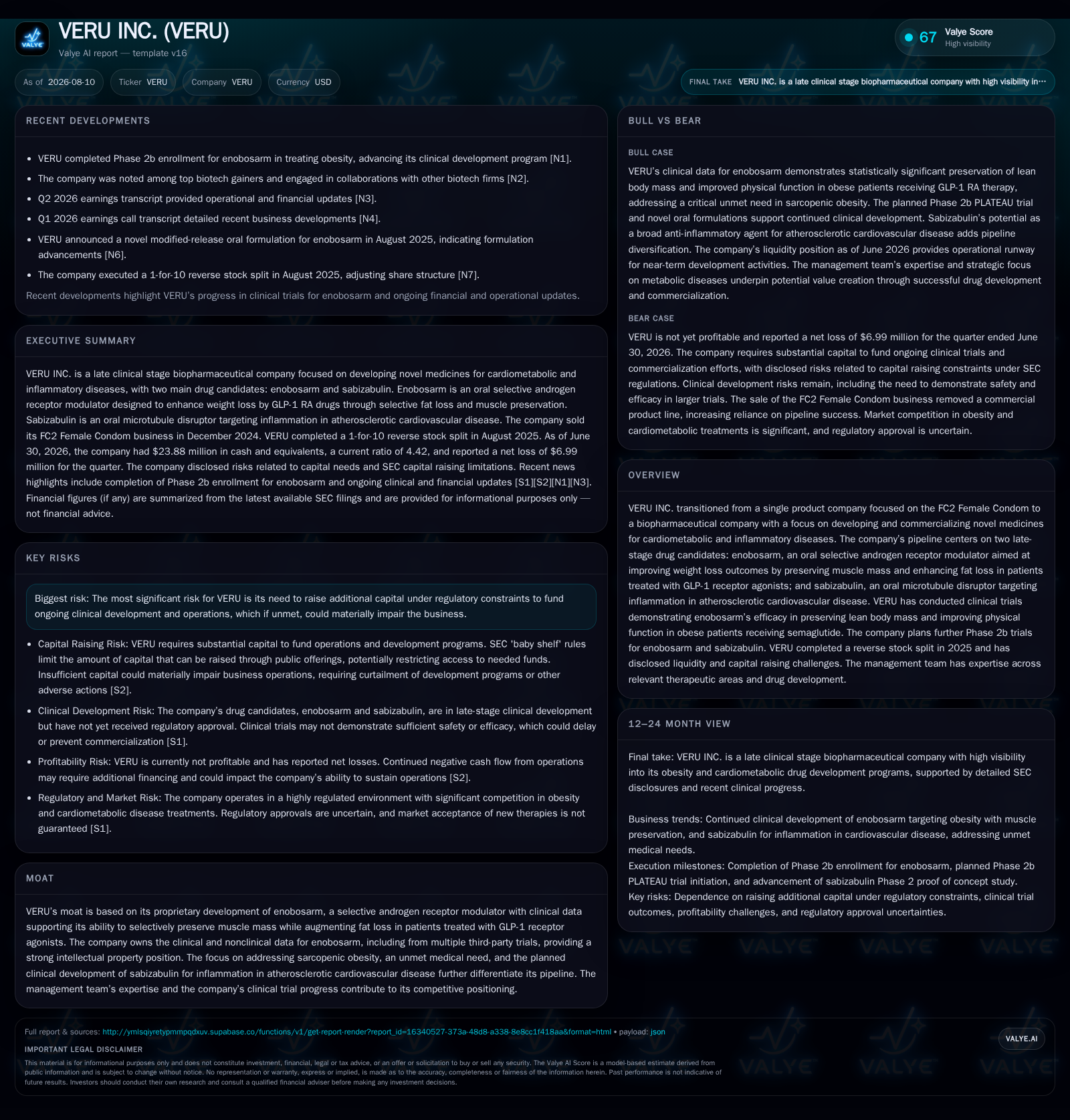
VERU Inc., transitioning from a single-product company to a clinical-stage biopharmaceutical firm, reported ongoing advancement of its dual late-stage pipeline targeting cardiometabolic and inflammatory diseases. The company recently completed enrollment in its Phase 2b study of enobosarm, a selective androgen receptor modulator designed to improve weight loss outcomes by preserving lean muscle during GLP-1 receptor agonist treatment. Meanwhile, sabizabulin development aims to address inflammation in atherosclerotic cardiovascular disease. Despite clinical progress, VERU faces financing headwinds due to SEC rules limiting capital raises and a sub-$75 million public float. Current cash supports near-term operations, but the firm will require additional funding to sustain development beyond the upcoming milestones.
Recent Operating Update
Veru Inc. reported its financial results for the quarter ending June 30, 2026, reaffirming its status as a clinical-stage biopharmaceutical focused on two late-stage drug candidates: enobosarm and sabizabulin [S2][S3]. Most notably, VERU achieved full enrollment in its Phase 2b PLATEAU trial evaluating enobosarm as an adjunct to GLP-1 receptor agonists for obesity treatment [N1]. This milestone is significant as it underscores tangible progress in the most advanced program aimed at achieving tissue-selective fat loss while preserving lean body mass—critical for functional outcomes in obese patients undergoing weight reduction.
Financially, the company maintained approximately $23.9 million in cash and equivalents as of mid-2026 and held a strong current ratio of 4.42, indicating sound short-term liquidity [F1]. However, the firm continues to operate with negative cash flows typical of biotech firms still in heavy R&D phases. Notably, SEC “baby shelf” regulations limit the quantum of capital VERU can raise publicly due to its public float being below $75 million—measured at roughly $65.5 million as of early July 2026 [S2]. These restrictions pose immediate challenges for raising sufficient funds post-Phase 2b completion.
Business Model Overview
VERU transitioned from legacy reliance on its FC2 Female Condom business—which was sold in late 2024—to become a dedicated biopharmaceutical entity focused on novel therapies addressing cardiometabolic and inflammatory diseases [S1][S6]. Revenue generation potential lies primarily downstream upon regulatory approvals through product sales or licensing partnerships; presently, revenue is limited with no commercialized biopharma product.
The core value proposition centers on two proprietary drug candidates:
Enobosarm: An oral selective androgen receptor modulator (SARM) designed to enhance weight loss therapy by preserving muscle mass while augmenting fat reduction when combined with GLP-1 receptor agonists such as semaglutide (Wegovy®). This mitigates sarcopenia risk associated with rapid weight loss. The product relies heavily on clinical data that demonstrate improved physical function and body composition – key differentiators supporting regulatory acceptance as an adjunct therapy.
Sabizabulin: An oral microtubule disruptor aimed at reducing vascular inflammation linked with atherosclerotic cardiovascular disease. Its positioning seeks to address residual inflammatory risk beyond standard lipid-lowering treatments through modulation of underlying disease pathophysiology.
These pipeline assets drive revenue prospects through eventual FDA approval followed by commercialization or out-licensing agreements. VERU outsources much of its clinical trial execution to contract research organizations (CROs) and depends on third-party manufacturers for drug substance production – standard practice minimizing fixed asset burdens but introducing operational dependencies.
Industry Structure and Competitive Positioning
Biotechnology firms like VERU inhabit the innovation-driven early/mid stages of pharmaceutical value chains predominantly characterized by high upfront R&D costs, extended clinical development timelines, and heavy regulatory oversight by bodies such as the FDA. Commercial success is contingent on demonstrating substantial unmet medical need fulfillment coupled with clear safety/efficacy profiles during pivotal trials.
VERU competes within a niche focusing on cardiometabolic diseases complicated by obesity-related sarcopenia—a segment witnessing rising prevalence aligned with global metabolic health trends but offering limited approved therapies targeting muscle preservation alongside weight loss enhancement. Several late-stage peers also explore SARMs or anti-inflammatory modalities; however, VERU’s ownership of extensive proprietary clinical datasets elevates its protective moat against direct replication.
Further differentiation arises from ongoing dialogue and partial collaboration with Novo Nordisk through supply arrangements of semaglutide for trials without current co-development obligations [S21]. Yet VERU remains responsible for navigating critical regulatory pathways independently.
Growth Drivers
Market expansion for VERU hinges on multiple growth drivers:
- Completion and positive readouts from ongoing Phase 2b studies leading toward Phase 3 initiation will validate therapeutic hypotheses underpinning enobosarm’s adjunctive advantage over GLP-1 monotherapy.
- Demonstration of sabizabulin’s efficacy in controlling vascular inflammation could open avenues into significant cardiovascular patient populations where residual risk persists after standard care.
- Advancement through regulatory interactions benefiting from FDA’s evolving guidance on acceptable endpoints related to muscle preservation may reduce approval uncertainty.
- Potential strategic partnerships or licensing deals that provide non-dilutive capital influx while leveraging industry scale for commercialization efficiency.
- Rising prevalence of obesity combined with increasing adoption rates of GLP-1 receptor agonists globally creates fertile demand conditions if enobosarm achieves regulatory acceptance.
Risks and Watchpoints
The principal risk impeding VERU centers on capital availability; ongoing negative cash flow coupled with constraints imposed by SEC baby shelf rules could materially delay or force curtailment of clinical development programs absent successful equity or debt raises [S2][S19]. Secondary risks aligned with typical biotech dynamics include:
- Possible delays or failures in achieving primary or secondary endpoints in Phase 2b trials for either pipeline asset which would diminish valuation.
- Regulatory uncertainty especially if FDA disagrees on trial designs or endpoint acceptability impacting phase progression timelines.
- Operational dependence on CROs and third-party manufacturers increases vulnerability to external disruptions affecting trial enrollment speed or supply chain continuity.
- Intellectual property challenges or emerging competitor therapies could erode market exclusivity potential.
- Market acceptance hurdles including reimbursement policies post-launch which are critical given the novel combination therapy approach targeting incremental benefit rather than standalone treatment.
What to Watch Next
Key milestones include:
- Full data readout from PLATEAU Phase 2b trial assessing enobosarm’s efficacy and safety endpoints expected later this year; positive outcomes would signal Phase 3 feasibility.
- Initiation timelines for additional Phase 2b dose-finding trials involving sabizabulin focused on inflammatory biomarkers such as high sensitivity C-reactive protein levels [S16].
- Updates from FDA interactions regarding trial designs which will clarify regulatory pathway clarity ahead of late-stage studies.
- Announcements related to executed financing transactions or partnership agreements that expand financial runway beyond current levels.
- Patient recruitment metrics across clinical sites serving as early indicators of trial execution capability critical for maintaining development pace.
Financial Profile Discussion
As of June 30, 2026, VERU reported cash and cash equivalents totaling approximately $23.9 million with current assets of $27.2 million and current liabilities of $6.2 million, resulting in a current ratio of about 4.42, reflecting a strong short-term liquidity position [F1]
Given these factors combined with limited market capitalization under $75 million triggering SEC baby shelf rules restricting primary public offerings volume annually [S2], securing material new capital remains critical. The company is exploring public/private equity offerings alongside other sources but must balance dilution impacts against developmental imperatives while preserving strategic optionality [S19]. Successful execution here will directly influence sustaining the operating model through imminent costly phases ahead before any potential revenue inflows commence.
Disclaimer: This report is prepared solely for informational purposes without offering investment advice or research views. Readers should perform their own due diligence before engaging with securities discussed herein.
Disclaimer: This is research-only, informational analysis and not investment advice. It may include AI-generated interpretation and general industry context. Always verify important details using primary sources.

Comments