
CitroTech Advances Fire Retardant Commercialization via Strategic Joint Venture and Licensing Model
CitroTech's August 2026 quarterly filing highlights its exclusive licensing partnership with Hexion through HexiTech LLC, emphasizing a capital-light commercialization strategy amid ongoing operating losses and regulatory dependencies.
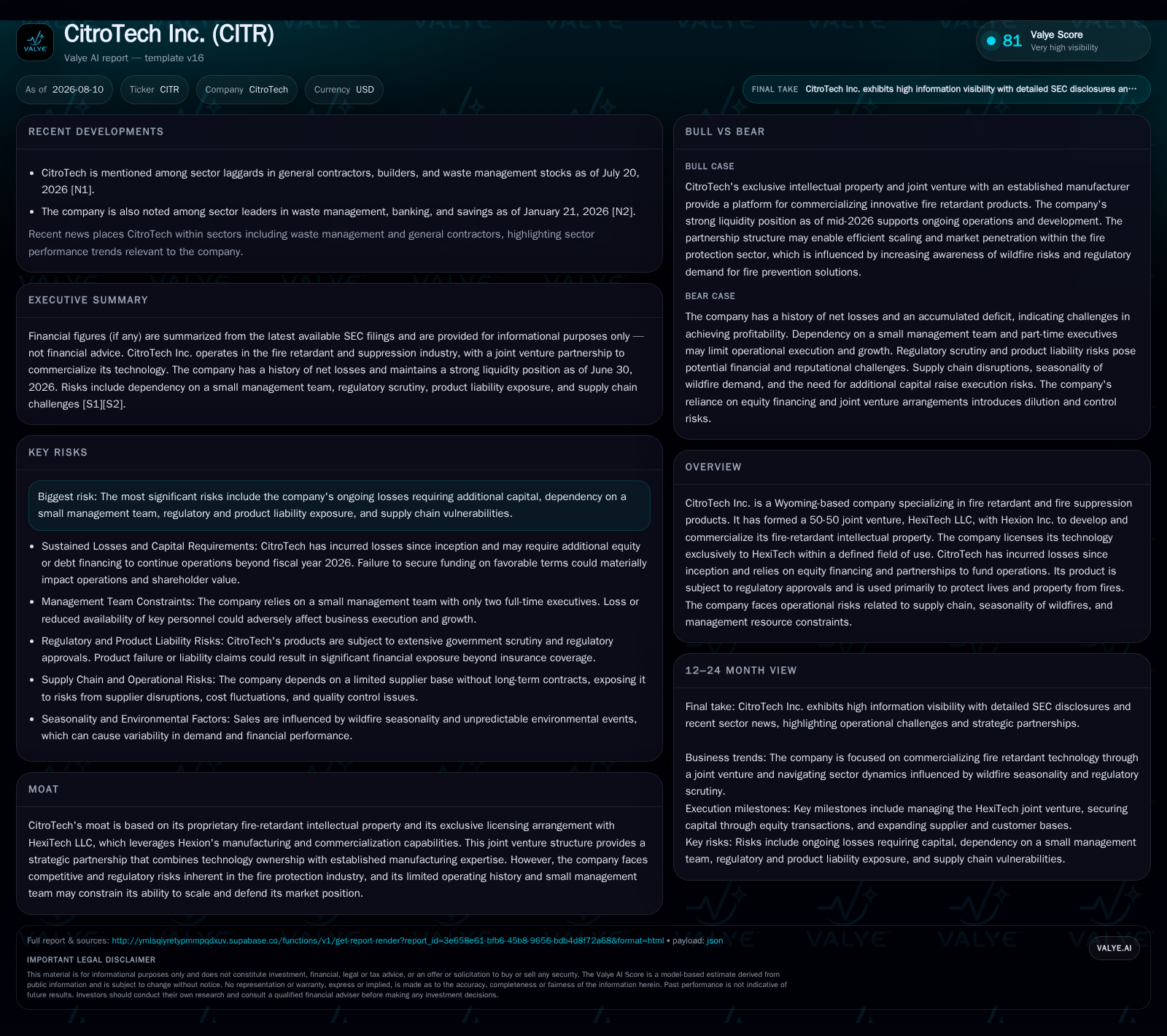
CitroTech Inc. continues to advance its fire retardant technology commercialization through a structured licensing model anchored by the HexiTech LLC joint venture with Hexion Inc. The latest quarterly filing confirms sustained operating losses balanced by solid liquidity, reflecting adaptive equity restructuring to support near-term operations. The company’s growth prospects depend heavily on regulatory approvals, supply chain stability, and expanding licensing agreements. Recent board appointments bring sector expertise that could enhance governance and execution as CitroTech navigates operational challenges and capital needs.
Latest Quarterly Update Validates Licensing Strategy Amid Continued Operating Losses
CitroTech’s August 2026 10-Q filing [S2] confirms the company remains committed to its licensing-focused business model without material changes in risk profile since its March 2026 annual report [S1]. While no new significant operational developments were reported, the company continues to confront substantial accumulated operating losses since inception. Recent equity restructuring transactions converted outstanding Series A Preferred Stock into Series C Convertible Preferred Stock [S7], streamlining governance and providing new preferred shareholders with registration rights and limited consent privileges. This move reflects ongoing efforts to maintain financial flexibility necessary for advancing commercialization.
As of June 30, 2026, CitroTech reported cash and equivalents of approximately $2.5 million against current liabilities near $420,000 [F1], yielding a robust current ratio of about 8.8 indicative of solid short-term liquidity despite persistent cash burn. Total debt remains low at roughly $173,000 as of late 2025 [F1], consistent with the company's asset-light approach that minimizes leverage but increases dependence on equity or joint venture funding.
Business Model: Exclusive IP Licensing via HexiTech Joint Venture
CitroTech’s core value proposition lies in owning proprietary fire retardant intellectual property which it licenses exclusively within a defined field to HexiTech LLC—a Delaware-based joint venture equally owned with Hexion Inc., an established industrial chemical manufacturer [S11]. This structure leverages Hexion’s manufacturing capabilities and commercialization infrastructure while enabling CitroTech to concentrate on technology development and IP management.
By outsourcing chemical compounding and product commercialization to HexiTech, CitroTech avoids direct capital expenditures associated with manufacturing scale-up. Revenue generation primarily derives from royalties linked to licensed product sales through the JV. Governance arrangements require consensus between CitroTech and Hexion managers on fundamental decisions [S11], ensuring aligned interests while distributing operational responsibilities.
This combination of proprietary IP protection within an exclusive licensing framework supported by a capable manufacturing partner establishes a defensible competitive position critical in the regulated fire protection industry.
Industry Context: Regulatory Approvals as Commercialization Gatekeepers
The fire protection technology sector is characterized by rigorous regulatory oversight due to safety implications of retardant chemicals used across residential, commercial, industrial, and wildland applications. Regulatory approvals serve as essential gatekeepers determining when new products can enter markets or expand use cases. CitroTech acknowledges these approval processes as key determinants of its commercialization timeline [S1]
Competitive dynamics include specialty chemical manufacturers developing alternative retardants as well as providers of integrated fire suppression systems. Success depends on technology efficacy validated through regulatory compliance and proven performance.
Product liability exposure inherent in this sector underscores the importance of stringent safety standards and robust intellectual property protections to mitigate infringement risks.
Operational Risks: Supply Chain Fragility and Demand Seasonality
CitroTech’s manufacturing throughput depends entirely on HexiTech’s ability to secure raw materials reliably. Disruptions in supply chains could constrain production capacity, delaying deliveries and impacting royalty income [S1,S2]. Given the complex chemical nature of advanced retardants, maintaining consistent input quality is vital yet susceptible to global supply volatility.
Demand exhibits pronounced seasonality driven by wildfire incidence peaks during specific periods annually. This cyclical pattern adds complexity to revenue recognition timing and working capital management for both HexiTech as manufacturer and CitroTech as licensor.
Furthermore, the company’s relatively small management team concentrates strategic execution responsibilities, which may limit agility in managing multiple simultaneous initiatives such as regulatory submissions or scaling partnerships [S1].
Growth Drivers: Wildfire Trends, Regulatory Tightening, Licensing Expansion
Structural tailwinds stem from escalating wildfire frequency linked to climate change alongside increasingly stringent fire safety regulations mandating higher protective standards in building codes globally. These factors drive demand for advanced fire retardants capable of mitigating property damage and loss of life more effectively than legacy products.
CitroTech aims to grow royalty revenues by broadening adoption through additional regulatory clearances enabling new product variants or geographic expansion. Expanding licensing agreements beyond the initial JV represents further upside potential.
The HexiTech joint venture provides a scalable commercialization platform that can accommodate growth contingent upon securing additional funding for R&D intensification and marketing outreach targeting diversified customer segments.
Risks & Watchpoints: Capital Needs, Regulatory Uncertainties, Management Bandwidth
Persistent net losses exceeding $36 million annually [F1,S1] necessitate continued access to external financing predominantly via equity issuance—posing dilution risks for shareholders over time.
Delays or setbacks in regulatory approvals could postpone market entry or require costly reformulations affecting revenue ramp-up.
Concentration risk arises from limited management bandwidth tasked with simultaneously advancing technical validation efforts while expanding commercial partnerships.
What To Monitor: Regulatory Milestones, Licensing Growth & Funding Activities
Investors should track progress on key regulatory submissions by HexiTech that could unlock broader market acceptance. Announcements regarding expanded or new licensing deals would indicate traction outside the foundational JV arrangement.
Corporate governance developments such as the appointment of Michael Feigin—bringing expertise in construction risk management and fire underwriting—may enhance oversight relevant for navigating complex regulatory environments [S3,S13].
Capital raising activities involving preferred stock issuances or convertible securities modifications will provide insight into liquidity sufficiency ahead of critical commercialization phases expected through late 2026 into early 2027.
Financial Profile Discussion: Strong Liquidity Cushion Amid Ongoing Losses
As of mid-2026, CitroTech maintains approximately $2.5 million in cash with negligible debt obligations resulting in a strong liquidity position (current ratio ~8.8) supportive of near-term operations [F1]. The company’s low leverage aligns with its IP licensing business model but underscores reliance on equity financing given sustained net losses exceeding $36 million annually at end-2025 [S1,F1].
This liquidity provides a temporary runway while research efforts continue and sales volumes remain nascent; however, failure to secure additional funding risks disruption of commercialization plans or forced operational contraction [S1]
Execution success will hinge not only on achieving favorable financing terms but also advancing regulatory approvals essential for transitioning from development toward revenue generation in this capital-intensive industry marked by long innovation cycles.
Disclaimer: This is research-only, informational analysis and not investment advice. It may include AI-generated interpretation and general industry context. Always verify important details using primary sources.

Comments