
N-able's Profitability Rebound Highlights Channel Strength and Platform Momentum
N-able’s Q2 2026 results demonstrate a decisive return to operating profitability driven by subscription growth and strong partner engagement, despite ongoing internal control challenges.
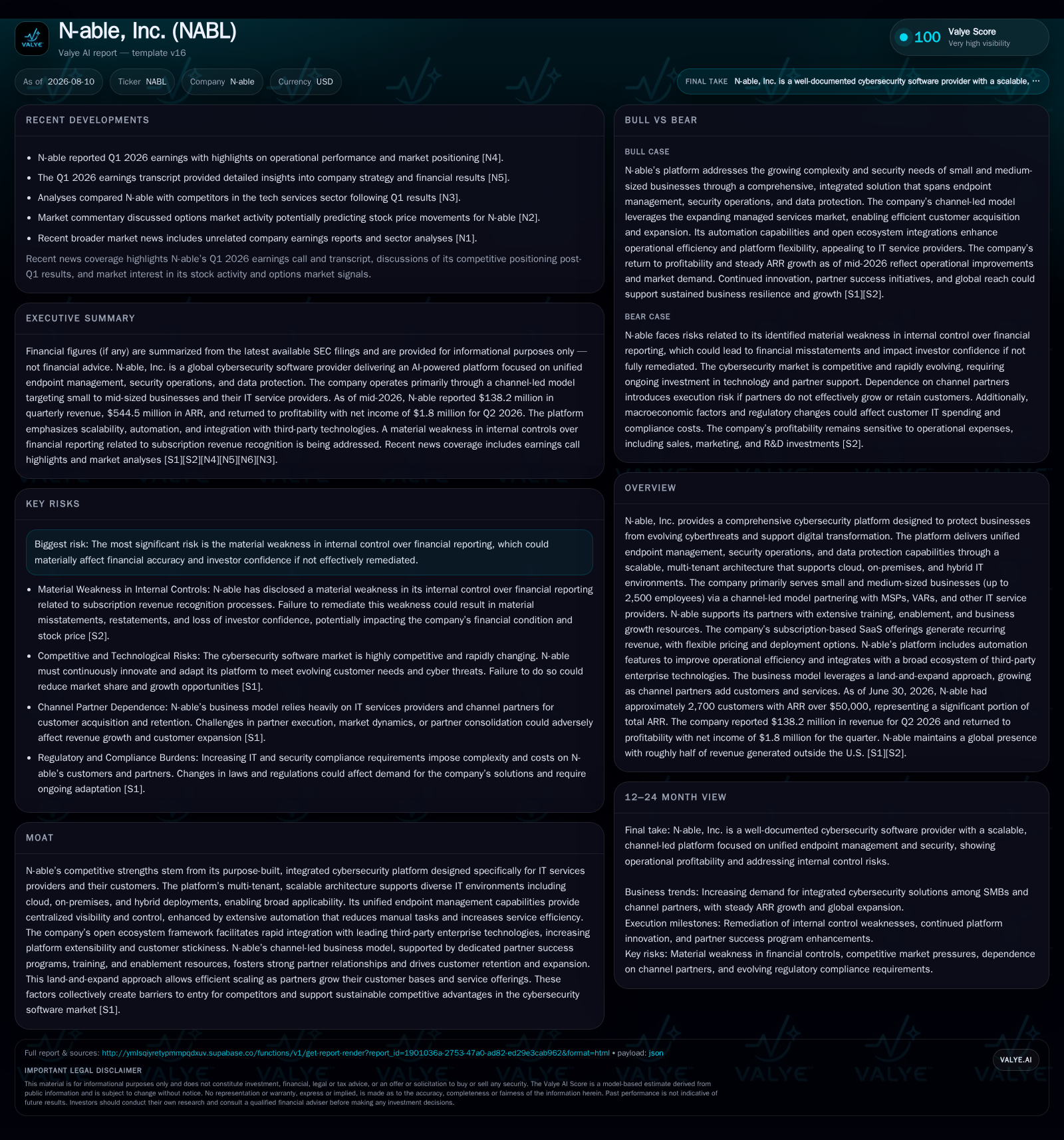
In Q2 2026, N-able delivered a significant profit turnaround with operating income rising to $16.5 million from $9.3 million a year earlier and net income turning positive at $1.8 million compared to a prior-year loss. This improvement reflects steady ARR growth to $544.5 million and expansion in customers contributing over $50K ARR, underscoring the effectiveness of its channel-led SaaS cybersecurity platform targeting SMBs. The company’s scalable multi-tenant architecture and automation enhance partner service efficiency, supporting durable retention as evidenced by stable net revenue retention around 103%. However, a material weakness in internal financial controls remains unresolved, posing execution risk.
Return to Profitability Reflects Subscription Growth and Operational Discipline
Channel-Led Model Fuels Land-and-Expand Growth
N-able distributes its SaaS cybersecurity solutions predominantly through a channel-led approach involving Managed Service Providers (MSPs), Value Added Resellers (VARs), distributors, and other partners who deliver technology services to end customers [S1]. The company invests heavily in partner success initiatives that provide training, enablement resources, and peer-led events designed to empower partners in servicing client security needs efficiently while expanding their service offerings. This ecosystem-centric strategy supports both strong customer retention and organic account expansion within installed bases.
Platform Architecture Supports Complex SMB Environments
Built on a multi-tiered multi-tenant architecture, N-able’s platform enables centralized visibility and role-based access controls across public cloud, private cloud, on-premises, or hybrid IT environments—addressing the complexity inherent in SMB IT infrastructures [S1]. This architectural flexibility is increasingly important as SMBs adopt hybrid cloud strategies requiring unified endpoint management alongside comprehensive security operations.
Embedded automation capabilities reduce manual operational burdens for MSPs and VARs by streamlining routine tasks such as threat detection response workflows and patch management [S1]. These efficiencies lower partner costs while improving service delivery quality. Additionally, an open ecosystem facilitates seamless integration with third-party enterprise tools commonly used by channel partners’ customers—driving platform extensibility and stickiness.
Revenue Recognition Shift Enhances Stability but Requires Careful Management
The Long-Term Contract Initiative has shifted subscription revenue mix toward longer-term committed contracts versus month-to-month arrangements [S1]. While this enhances revenue visibility and contract stability under ASC Topic 606 revenue recognition standards, it introduces complexities that have affected net revenue retention metrics slightly due to rationalization effects tied to contract term changes [S1][S2]. Nonetheless, N-able maintained an annual dollar-based net revenue retention rate near 103%, signaling healthy upsell dynamics within recurring accounts despite these transitions.
Growth Drivers: Increasing Cyber Threats & Regulatory Pressure
Industry tailwinds supporting demand include accelerating cyberattack sophistication impacting all organizational sizes—including SMB segments historically underserved technologically—and growing regulatory requirements around data privacy. N-able’s integrated platform covering endpoint management through backup/recovery aligns well with these market needs.
Key Risks: Internal Control Weakness & Competitive Pressure
The company disclosed a material weakness in internal control over financial reporting related primarily to manual processes outside automated ERP modules handling subscription revenue recognition; this weakness remained unremediated as of quarter-end June 30, 2026 [S2]. Failure to resolve this could lead to material misstatements affecting investor confidence.
Competitive dynamics remain intense among MSP-focused cybersecurity SaaS providers competing on price and technology breadth; sustained differentiation through automation and partner enablement will be critical.
What To Watch: Subscription Metrics & Control Remediation Progress
Monitoring quarterly ARR trends including new wins versus churn will be key indicators of growth momentum [S2][S3]. Growth in customers with high ARR levels will reveal success in account expansions. Tracking shifts in net retention rates will reflect pricing/mix optimization effectiveness amid contract transitions. Progress on remediating internal control weaknesses will be essential for restoring confidence in financial reporting transparency
Partner enablement outcomes measured via training adoption rates or pipeline contribution could also indicate scalability potential.
Financial Profile Discussion: Cash Cushion Amid Leverage & Amortization Impact
As of June 30, 2026, N-able held approximately $115.8 million in cash against total debt near $398 million yielding net debt around $282 million—consistent with prior leveraged positioning supporting recent acquisitions financed mainly through debt facilities [F1][S2]. Current assets exceed current liabilities resulting in a current ratio of approximately 1.3 which indicates reasonable short-term liquidity but not an excessive capital buffer [F1].
Cost of revenue includes amortization charges related primarily to technologies acquired through recent purchases such as Spinpanel B.V. (2022) and Adlumin (2024), adding materially to gross margin pressure but offset partly by operational efficiencies elsewhere [S2]. Increased investments in research & development aim at sustaining competitive differentiation through product enhancements but weigh on short-term margins during scale-up phases.
Overall free cash flow generation should improve if operating income gains continue alongside disciplined capital expenditures aligned with strategic technology development plans.
This analysis synthesizes N-able’s latest quarterly disclosures alongside relevant industry context without providing investment research views or speculative forecasts. It highlights strengths within its channel-driven cybersecurity SaaS niche while flagging key risks including financial controls that merit close monitoring as the business evolves.
Disclaimer: This is research-only, informational analysis and not investment advice. It may include AI-generated interpretation and general industry context. Always verify important details using primary sources.

Comments