
Daktronics Inc. (DAKT) Company Analysis: Navigating Supply Chain Complexity and Market Expansion in Electronic Display Systems
Daktronics leverages a vertically integrated model to serve diverse markets with electronic display solutions, balancing innovation and manufacturing scale amid geopolitical and supply risks.
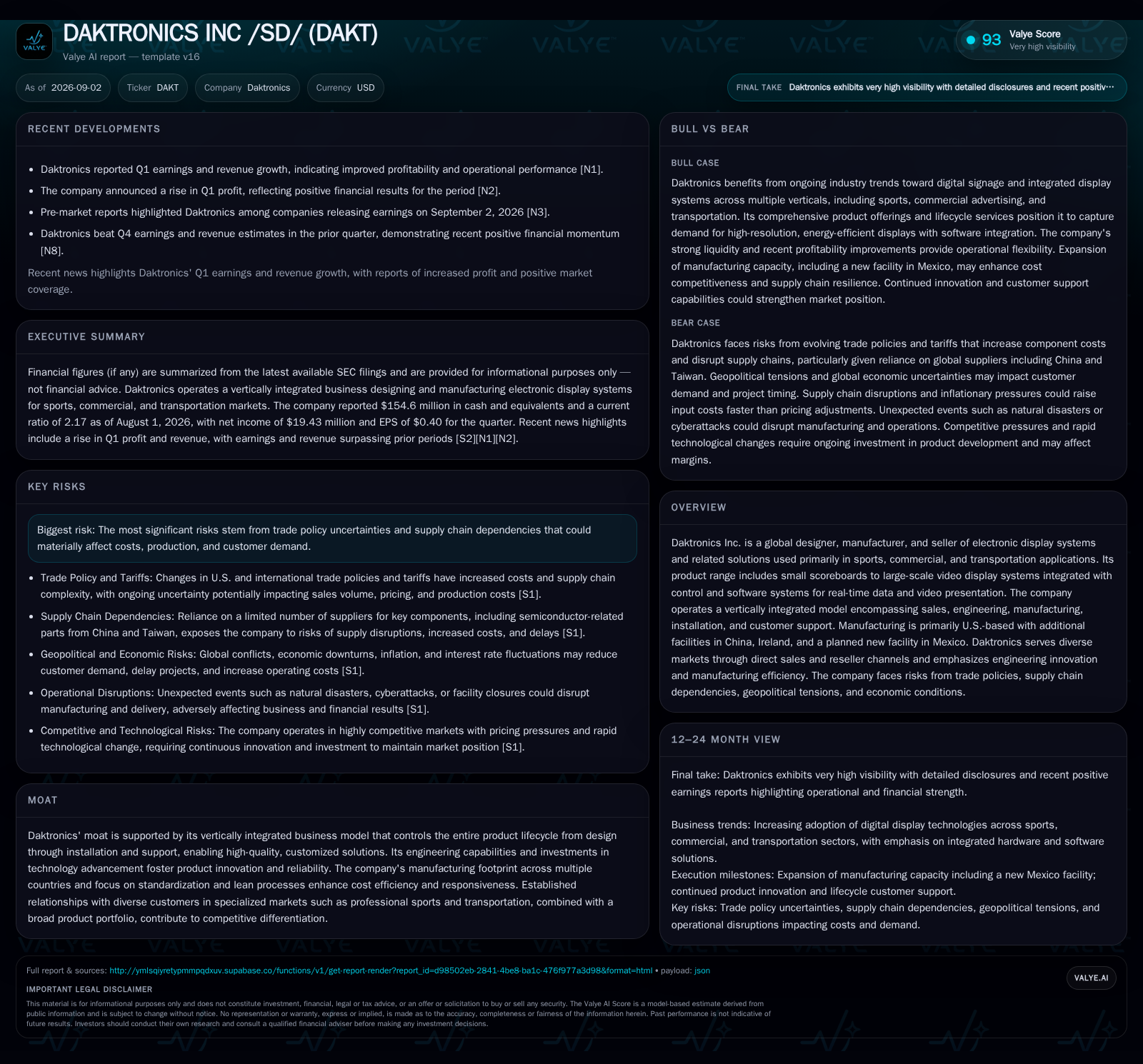
Daktronics operates a comprehensive business designing and manufacturing electronic display systems for sports, commercial, and transportation markets. Recent financial reports show improved profitability and liquidity, supported by operational momentum and manufacturing expansion plans. The company’s moat lies in its vertically integrated model, engineering expertise, and diversified product portfolio. Risks from supply chain dependencies, trade policies, and geopolitical tensions are key challenges to watch. The outlook depends on successful capacity expansion, cost management, and continued adoption of integrated digital signage technologies.
Daktronics Inc. stands as a vertically integrated designer and manufacturer of electronic display systems serving sports, commercial, and transportation markets globally. The company’s recent quarterly results show rising profitability and reported liquidity position, underscoring operational resilience amid a complex geopolitical and supply chain environment. With a diverse product portfolio ranging from small scoreboards to large-scale video systems, Daktronics leverages engineering innovation and manufacturing scale to meet growing digital signage demand. However, critical risks from trade policies, component sourcing, and inflation pose challenges. The company’s ability to expand manufacturing capacity, control costs, and advance integrated hardware-software solutions will shape its trajectory over the next 12 to 24 months.
Latest Operating Snapshot
Daktronics reported net income of $19.43 million and basic and diluted EPS of $0.40 for the quarter ending August 1, 2026, reflecting improved profitability and operational performance compared to prior periods [S2][N1][N2]. Cash and equivalents stood at $154.6 million with a current ratio of 2.17, indicating solid liquidity and balance sheet strength [S2]. These financial metrics underscore Daktronics’ ability to fund operations and invest in growth initiatives despite external headwinds.
Manufacturing operations remain predominantly U.S.-based with facilities in South Dakota and Minnesota, complemented by sites in China and Ireland. A new manufacturing facility planned for Mexico in fiscal 2027 aims to enhance cost competitiveness, diversify supply chains, and improve responsiveness to North American customers [S1]. The company’s sales approach combines direct sales for large integrated systems and reseller channels for standard products, enabling broad market coverage across professional sports, commercial venues, and transportation sectors [S1]. These operational features support scalability and customer-specific customization.
Business Model and Unit Economics
Daktronics generates revenue primarily through the design, manufacture, and sale of electronic display systems and related software solutions. Pricing depends on product complexity and integration level—ranging from standardized smaller scoreboards sold via resellers to large custom systems requiring direct sales, installation, and ongoing support. The vertically integrated model encompasses engineering, manufacturing, installation, and post-sale services, enabling control over quality and customer experience but requiring significant fixed costs and capital investment in facilities and R&D [S1].
Unit economics vary by product scale and integration. Large systems likely exhibit higher gross margins due to customization and bundled software services, while smaller catalog products may operate with tighter margins and greater price sensitivity. Operating leverage could emerge by increasing volume in high-margin integrated systems, spreading fixed engineering and manufacturing costs. However, supply chain disruptions and tariff-driven input cost inflation may compress margins unless offset by pricing adjustments or efficiency gains. The planned Mexican facility may reduce manufacturing costs and improve supply chain resilience, potentially enhancing operating leverage if ramped efficiently [S1].
Moat, Competition and Counterforces
Daktronics’ moat is anchored in its vertically integrated business model, which allows it to deliver end-to-end solutions—from hardware design and manufacturing to software integration and ongoing support. This integration supports product customization, quality assurance, and lifecycle customer relationships that can increase switching costs. Its engineering capabilities and investments in technology foster ongoing innovation in electronic displays, control systems, and software, differentiating offerings in specialized markets such as professional sports and transportation [S1].
Competitive pressures come from other electronic display manufacturers and software providers, including companies focused purely on hardware or software-based digital signage solutions. Rapid technological advances, such as the shift toward higher resolution, energy-efficient displays and integrated cloud-based management, require continuous R&D investment to maintain competitiveness. Supply chain dependencies, especially reliance on semiconductor components from China and Taiwan, represent a vulnerability that competitors with more diversified or localized sourcing might better navigate [S1]. Trade policy changes and tariffs add cost pressure, potentially eroding the cost advantage from manufacturing scale.
Bull Case
In the bull scenario, Daktronics capitalizes on accelerating adoption of digital signage and integrated display systems across sports venues, commercial advertising, and transportation infrastructure. The company’s vertically integrated model enables delivery of tailored, high-value solutions that combine hardware, software, and services, creating differentiation and customer stickiness. Expansion of manufacturing capacity, including the new Mexican facility, reduces costs and mitigates supply chain risks, enhancing margins and fulfillment reliability. reported liquidity position provides flexibility to invest in product innovation and market expansion.
Evidence supporting this scenario would include sustained revenue growth driven by larger integrated system sales, successful ramp-up of new manufacturing capacity, and increasing contribution from software and service offerings improving operating margins. Falsification would occur if Daktronics fails to scale manufacturing efficiently, customers delay capital projects due to macroeconomic weakness, or competitors outpace innovation, leading to margin erosion or lost market share.
Base Case
The base case envisions steady demand growth for Daktronics’ display systems aligned with general industry trends toward digital signage and integrated hardware-software solutions. The company maintains its vertically integrated model and geographic manufacturing spread, balancing cost pressures with operational efficiencies and moderate pricing power. Supply chain disruptions and tariff impacts persist but are manageable through supplier diversification and lean manufacturing. Incremental capacity expansion in Mexico improves cost structure gradually but does not dramatically alter economics in the near term.
Under this scenario, Daktronics’ financial performance grows modestly with stable margins and consistent profitability. Innovation efforts sustain product competitiveness but do not yield disruptive new offerings. Potential downside risks such as geopolitical tensions or inflationary pressures slow growth but do not cause material shocks. This scenario is falsified if the company faces significant margin compression, persistent supply delays, or customer demand contraction beyond manageable levels.
Bear Case
The bear case involves sustained adverse impacts from trade policies, tariffs, and geopolitical tensions that substantially increase component costs and disrupt supply chains, especially for semiconductors sourced from China and Taiwan. Inflationary pressures outpace the company’s ability to raise prices, eroding margins. Economic downturns reduce capital spending by key customers in sports and commercial segments, delaying or canceling projects. Operational disruptions such as natural disasters or cyberattacks impair manufacturing capabilities, further hindering revenue and profitability.
Confirmation of this downside would be evident in deteriorating gross margins, rising inventory or supply delays, missed revenue targets, and weakening cash flow. Conversely, early signs of supply chain stabilization, successful cost pass-through pricing, or customer announced awards growth would challenge this scenario. Prolonged margin compression or liquidity strain would be particularly negative signals.
What Matters Next
Key metrics to watch include quarterly revenue growth by segment (integrated systems versus catalog products), gross margin trends reflecting cost inflation and pricing power, and operating income reflecting leverage on fixed costs. Monitoring announced awards or order intake data, if disclosed, would provide insight into demand momentum and project pipeline health. The progress of the Mexico manufacturing facility ramp and its impact on cost structure and lead times will be critical milestones.
Additional KPIs include R&D spending as a percentage of sales to assess innovation investment, customer retention or continued-adoption indicators indicating switching friction, and supply chain metrics such as component lead times or supplier diversity. External factors like changes in trade policies or geopolitical developments affecting key supply regions will also materially influence prospects.
Disclaimer: This is research-only, informational analysis and not investment advice. It may include AI-generated interpretation and general industry context. Always verify important details using primary sources.

Comments