
N-able Advances Profitability on Steady ARR Growth Supported by Channel Ecosystem
N-able’s Q2 2026 results highlight improved operating efficiency amid expanding annual recurring revenue driven by its MSP-focused cybersecurity SaaS platform.
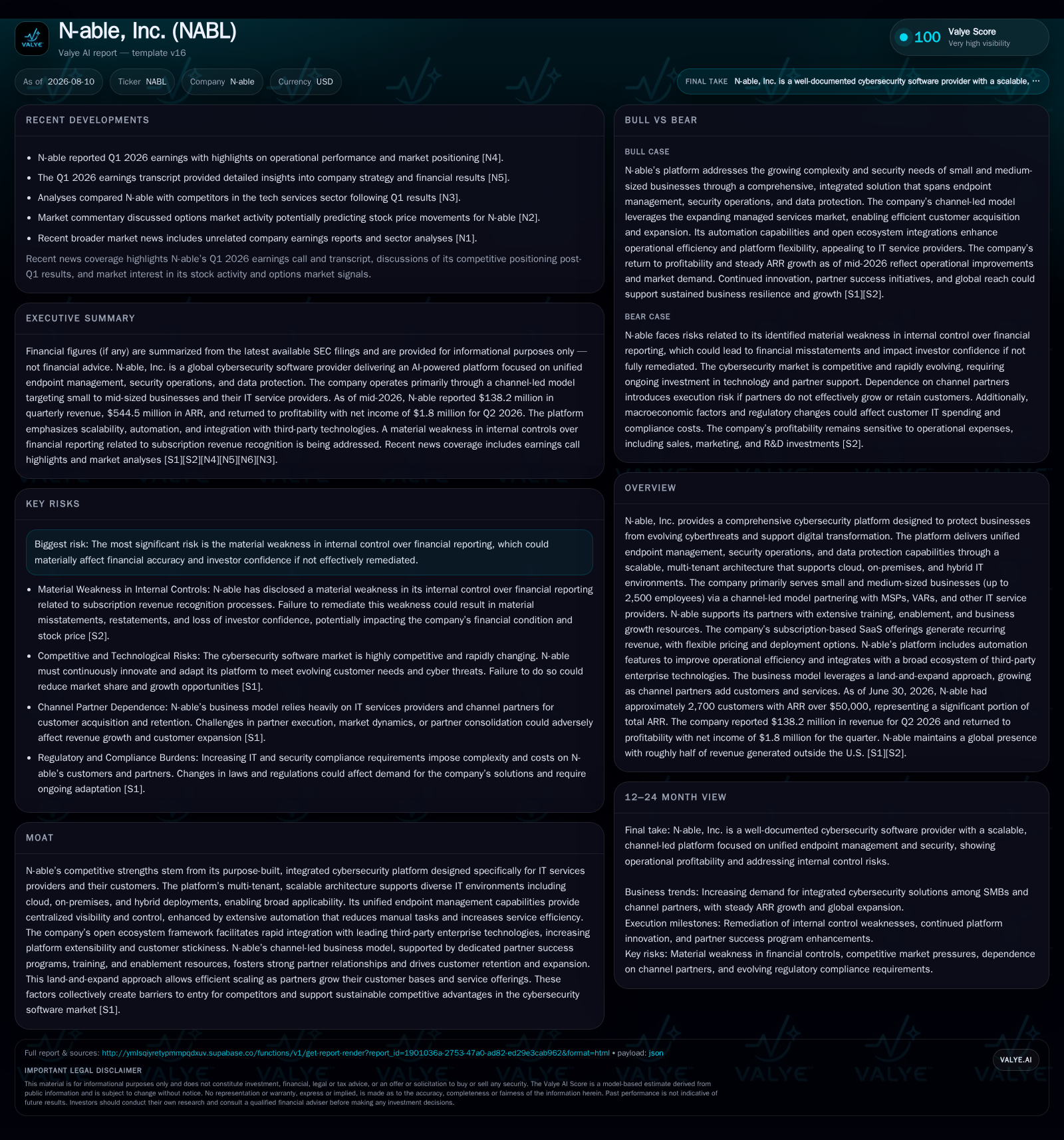
In the second quarter of 2026, N-able, Inc. reported a solid increase in Annual Recurring Revenue (ARR) to $544.5 million, reflecting a 6.0% year-over-year growth supported by expanding customer counts and higher contract values. The company returned to profitability with operating income of $16.5 million and net income of $1.8 million, aided by revenue gains and controlled operating expenses despite increased investments in R&D and sales marketing. N-able’s channel-led model targeting MSPs, VARs, and IT service providers continues to underpin steady subscription revenue expansion, while challenges include remediation of a material weakness in financial controls and rising cloud infrastructure costs impacting margins.
Recent Operating Update
N-able's latest quarterly filing for Q2 ended June 30, 2026 reveals continued momentum in its core cybersecurity SaaS business amid operational improvements that have pushed the company back into profitability [S2]. Total revenues climbed to $138.2 million from $130.5 million year-over-year, a solid increase fueled by sustained demand across its solution suite which bundles Unified Endpoint Management (UEM), Security Operations Center (SOC) capabilities, and Data Protection features into a scalable AI-powered platform aimed at SMBs via managed service providers (MSPs) and other channel partners [S2], [S1].
Profitability metrics improved markedly: operating income rose to $16.5 million compared to $9.3 million the previous year same quarter while net income swung positive at $1.8 million versus a net loss of $4.6 million [S2]. This turnaround was driven primarily by top-line growth combined with disciplined reductions in general and administrative expenses as well as favorable swings in non-operating expenses, even though cost of revenue and other operational investments saw increases [S2]. Adjusted EBITDA also improved reflecting operational leverage.
Cost of revenue reflected heightened cloud infrastructure fees related to public cloud hosting services integral to the multi-tenant SaaS platform design alongside personnel costs for technical support staff and Security Operations Center functioning [S2]. Additionally, amortization charges from acquired technologies linked to recent strategic acquisitions (Spinpanel in July 2022 and Adlumin in November 2024) elevated cost line items further [S2]. While these pressures weigh on gross margins, they are part of strategic investments aiming to broaden product breadth and integrated security coverage.
Business Model Analysis
N-able operates a subscription-based SaaS platform selling cybersecurity solutions primarily to small- and medium-sized businesses (SMBs)—generally under 2,500 employees—through an extensive network of channel partners, including MSPs, Value Added Resellers (VARs), and distributors who manage the customer relationship end-to-end [S1]. This model leverages the partners' domain expertise and local market reach while offloading direct sales costs from N-able.
Revenue mechanics revolve around annual recurring revenue derived from flexible subscription agreements offering both month-to-month plans and increasingly long-term committed contracts—a strategic shift implemented since late 2024 called the Long-Term Contract Initiative [S1]. Such contracts involve upfront license access recognition at delivery with ratable support revenue over contract terms per ASC Topic 606 standards dictating SaaS revenue recognition policies [S1]. This shift affects the timing mix between point-in-time license revenue versus ongoing subscription streams but aims to enhance revenue visibility and customer stickiness.
N-able generates most of its subscription value from modular offerings spanning endpoint management for device control (UEM), advanced security operations enabling threat detection and response (SOC), plus data protection including backup/recovery capabilities important for business continuity [S1]. Its AI-driven platform architecture supports deployment across cloud, on-premises, or hybrid environments with centralized administrative tools providing unified visibility suitable for managed service delivery models.
The company's open integration ecosystem fosters interoperability with third-party cybersecurity products—a crucial factor enhancing platform extensibility that underpins partner loyalty as it allows customization based on differing customer environments or compliance needs [S1]. Automation embedded throughout reduces manual effort for IT service providers enabling scalability which is essential given the operational intensity typical for MSP-supported SMB clientele.
Beyond technology, N-able emphasizes partner enablement via extensive training programs, go-to-market resources, community events, and success services designed to accelerate partners' service offerings built on its platform—all fundamental drivers supporting partner retention and incremental ARR expansion within existing installed bases [S1]
Industry Structure & Competitive Position
The cybersecurity software-as-a-service sector is highly dynamic marked by rapid technology evolution demanded by increasingly sophisticated cyber threats targeting all business scales globally. N-able's primary competition spans companies offering endpoint protection platforms like CrowdStrike or SentinelOne that emphasize AI-powered threat detection but sometimes cater more toward direct enterprise sales rather than exclusively channel-driven SMB models.
Unlike broad-spectrum enterprise-centric vendors such as Palo Alto Networks that combine hardware appliances with SaaS offerings, N-able focuses heavily on a cloud-native multi-tenant platform expressly designed for easy consumption through MSPs servicing SMBs lacking internal cybersecurity teams—the segment forecasted for robust growth due to growing regulatory pressures and digital transformation adoption driving outsourcing trends.
Furthermore, companies like ConnectWise share similar go-to-market routes through MSP-focused IT management suites but may differ in product breadth or integration focus areas. N-able’s acquisitions of Spinpanel and Adlumin expanded its capabilities into identity lifecycle management and extended detection/response respectively—moves strengthening competitive differentiation within the increasingly converged UEM plus SOC space essential for comprehensive security coverage in hybrid environments.
Growth Drivers
Several structural forces fuel N-able's growth potential. The escalating frequency and complexity of cyberattacks compel even resource-constrained SMBs toward managed digital defenses delivered efficiently via MSP channels who can leverage automated platforms like N-able's to optimize operations while maintaining robust security postures.
Digital transformation initiatives worldwide drive adoption of cloud infrastructure alongside hybrid IT setups demanding integrated endpoint management coupled with unified security operations—core strengths of N-able’s platform architecture designed from inception for multi-tenant scalability across various deployment modes [S1].
Furthermore, increased regulatory mandates globally impose compliance requirements pressuring organizations toward continuous monitoring and data protection services—creating incremental addressable markets particularly suited for software vendors capable of bundling these functionalities in their SaaS stack while empowering channel partners with specialized expertise.
The Long-Term Contract Initiative evidences maturation toward more predictable recurring revenue streams enhancing customer lifetime value predictability crucial for valuation multiples typical within subscription software sectors [S1], [S2]. Alongside, ongoing investments in AI automation embedded throughout improve operational efficiency for MSPs allowing them to scale without proportionate headcount growth driving partner satisfaction metrics upwards.
Risks & Constraints
A critical near-term risk is N-able’s identified material weakness in internal control over financial reporting associated specifically with manual processes outside their automated ERP revenue recognition systems affecting subscription arrangements [S2]. Although remediation efforts are underway, failure to fully resolve this could harm investor confidence causing volatility in reported results or necessitating costly corrective actions impacting liquidity.
Cloud infrastructure cost volatility represents another margin pressure point since public cloud hosting fees form a significant portion of cost of goods sold linked directly to usage patterns; unpredictable spikes or long-term pricing inflation could compress gross margins especially as competitive necessities mandate feature-rich development increasing operational overhead [S2]
Channel dependence also implies some concentration risk; since most customer relationships pass through MSPs or VARs rather than direct sales channels, shifts in partner strategies or weaker-than-expected partner ecosystem expansions could constrain new sales velocity or renewal rates disrupting ARR growth trajectories.
Continuous innovation is imperative given rapid threat evolutions; lagging behind emergent technologies such as integrated AI-driven threat hunting platforms might erode competitive moats ultimately pressuring pricing power or churn rates amidst intensifying sector rivalry.
What To Watch Next
Key milestones include progress on remediating internal control weaknesses verified through subsequent audit reports indicating sustainable improvements which would restore full confidence in financial disclosures [S2]. Tracking sequential quarterly ARR growth figures alongside dollar-based net revenue retention rates will illuminate underlying customer stickiness trends critical for validating land-and-expand efficiencies inherent in the channel-led business model.
Monitoring changes in gross margin percentages relative to cloud infrastructure spending fluctuations will offer insight into cost controls effectiveness amidst ongoing R&D investment cycles tailored toward integrating acquired technologies like Adlumin’s EDR capabilities further into core offerings.
Partner enablement metrics announced during earnings or investor communications such as expansions in certified partner counts or program participation rates could signal scaling capacity impacting future booking trends.
Lastly, commentary on pricing dynamics evaluating how long-term contract shifts affect overall revenue recognition patterns will clarify sustainability of recent ARR gains while signaling potential adjustments required under evolving accounting frameworks.
Financial Profile Discussion
As of June 30, 2026, N-able reported cash and equivalents totaling approximately $115.8 million against total debt nearing $398 million culminating in net debt around $282.2 million with a current ratio near 1.3 times demonstrating manageable near-term liquidity conditions relative to current liabilities clocking at about $162.4 million versus current assets just above $211.8 million [F1], [S2].
The return to profitability indicated by positive operating income ($16.5 million) after prior losses signifies improved operating leverage aligned with growth phases common amongst mid-tier SaaS firms investing heavily while scaling subscribe-based businesses[S2]. Rising interest expense partly offsets gains pointing toward ongoing debt servicing demands likely tied to acquisition financing structures.
Overall cost structure reflects strategic prioritization balancing necessary outlays towards cloud operations support personnel alongside amortization charges linked explicitly to acquired tech assets with simultaneous restraints applied on G&A spend contributing favorably toward bottom-line enhancements over time [S2]
Continued focus on maintaining robust free cash flow conversion alongside prudent capital allocation amidst competitive pressures will be vital markers signaling long-term financial health as N-able pursues sustained market penetration within an increasingly complex cybersecurity ecosystem.
This analysis reflects detailed review of publicly filed SEC disclosures up through August 10, 2026 combined with industry context framing specific to SaaS-based cybersecurity firms targeting SMB channels via MSP partnerships. All financial figures are as reported without projection or endorsement.
Disclaimer: This is research-only, informational analysis and not investment advice. It may include AI-generated interpretation and general industry context. Always verify important details using primary sources.

Comments