
Ethan Allen Interiors Inc. (ETD) Deep Dive: Navigating Cost Pressures and Retail Dynamics
Ethan Allen operates a mixed-owned and leased retail design center network, facing raw material and inflation challenges while leveraging operational efficiencies and brand presence. This analysis explores its economic model, competitive moats, and scenarios shaping value creation amid macro and sector headwinds.
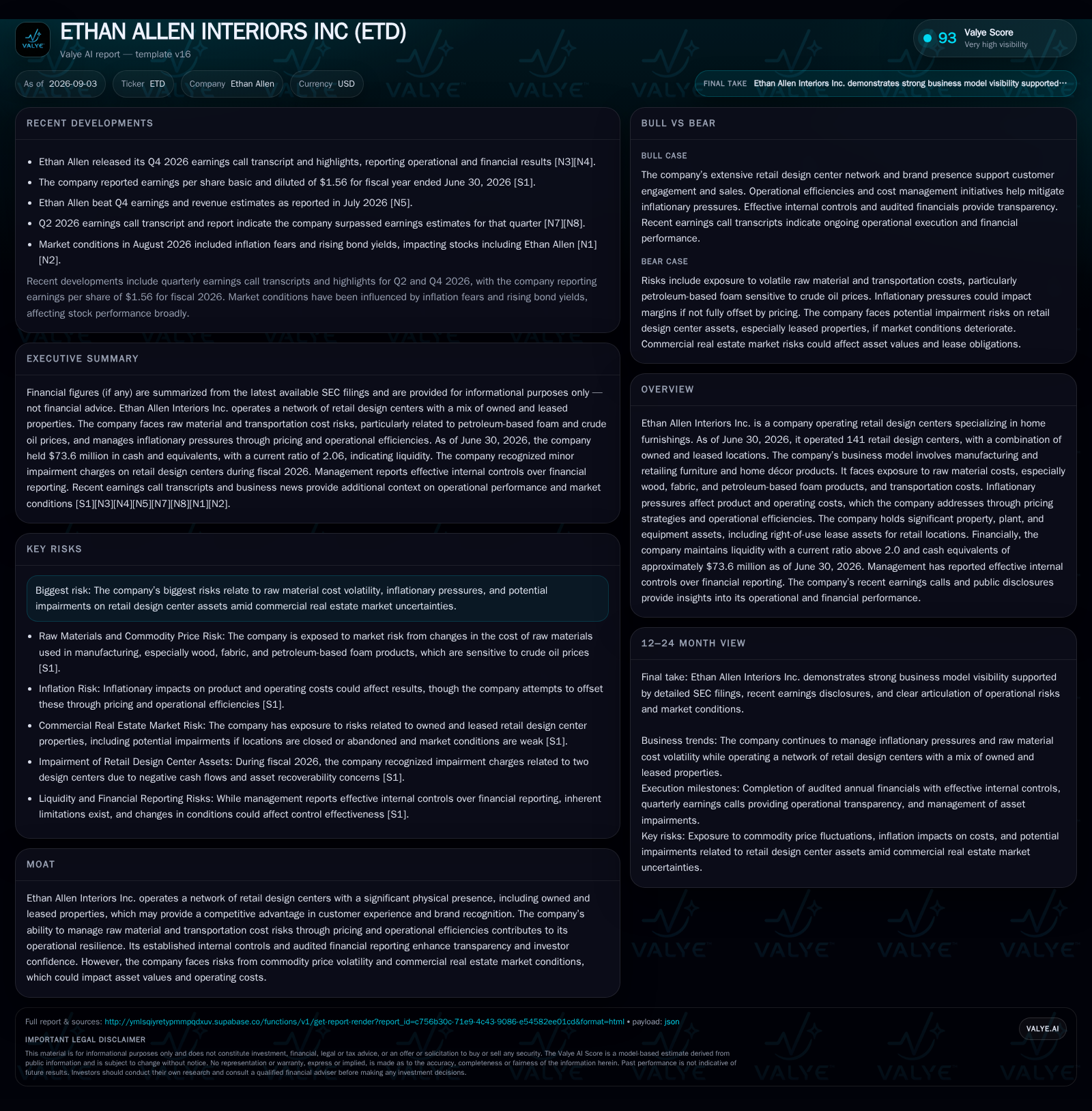
Ethan Allen’s vertically integrated furniture retail model combines manufacturing with retail design centers, exposing it to raw material cost volatility and real estate risks. The company mitigates inflationary pressures through pricing and operational efficiencies but faces margin risks if cost inflation outpaces price adjustments. Its mix of owned and leased retail locations provides customer engagement advantages but creates capital intensity and potential impairment exposure. Durable advantages hinge on brand reputation, operational control, and customer experience. Key value drivers include managing cost inputs, sustaining pricing power, and adapting retail footprint to evolving consumer trends and macroeconomic conditions.
Ethan Allen Interiors Inc. operates a network of 141 retail design centers specializing in furniture and home décor, blending owned and leased properties to serve discerning customers. The company’s vertically integrated business exposes it to raw material costs sensitive to crude oil and transportation price swings, necessitating agile pricing and operational strategies to protect margins. As inflationary pressures and real estate market uncertainties intensify, Ethan Allen’s ability to manage cost inputs, optimize retail footprint, and sustain brand-driven customer engagement will critically influence its financial trajectory. This analysis dissects the company’s business model economics, competitive positioning, and plausible future paths amid evolving macroeconomic and industry-specific dynamics.
Latest Operating Snapshot
As of June 30, 2026, Ethan Allen operates 141 retail design centers, with 48 owned properties and 93 leased locations, reflecting a strategic balance between capital ownership and operational flexibility [S1]. This blend affects fixed asset intensity, lease obligations, and potential impairment exposure. The company reported earnings per share of $1.56 for fiscal 2026, surpassing analyst expectations in recent quarters, indicating resilient operational execution despite inflationary headwinds [S1][N3][N5][N7][N8].
Raw material costs remain a significant operational lever, particularly petroleum-based foam products whose prices correlate with crude oil fluctuations, exposing margins to commodity volatility [S1]. Transportation costs, including container and fuel expenses, also impact cost structures, requiring ongoing supply chain management. Ethan Allen manages inflationary pressures with a multi-pronged approach: retail price increases, manufacturing input cost reductions, repositioning retail centers, and operational efficiencies such as headcount reductions [S1]. Liquidity positions are healthy with $73.6 million in cash and a current ratio of 2.06, providing financial stability amid uncertain macroeconomic conditions characterized by inflation fears and rising bond yields [S1][N1][N2].
Business Model and Unit Economics
Ethan Allen’s business model integrates furniture manufacturing with retail design center sales, enabling direct customer engagement and control over product presentation and service. Revenue generation depends on retail sales volume and pricing, influenced by brand positioning and customer experience. The mix of owned versus leased stores influences fixed cost commitments: owned properties represent capital-intensive fixed assets with depreciation, while leased stores embed operating lease expenses that fluctuate with occupancy costs. This hybrid model offers some flexibility to adjust footprint but also creates complexity in cost management [S1].
Unit economics hinge on effectively managing raw material and transportation costs, which constitute a large portion of cost of goods sold. Pricing power is critical to offset inflationary input cost increases, but is constrained by competitive and consumer price sensitivity. Operational leverage emerges if fixed costs and store-level efficiencies scale with sales growth, but margin compression may occur if cost inflation outpaces price increases. Capital expenditures are significant for owned design centers and manufacturing facilities, while leased stores reduce upfront capital but increase operating expenses. The impairment of two centers in 2026 signals potential challenges in sustaining profitability across all stores, highlighting the importance of portfolio optimization [S1].
Moat, Competition and Counterforces
Ethan Allen’s competitive moat primarily derives from its established brand, extensive brick-and-mortar retail design center network, and vertically integrated manufacturing-to-retail model. The physical presence facilitates personalized customer experiences and design consultation services that are difficult to replicate fully online, potentially building switching frictions. Ownership of nearly one-third of centers provides control over store environments and long-term asset value, while leasing offers geographic flexibility. Operational controls and cost management capabilities also contribute to resilience amid inflationary pressures [S1].
However, the company faces counterforces including raw material price volatility, especially petroleum-based foam linked to crude oil, and transportation cost inflation that can erode margins. Competitive pressure from online furniture retailers and large home furnishing chains with scale advantages may limit pricing power. The retail real estate market’s volatility introduces risks of asset impairments and increased lease costs, especially for leased stores. Consumer purchasing behavior trends toward digital channels and alternative furnishing options could challenge Ethan Allen’s traditional retail model if not adapted effectively. Thus, sustaining the moat requires balancing physical retail strengths with cost discipline and evolving consumer preferences.
Bull Case
In a favorable scenario, Ethan Allen leverages its strong brand and expansive retail design center footprint to deepen customer engagement and increase sales volume and pricing power. Effective operational initiatives—such as input cost reductions, manufacturing efficiencies, and retail footprint optimization—successfully offset raw material and transportation cost inflation, preserving or expanding margins. The company’s liquidity and capital structure support selective investments in store upgrades and digital integration, enhancing the customer experience and driving increased repeat business. Impairment risks are contained through proactive portfolio management, and real estate market conditions stabilize, preserving asset values.
Confirming evidence would include sustained or growing comparable store sales, stable or improving gross and operating margins despite inflation, positive free cash flow trends, and no further impairment charges. A falsification test would be if raw material costs escalate beyond pricing power, leading to margin contraction, or if retail traffic declines materially due to changing consumer preferences or economic downturns, triggering additional store impairments and cash flow pressures.
Base Case
Under the base case, Ethan Allen continues to navigate commodity price volatility and inflation with moderate success, managing to pass through a portion of cost increases via pricing while realizing some operational efficiencies. Retail sales grow modestly, supported by brand loyalty and the differentiated in-store design center experience, but margin expansion remains constrained. The mix of owned and leased properties balances capital deployment but also entails selective impairments of underperforming locations. The company maintains sufficient liquidity and stable financial controls, enabling steady execution without major disruptions.
Evidence confirming this scenario includes earnings and sales growth in line with guidance, manageable inflation impacts on margins, occasional but contained impairment charges, and consistent liquidity ratios. Falsification would occur if inflation becomes unmanageable, leading to significant margin erosion, or if consumer demand weakens substantially, causing widespread store closures and impairments.
Bear Case
In a downside scenario, Ethan Allen faces sustained raw material cost surges, particularly in petroleum-based foam and transportation, which outstrip pricing adjustments and operational efficiencies. Inflationary pressures compress margins, while weakening consumer demand—possibly triggered by rising interest rates and economic slowdown—reduces retail foot traffic and sales volume. The company incurs additional impairment charges on retail design centers as some leased locations become uneconomical amid commercial real estate headwinds. Liquidity tightens, and capital expenditures are curtailed, constraining growth initiatives and digital transformation efforts.
Confirming evidence would include repeated negative comparable store sales, increasing impairment charges, deteriorating margins, and cash flow stress. Conversely, signs that input costs are stabilizing, pricing remains effective, and impairments are limited would falsify this bear case. Monitoring macroeconomic indicators such as crude oil prices, inflation trends, and consumer discretionary spending provides early signals of scenario risk.
What Matters Next
Key performance indicators to watch include comparable store sales growth and retail design center traffic, which directly influence top-line momentum and operating leverage. Gross margin trends will reveal the effectiveness of pricing and cost management in offsetting inflation. Operating margin and EBITDA progression indicate operating leverage and efficiency gains or losses. Monitoring impairment charges and asset write-downs offers insight into real estate and retail footprint health. Liquidity metrics, including cash balances and current ratio, signal potential financial flexibility to invest or weather downturns.
Additional milestones include management commentary on raw material cost outlook and pricing strategy adjustments in upcoming earnings calls, capital expenditure plans for store remodeling or digital initiatives, and updates on the mix of owned versus leased locations. External macro conditions such as crude oil price movements, inflation data, and consumer confidence indices will contextualize the operating environment. Tracking competitive developments in the home furnishings sector, especially from e-commerce players, will also be critical.
Disclaimer: This is research-only, informational analysis and not investment advice. It may include AI-generated interpretation and general industry context. Always verify important details using primary sources.

Comments