
Hewlett Packard Enterprise (HPE) Deep-Dive: Navigating AI-Driven Hybrid Cloud Transformation
HPE leverages its expanded networking portfolio, AI infrastructure heritage, and hybrid cloud platform to capture enterprise demand for data-first modernization, amidst execution and competitive challenges.
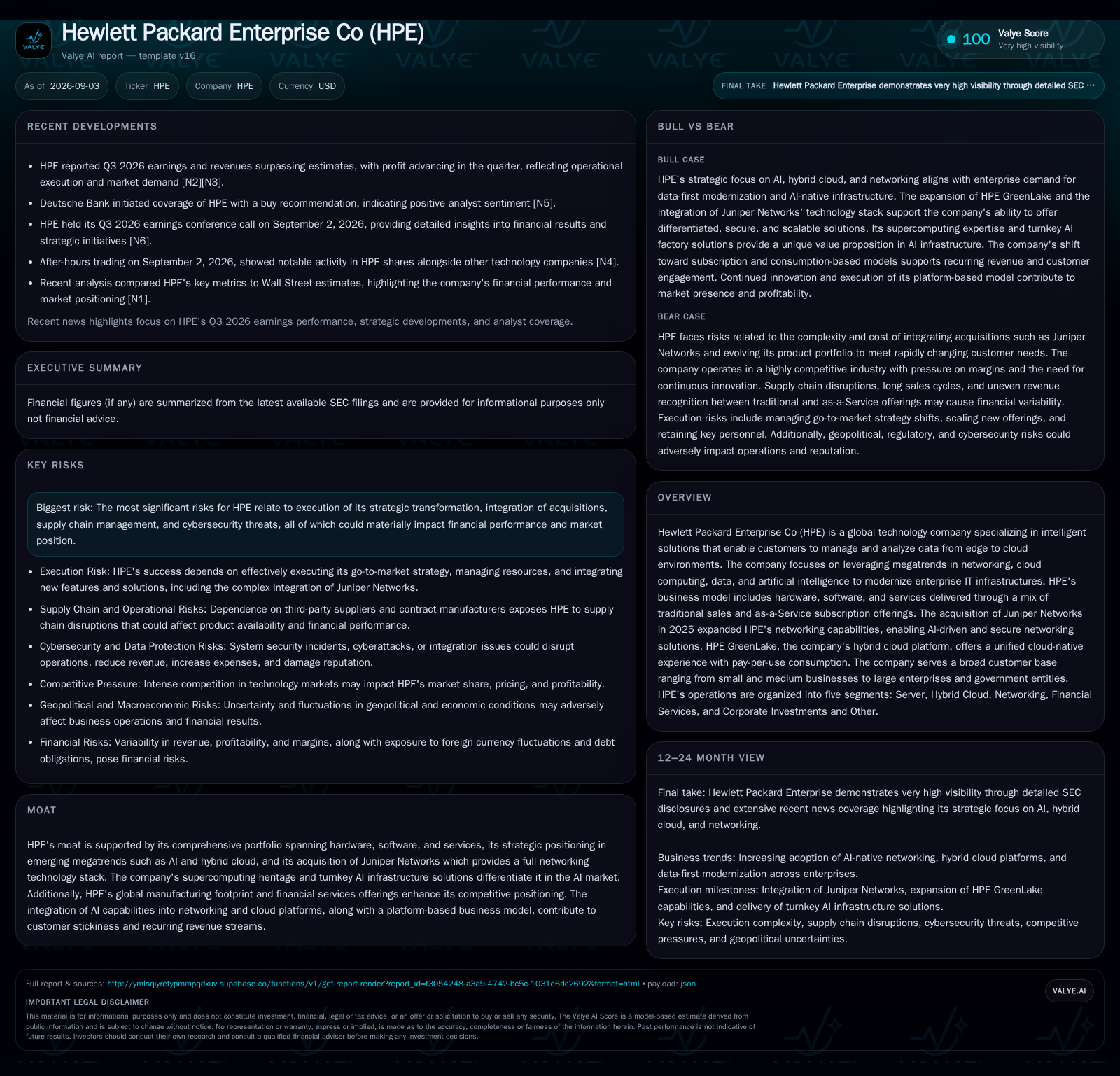
HPE’s strategic pivot towards AI-native networking, hybrid cloud-as-a-service, and turnkey AI infrastructure positions it well for growth in enterprise digital transformation. The Juniper acquisition deepens its networking stack, while GreenLake’s pay-per-use model signals recurring revenue potential. However, integration complexity, competitive intensity, and supply chain risks temper near-term outlook. Key value drivers include platform adoption rates, AI infrastructure wins, and execution on go-to-market shifts.
Hewlett Packard Enterprise (HPE) stands at a pivotal juncture as it integrates Juniper Networks’ networking assets and expands its AI-native hybrid cloud platform, GreenLake, to capitalize on enterprise demand for data-first modernization. The company’s Q3 2026 results surpassed consensus, driven by strength in AI infrastructure and networking, validating its platform-based business model shift. However, substantial integration complexity and competitive intensity in cloud and networking markets impose execution risks. HPE’s ability to scale consumption-based offerings and leverage its supercomputing heritage to deliver turnkey AI infrastructure solutions will be decisive factors shaping its medium-term growth trajectory.
Latest Operating Snapshot
In Q3 2026, HPE posted revenue of $12.213 billion and net income of $1.54 billion, surpassing Wall Street estimates and signaling solid operational execution and demand for its growth areas [N2][N3]. The company’s basic earnings per share were $1.13, indicating profitability improvement amid evolving business mix.
A transformative event was the July 2025 acquisition of Juniper Networks, which broadened HPE’s networking portfolio from silicon to software and services, enabling AI-driven secure networking solutions [S2]. This acquisition is a foundational step in HPE’s platform approach, aiming to differentiate through integrated, AI-native networking capabilities.
HPE’s GreenLake hybrid cloud platform continues to expand, offering unified AI-driven cloud-native experiences with pay-per-use consumption, which potentially improves revenue visibility and customer retention [S2]. Additionally, HPE’s server business supports traditional workloads and AI infrastructure, including supercomputing-class Cray EX systems, highlighting its breadth across enterprise computing needs.
Liquidity remains adequate with $6.216 billion in cash and equivalents, current assets of $33.865 billion against current liabilities of $30.436 billion, and a current ratio of 1.11, supporting operational flexibility [S2]. Analyst sentiment has turned positive, exemplified by Deutsche Bank’s recent buy recommendation [N5].
Business Model and Unit Economics
HPE’s revenue derives from hardware sales (servers, networking gear), software licenses, and rapidly growing subscription and consumption-based services, particularly through GreenLake. The latter shifts revenue recognition from upfront capital expenditure to recurring, pay-per-use streams, enabling more predictable cash flow and enhanced customer engagement over time. This hybrid model blends traditional product sales with as-a-Service offerings, balancing upfront margin capture with longer-term revenue visibility [S2].
Operating leverage hinges on scaling software and service revenues, which have higher gross margins and lower capital intensity than hardware. Fixed costs include R&D and manufacturing infrastructure, while variable costs relate to supply chain, fulfillment, and service delivery. Expansion of AI infrastructure and turnkey AI factory solutions could increase operating leverage if these higher-margin offerings gain traction, but complexity in integrating Juniper Networks and evolving product mix may temper cost efficiencies initially. Capital needs remain significant for R&D and manufacturing, but financial services offerings help customers adopt AI and hybrid cloud faster by easing upfront investment barriers.
Moat, Competition and Counterforces
HPE’s moat stems from its comprehensive technology stack spanning hardware, software, and services, enhanced by the Juniper acquisition that provides a full networking IP stack from silicon to software. This integrated approach supports AI-native networking and hybrid cloud solutions that competitors often struggle to replicate holistically. Its supercomputing heritage, underpinning turnkey AI infrastructure offerings, differentiates it in a market where AI workloads demand specialized capabilities.
However, the competitive landscape is intense, with peers like Dell, Cisco, Nvidia, and cloud hyperscalers exerting pressure on pricing, innovation, and customer retention. Switching frictions exist due to the scale and complexity of enterprise IT environments, but rapid technological shifts in AI and cloud services could erode incumbency advantages if HPE’s platform adoption lags. Supply chain disruptions and long sales cycles further complicate maintaining competitive momentum.
Bull Case
In a bullish scenario, HPE successfully integrates Juniper Networks’ assets, creating a differentiated AI-driven networking and hybrid cloud platform that resonates strongly with enterprises pursuing data-first modernization. GreenLake’s pay-per-use model scales rapidly, generating higher recurring revenues and improving customer lifetime value. The company’s turnkey AI factory solutions gain broad enterprise adoption, capitalizing on its supercomputing DNA to serve complex AI workloads efficiently.
Confirmation would come from accelerating GreenLake bookings, higher service attach rates, and expanding AI infrastructure deployments, coupled with improving margins from software and services. Market share gains in AI networking and hybrid cloud would validate the platform strategy. Falsification would be persistent integration setbacks, stagnant subscription growth, or loss of key customers to competitors offering more seamless cloud-native experiences.
Base Case
The base case envisages steady revenue growth driven by gradual adoption of AI-native networking and hybrid cloud solutions, with GreenLake growing in importance but not yet dominating revenue. Juniper Networks integration proceeds with manageable friction, enabling incremental product innovation but limited immediate margin expansion. Traditional hardware sales remain significant, offsetting some volatility in the subscription business.
Execution risks moderate growth pace, and competitive pressures keep pricing power constrained. Operating leverage improves slowly as software and services scale but is offset by ongoing investments in R&D and sales. Profitability advances modestly with occasional quarter-to-quarter variability reflecting timing differences in revenue recognition between product sales and as-a-Service offerings. The company maintains adequate liquidity and potential financial flexibility amidst geopolitical uncertainties.
Bear Case
In a downside scenario, HPE encounters significant integration difficulties with Juniper Networks, leading to product delays, customer dissatisfaction, and margin compression. Supply chain disruptions persist, exacerbating inventory and fulfillment challenges. Competitive dynamics intensify, with hyperscalers and agile cloud-native competitors eroding HPE’s enterprise market share, particularly in AI infrastructure and networking.
Recurring revenue growth slows, undermining revenue visibility and increasing earnings volatility. Talent attrition hampers innovation and go-to-market execution. Cybersecurity incidents or regulatory setbacks further dent reputation and operational stability. Confirming evidence includes flat or declining GreenLake bookings, widening losses in strategic segments, and failed cross-selling synergies. Falsification would require sustained revenue growth, margin improvement, and successful product launches.
What Matters Next
Key performance indicators to watch include: 1) GreenLake’s revenue growth and percentage of total revenue, indicating subscription model traction; 2) Juniper Networks integration progress and contribution to networking revenue; 3) AI infrastructure bookings and deployment wins, reflecting competitive positioning in high-growth segments; 4) Operating margin trends to assess operating leverage realization; 5) Customer retention and net revenue retention rates, measuring platform stickiness; 6) R&D spend efficiency and pipeline of new products; 7) Supply chain stability metrics impacting product availability; and 8) Talent retention rates, critical for sustaining innovation and execution.
Monitoring quarterly trends in these KPIs, alongside macroeconomic and geopolitical developments, will provide early insight into HPE’s ability to navigate its strategic transformation and maintain growth momentum.
Disclaimer: This is research-only, informational analysis and not investment advice. It may include AI-generated interpretation and general industry context. Always verify important details using primary sources.

Comments