
Toro Co (TTC) Equity Analysis: Navigating Operational Momentum Amid Sector Uncertainty
Toro Co’s recent quarterly earnings strength and raised fiscal outlook highlight operational resilience. However, limited sector disclosure and modest cash reserves invite caution on sustainability and competitive positioning.
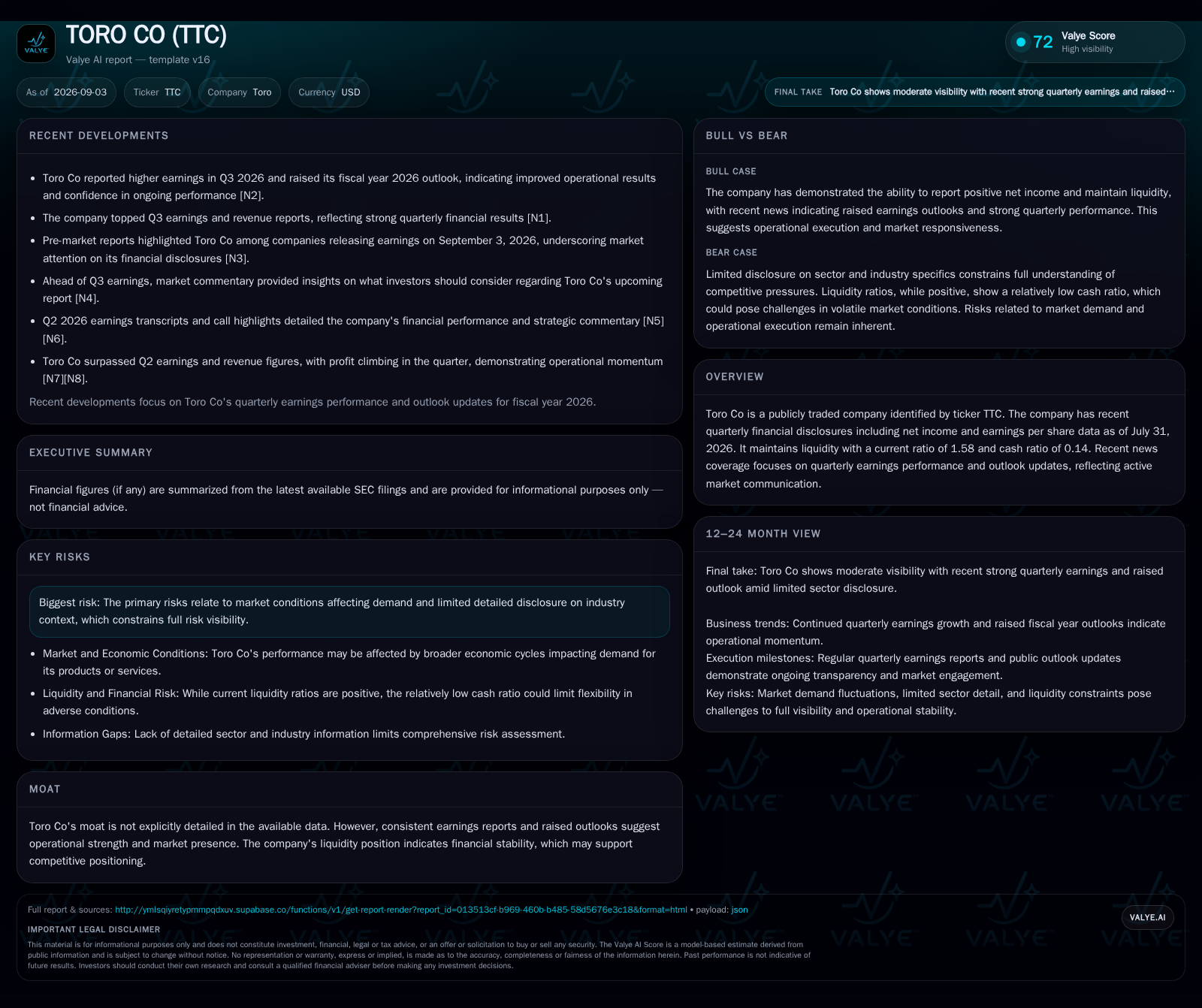
Toro Co delivered robust Q3 2026 results with raised guidance, supported by positive net income and liquidity ratios signaling operational health. The company’s business model likely hinges on product-driven volume and mix dynamics, with capital intensity and operating leverage influenced by manufacturing and distribution scale. Competitive advantages appear rooted in consistent execution and financial stability, though detailed moat attributes remain opaque. Bull, base, and bear scenarios pivot on sustaining demand, managing liquidity, and navigating competitive pressures amid informational gaps. Key near-term metrics focus on profitability trends, cash flow, and market positioning clarity.
Toro Co’s Q3 2026 financial results showcased notable earnings strength, with net income of $77 million and earnings per share of $0.81, surpassing market expectations and prompting an upward revision of the full-year outlook. Despite these encouraging financial indicators, the company’s limited disclosure concerning its industry specifics and competitive landscape tempers the clarity on sustainability of growth drivers. Liquidity metrics affirm operational stability, though the relatively low cash ratio may constrain strategic flexibility in volatile conditions. This analysis explores Toro’s operating model, competitive dynamics, and plausible future trajectories, establishing a foundational lens for investors to assess risk-reward trade-offs amid partial transparency.
Latest Operating Snapshot
Toro Co reported net income of $77 million for the quarter ending July 31, 2026, alongside basic and diluted earnings per share of $0.81, marking a performance that exceeded analysts’ expectations and led to a raised fiscal year 2026 outlook [N1][N2][S2]. These results suggest effective revenue generation and cost management during the quarter, signaling operational momentum.
As of the same date, Toro held cash and cash equivalents totaling approximately $143.3 million, with current assets around $1.66 billion versus current liabilities near $1.05 billion. This translates to a current ratio of 1.58 and a cash ratio of 0.14, indicating that while short-term obligations are well covered, cash on hand relative to liabilities is modest [S2]. This liquidity profile implies balanced working capital management but limited cash reserves as a buffer against unexpected shocks.
Business Model and Unit Economics
Toro Co’s business model likely centers on manufacturing and selling equipment or products related to outdoor or industrial applications, inferred from its capital intensity and liquidity structure. Revenue generation depends on a combination of unit volume, product mix, and pricing strategies. Volume growth could stem from market expansion or share gains, while mix shifts toward higher-margin products would enhance profitability. Pricing power may be constrained by competitive dynamics and commodity input costs, impacting margin stability.
Fixed costs related to manufacturing facilities, supply chain infrastructure, and R&D investments suggest high operating leverage, where incremental sales growth can disproportionately increase profits once capacity utilization improves. Conversely, demand volatility could expose the company to margin compression if fixed costs remain elevated amid lower volumes. Capital needs appear significant but manageable, with working capital adequacy supporting ongoing operations. The limited cash ratio indicates capital expenditures or debt servicing might restrict free cash flow in more adverse scenarios.
Moat, Competition and Counterforces
Toro’s competitive moat is not explicitly delineated in the available disclosures. However, consistent earnings performance and a raised outlook imply operational competence and a stable market position. Financial stability, evidenced by liquidity management and positive net income, may underpin resilience against peers in cyclical downturns or supply chain disruptions. The company’s ability to sustain profitability could reflect brand strength, distribution networks, or product reliability, though such factors remain unconfirmed.
Potential counterforces include market entrants with disruptive technologies, pricing pressures from competitors, and raw material cost inflation. Limited sector transparency complicates assessment of competitive intensity and market share dynamics. Without clear differentiation, Toro risks margin erosion and volume declines if rivals innovate or undercut pricing. Additionally, modest cash reserves could constrain strategic initiatives like acquisitions or capacity expansion that reinforce moat elements.
Bull Case
In an optimistic scenario, Toro leverages its operational momentum to sustain volume growth and improve product mix, driving higher margins and earnings. Effective cost control and supply chain optimization amplify operating leverage, translating incremental sales into significant profit expansion. The company’s liquidity position supports strategic investments in innovation and market expansion, reinforcing competitive positioning. Clearer disclosures emerge, enhancing investor confidence and valuation multiples.
Confirming evidence includes continued quarterly earnings beats, upward revisions of guidance, and positive cash flow generation. Expansion into new markets or product lines with higher margins and customer stickiness would also validate this path. A falsification test would be a sudden margin contraction, declining sales, or deterioration in liquidity ratios, indicating operational or competitive stress.
Base Case
Toro maintains steady revenue growth driven primarily by stable demand in its core markets, with incremental margin improvements offset by fluctuating input costs. Operating leverage yields moderate profit gains, while capital expenditures and working capital needs remain balanced within existing cash flow generation. The company sustains its liquidity position but with limited expansion of cash reserves, reflecting cautious financial management.
Earnings and cash flow remain positive but lack significant acceleration, and market share holds steady amid competitive pressures. Management provides consistent but limited disclosure on strategic initiatives, maintaining investor awareness without major surprises. The base case is falsified if the company either accelerates growth substantially or faces material operational setbacks evidenced by margin declines or liquidity stress.
Bear Case
A downside scenario emerges if demand weakens due to macroeconomic headwinds or sector-specific disruptions, leading to volume declines and margin compression. Fixed costs exert pressure on profitability, while limited cash reserves constrain the company’s ability to invest or absorb shocks. Competitive pressures intensify with rivals capturing market share through innovation or pricing, eroding Toro’s position. Reduced transparency and missed guidance further undermine investor confidence.
Confirming evidence includes consecutive quarters of earnings misses, deteriorating liquidity ratios, and negative cash flow trends. A failure to raise or maintain guidance, coupled with operational inefficiencies or supply chain disruptions, would reinforce this view. Conversely, stabilization or improvement in these metrics would falsify the bear case.
What Matters Next
Key metrics to monitor include quarterly revenue growth and margin trends to assess demand strength and operational efficiency. Close attention to cash flow from operations and changes in liquidity ratios will illuminate potential financial flexibility. Disclosure of capital expenditure plans and debt servicing will indicate capacity for strategic investments.
Additional milestones encompass management commentary on competitive dynamics and product innovation, which could signal moat development or erosion. Any updates on market expansion, customer diversification, or pricing initiatives will also be critical. Finally, enhanced transparency regarding sector positioning and risk factors would improve visibility into Toro’s future trajectory.
Disclaimer: This is research-only, informational analysis and not investment advice. It may include AI-generated interpretation and general industry context. Always verify important details using primary sources.

Comments